 CroatiaExplore Croatia: where it is, its history, culture and food, from Zagreb and the…
DESTINATION
Namibia
Namibia is a southwest African country of desert coast, high plateau and wide-open space, with a rich mix of cultures, history and food.
📅 Last updated:
🌍 Quick Facts

Namibia at a glance
Capital: Windhoek
Currency: Namibian dollar (NAD)
Language: English (official); Afrikaans, German and Oshiwambo are also widely spoken
Population: About 3 million
Time zone: Central Africa Time (UTC+2)
Calling code: +264
Internet domain: .na
Main airport: Hosea Kutako International Airport (WDH)
Best time to visit: May to October (dry season)
📍 Namibia Map
🖼️ Namibia: Location, History, Culture & Food
✨ Complete Travel Guide
Where Is Namibia Located?
Namibia lies on the southwestern coast of Africa. Angola and Zambia sit to the north, Botswana to the east, South Africa to the south and southeast, and the Atlantic Ocean forms its western edge. Windhoek, the capital, stands on the central plateau, and the country covers roughly 824,000 square kilometres.
Last checked: November 2026
The map shows a rough rectangle with a long, narrow arm stretching out in the northeast. That arm, known historically as the Caprivi Strip and now the Zambezi Region, reaches towards Zambia and the Zambezi River, and it is greener and wetter than most of the country. The southern frontier follows the Orange River, while the Kunene and Okavango river valleys mark much of the north.
Three broad landscape belts run north to south. The Namib Desert hugs the whole Atlantic shoreline, a strip of dunes and gravel plains that gave the country its name. Behind it rises a high central plateau, where Windhoek sits at around 1,700 metres, and further east the land drops towards the sandy plains of the Kalahari that Namibia shares with Botswana and South Africa. The coastline measures about 1,570 kilometres and is cooled by an offshore current, which brings fog far more often than rain.
Roughly three million people live here, which makes Namibia one of the emptiest countries on Earth. Towns are small and often hundreds of kilometres apart, so distance shapes every trip more than a first look at the map suggests. Namibia keeps Central Africa Time, which is UTC+2, and its international calling code is +264.
Introduction to Namibia
Namibia is a southern African country known for towering desert dunes, wildlife-rich national parks and some of the emptiest landscapes anywhere. The capital is Windhoek, the official language is English, and the currency is the Namibian dollar. The country became independent on 21 March 1990.
Last checked: November 2026
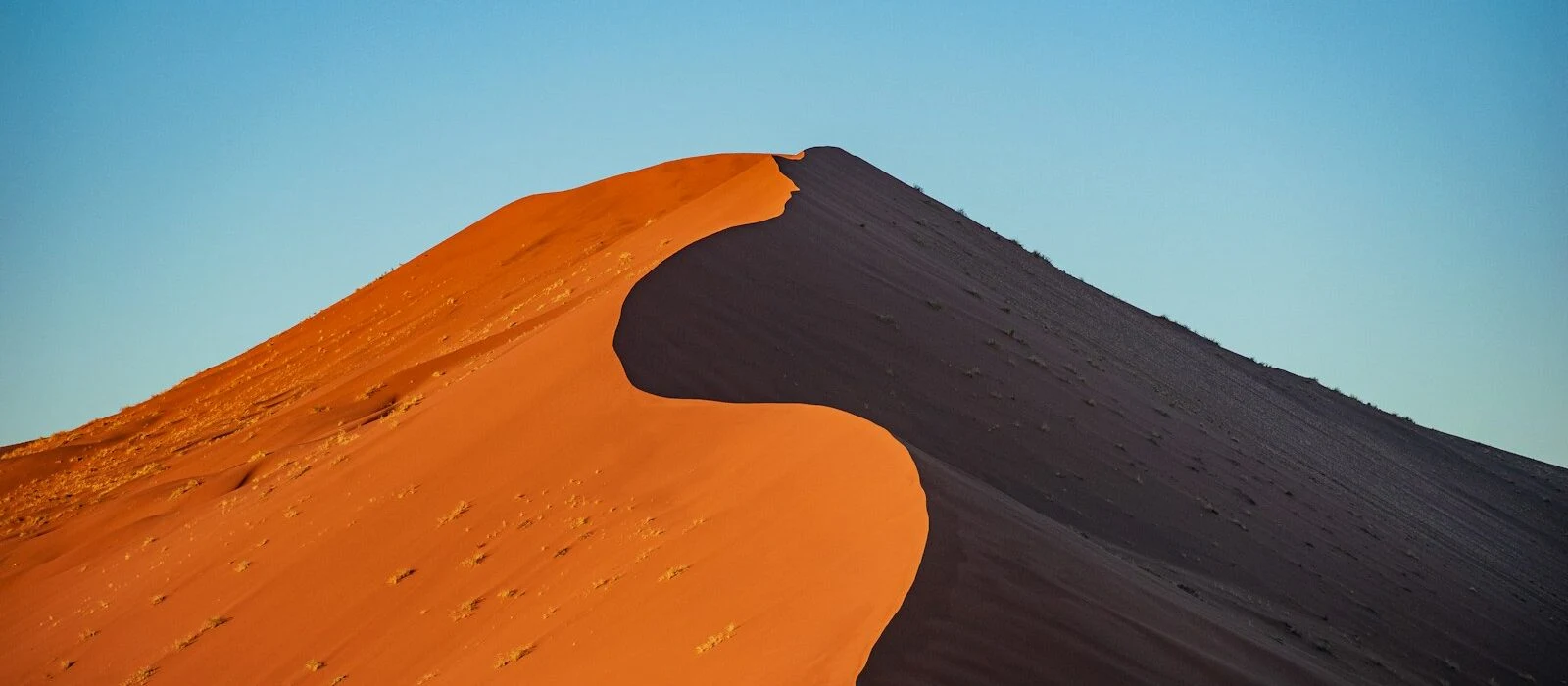
What draws travellers here is scale and silence. Rust-red dunes rise above the clay pans of Sossusvlei, elephants and rhinos gather at floodlit waterholes in Etosha National Park, and the Fish River Canyon in the south ranks among the largest canyons on the continent. Along the Atlantic, the Skeleton Coast earns its name from shipwrecks and bleached whale bones half buried in fog-damp sand.
Namibia is also one of the more approachable corners of Africa for independent travel. Windhoek and coastal Swakopmund have supermarkets, banks and a wide choice of lodges, and the Namibian dollar is tied to the South African rand at a one-to-one rate, so both currencies are accepted in shops. Outside the towns, however, services thin out quickly, and fuel, water and a reliable plan matter more than a long list of sights.
The people are as varied as the terrain. Oshiwambo-speaking communities make up the largest group, while Herero, Nama, Damara, San, Kavango and Lozi traditions all add to the mix, alongside Afrikaans and German heritage communities. English is the official language and works well for visitors, though it is the first language of only a small share of the population, so a few greetings in a local language are always appreciated.
To turn this overview into a trip, begin with the Namibia visa guide, browse the best places to visit in Namibia and check the best time to visit. From there, sample itineraries, where to stay, flights to Namibia and tips on getting around cover the practical details.
History of Namibia
Namibia’s earliest inhabitants were San hunter-gatherers, later joined by Khoekhoe herders and Bantu-speaking peoples. Germany claimed the territory in 1884, South Africa took control during the First World War, and a long liberation struggle followed. Namibia achieved independence on 21 March 1990.
Last checked: November 2026
People have lived in this land for many thousands of years, and the rock engravings at Twyfelfontein, a UNESCO World Heritage site, record the lives of early hunter-gatherer communities. Portuguese sailors touched the coast in the late 1480s, but the fog, shifting dunes and lack of fresh water kept Europeans from settling. Over the following centuries, Nama, Herero, Ovambo and other groups built pastoral and farming societies across the interior and the north.
The scramble for Africa changed everything. After Germany declared a protectorate in 1884, settlers took land and cattle, and resistance grew. The Nama and Herero rose up against colonial rule between 1904 and 1908, and the German response, widely recognised as genocide, killed tens of thousands of people. The memory of those years still shapes national politics and relations with Germany today.
South African forces occupied the colony in 1915, and the League of Nations later placed it under South African administration. Instead of preparing the territory for self-rule, Pretoria extended its racial segregation policies and ignored United Nations calls to withdraw. In 1966 the South West Africa People’s Organisation, known as SWAPO, began an armed campaign, and talks linked to the withdrawal of Cuban troops from Angola finally opened the way to elections.
Namibia became independent in 1990 with Sam Nujoma as its first president. The port enclave of Walvis Bay joined the new country in 1994. Today Namibia is a multiparty republic, and Independence Day and Heroes’ Day remain national holidays that keep this fairly recent story in public view.
Culture and Traditions of Namibia
Namibian culture is a patchwork of many peoples, including Ovambo, Herero, Himba, Nama, Damara, San, Kavango and Lozi communities, with German and Afrikaans influences layered on top. Cattle, storytelling, music, church life and shared meals matter across groups, and the national motto emphasises unity, liberty and justice.
Last checked: November 2026
Traditions differ sharply from one region to the next. In the far north-west, Himba families live as semi-nomadic herders and are recognisable by the reddish otjize paste that women rub onto skin and hair. Herero women in the centre and east wear long, full-skirted dresses and sculpted headscarves whose shape echoes cattle horns, a style that grew out of nineteenth-century missionary fashion and has become a proud marker of identity. In the north, Ovambo communities, the largest group, are farmers who grow pearl millet around homesteads laid out inside wooden fences.
The San, among the oldest peoples of southern Africa, are known for tracking skills and for deep knowledge of desert plants and animals. Rock paintings and engravings across the country are a reminder of how long these traditions have lasted. Nama and Damara communities, who speak Khoekhoegowab, are known for lively clicking speech, choral singing and a rich tradition of praise poetry and folk tales.
Modern Namibia moves to a different beat as well. Church choirs, gospel music, kwaito, house and Afro-pop fill Windhoek’s venues, while Swakopmund and a few inland towns keep a German-flavoured streak in their bakeries, street names and brass bands. Sport is a social glue, and rugby, football and athletics draw big crowds.
A few habits go a long way with hosts. Greet people properly before asking for anything, ask before photographing individuals or homesteads, and agree on a fee if a community member is going to pose. Dress modestly when visiting villages, and treat cultural visits as an exchange rather than a photo stop.
Food and Cuisine of Namibia
Namibian cuisine mixes northern millet staples, southern African barbecue traditions, German baking and fresh Atlantic seafood. Meat is central, from beef and game to dried snacks, and meals are often shared. Porridge, grilled skewers, stews and a surprising range of oysters, pastries and local drinks round out the table.
Last checked: November 2026
Fire cooking is a way of life. Families gather for a braai, the local word for a barbecue, and for stews simmered in cast-iron pots, while roadside grills in towns and townships sell skewered meat by the stick. In the north, a stiff porridge made from millet anchors most meals, and it is usually eaten with the right hand alongside a relish or meat stew.
The coast adds its own flavour. Cold Atlantic waters around Walvis Bay and Swakopmund supply oysters, hake and crayfish, and German-style bakeries still turn out cakes, pretzels and strudel. Game meats such as oryx, kudu and springbok appear on restaurant menus, so vegetarians should check dishes carefully and ask lodges ahead of time.
Start with these signature dishes and drinks:
- Kapana: strips of beef grilled over coals, sprinkled with spice and sold from street stalls, often eaten straight from the paper.
- Oshifima: a dense millet porridge, the staple of the north, served with relish, vegetables, fish or meat.
- Mopane worms: caterpillars from mopane trees, cooked or dried and eaten as a crunchy snack or stewed with onion and tomato.
- Biltong: air-dried, seasoned strips of beef or game, sold almost everywhere as a travelling snack.
- Droëwors: thin, dried sausage, spiced with coriander, a chewy cousin of biltong.
- Potjiekos: a slow-cooked stew of meat and vegetables, made in a three-legged cast-iron pot over an open fire.
- Boerewors: a coiled, spiced sausage grilled at braais and often served with porridge or bread.
- Walvis Bay oysters: plump oysters from the cold Benguela Current, a highlight on the central coast.
- Vetkoek: deep-fried dough balls or rolls, filled with mince, cheese or jam.
- Oshikundu: a cloudy, lightly fermented drink made from millet flour, popular in northern communities.
Explore Namibia Travel Guides
Explore our detailed guides to plan every part of your Namibia trip.
Namibia: Best Places
Namibia’s standout places grouped by type, from Sossusvlei and Etosha to Swakopmund and Twyfelfontein, with suggested time and access notes for each.
View Guide ›Namibia: Best Time to Visit
When to go to Namibia depends on region and goals: dry-season safaris, green-season landscapes and foggy coasts, with a month-by-month weather summary.
View Guide ›Namibia: Flights
Which airport and airlines connect you to Namibia, how Windhoek links to Europe and southern Africa, plus arrival tips and a pre-flight...
View Guide ›Namibia: Getting Around
How to travel inside Namibia: self-drive and road rules, domestic and light-aircraft flights, coaches, the state of the rail network and taxi...
View Guide ›Namibia: Itineraries
Four ready-to-use Namibia routes for 3, 5, 7 and 10 days, with approximate driving times, overnight stops and tips to keep each...
View Guide ›Namibia: Visa
How Namibia’s entry rules work in practice: who needs an e-visa or visa on arrival, what to carry, current fees and what...
View Guide ›Namibia: Hotels
A guide to where to stay in Namibia, from Windhoek and Swakopmund to desert and safari lodges, with advice on budgets, families,...
View Guide ›Explore Namibia Tours
Discover guided tours and adventures in Namibia. Compare itineraries, prices and traveller reviews on TourRadar before you book.
Guided tours & deals
Affiliate partner · Globe Navo may earn a commission from qualifying bookings at no extra cost to you.
❓ Namibia FAQ
Where is Namibia?
Namibia is a country on the southwestern coast of Africa, bordered by Angola, Zambia, Botswana, South Africa and the Atlantic Ocean. Its capital, Windhoek, sits on the central plateau, and the country is known for desert landscapes and very low population density.
What language is spoken in Namibia?
English is the official language and is used in government, schools and tourism, so visitors can usually get by easily. Afrikaans, German and several Namibian languages such as Oshiwambo are widely spoken, and a few local greetings are always appreciated.
What currency does Namibia use?
Namibia uses the Namibian dollar, which is tied one-to-one to the South African rand, and rand notes are widely accepted in shops. Cards work in towns and lodges, but carry some cash for fuel, markets and remote areas.
What food is Namibia known for?
Namibia is known for meat-centred cooking, including grilled beef, game, biltong and boerewors, plus millet porridge in the north and fresh oysters on the coast. German-style bakeries add cakes and pastries in towns such as Swakopmund.
Is Namibia densely populated?
No. Namibia has only around three million people spread over roughly 824,000 square kilometres, making it one of the least densely populated countries in the world. Towns are small and far apart, so plan long drives and refuel often.
Plan Your Trip to Namibia
Your Next Adventure in Namibia Awaits!
Explore Deals →🎁 Best deals for Namibia
Offers from trusted travel stores for your Namibia trip. Compare a few options before you book, and check each store's terms for the final price.
Browse by type: Hotel deals · Flight deals · Travel eSIM · Car rental
More destinations to explore
CroatiaExplore Croatia: where it is, its history, culture and food, from Zagreb and the…
 El SalvadorEl Salvador travel guide covering where the country is, its history, culture, traditions and…
 HungaryHungary travel guide: where the country is, its history, culture and food, from Budapest…