 GrenadaDiscover Grenada, the Spice Isle of the southeastern Caribbean: its location, history, culture and…
DESTINATION
Hungary
Hungary travel guide: where the country is, its history, culture and food, from Budapest and the Danube to Lake Balaton and Hungarian dishes.
📅 Last updated:
🌍 Quick Facts

Hungary at a glance
Capital: Budapest
Currency: Hungarian forint (HUF)
Language: Hungarian
Population: About 9.5 million (approximate)
Time zone: CET (UTC+1), CEST (UTC+2) in summer
Calling code: +36
Internet domain: .hu
Main airport: Budapest Ferenc Liszt International Airport (BUD)
Best time to visit: April to June and September to October
📍 Hungary Map
🖼️ Hungary: Location, History, Culture & Food
✨ Complete Travel Guide
Where Is Hungary Located?
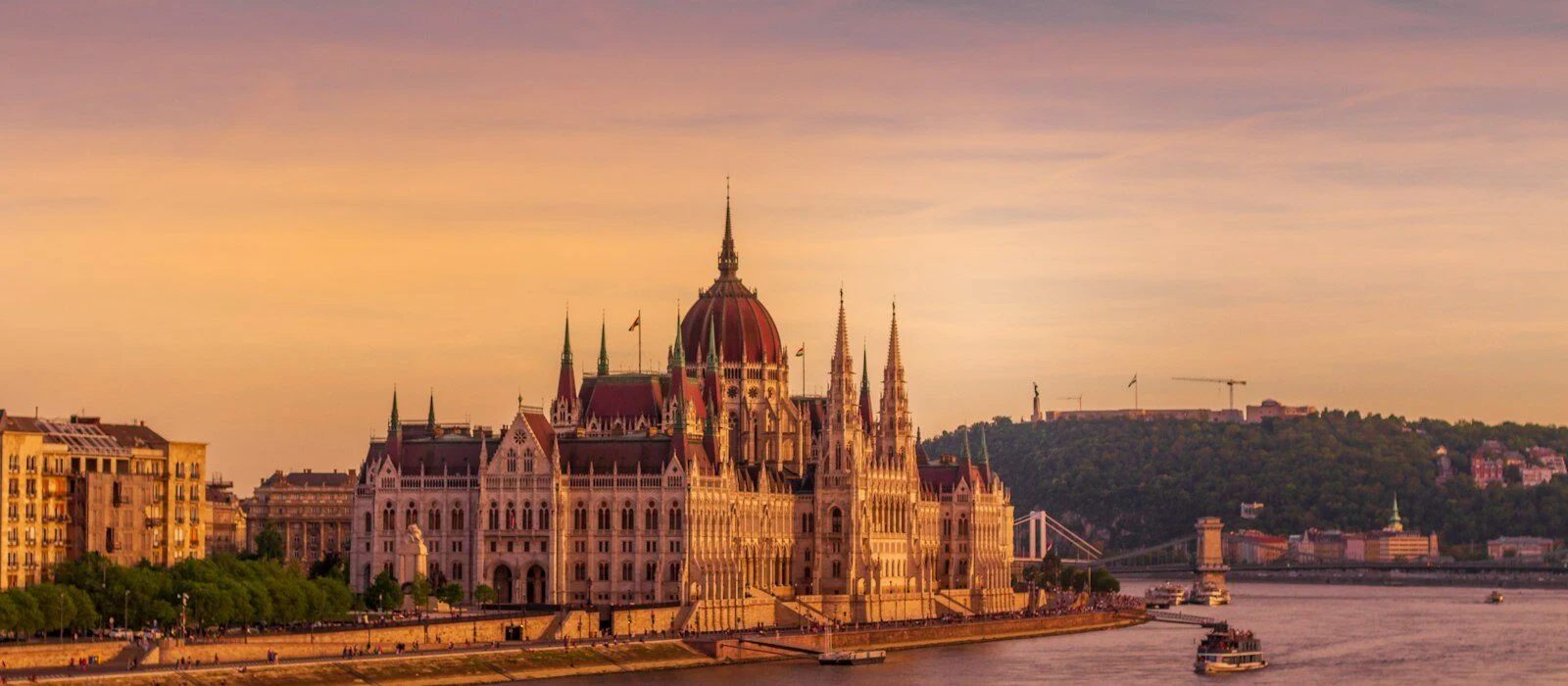
Hungary is a landlocked country in Central Europe, in the Carpathian Basin. It borders seven countries: Austria, Slovakia, Ukraine, Romania, Serbia, Croatia and Slovenia. Its capital, Budapest, lies on both banks of the Danube, the great river that crosses the country from north to south.
Last checked: November 2026
The country covers roughly 93,000 square kilometres, which makes it a medium-sized European state. It has no sea coast, yet its position at the crossroads of land routes between Western Europe and the Balkans has shaped its trade, its cities and its mix of cultures.
Most of the land is flat or gently rolling. The Danube and the Tisza flow north to south and divide Hungary into three broad regions. East of the Danube, the Great Hungarian Plain stretches towards Romania and Ukraine, while Transdanubia to the west is hillier, with vineyards, forests and routes towards Austria and Slovenia. Low mountains rise in the north, and Kékes, at 1,014 metres, is the highest point in the country.
Water is a defining feature of the map. Lake Balaton, at about 590 square kilometres, is the largest lake in Central Europe and the country’s favourite summer resort area. Smaller lakes include Lake Velence and part of Lake Fertő, which Hungary shares with Austria. In the east, Hortobágy National Park protects Europe’s largest natural grassland.
Budapest sits in the north-central part of the country, and most visitors arrive there first. From the capital, the borders of Austria, Slovakia and Croatia can be reached by road or rail, and the Danube links Hungary with neighbouring countries by river.
Introduction to Hungary
Hungary is a Central European republic of about 9.5 million people, with Budapest as its capital and Hungarian as its official language. It joined the European Union in 2004 and belongs to the Schengen Area, but it still uses the forint rather than the euro. Visitors know it for thermal baths, historic cities and wine.
Last checked: November 2026
Hungary is a parliamentary republic. It is divided into 19 counties, and Budapest is administered separately from them. Budapest, home to around 1.7 million people, grew from the union of Buda and Pest in 1873 and remains the political, economic and cultural centre. Debrecen, Miskolc, Szeged, Pécs and Győr are the other large cities, and each has its own university and old town.
Hungarians make up most of the population, with Roma and German communities as the largest minorities. The Hungarian language belongs to the Uralic family and is unrelated to the Slavic, Germanic and Romance languages around it. Its only distant relatives are Finnish and Estonian, which is why road signs and menus can feel unfamiliar even to experienced European travellers. Hungary uses Central European Time, observes daylight saving in summer, and its international dialling code is +36.
For international visitors, the country offers a compact mix of heritage and nature. UNESCO has listed Budapest’s Danube banks, the Buda Castle Quarter and Andrássy Avenue, the old village of Hollókő, Hortobágy National Park and the Pannonhalma Archabbey, among other places. Lake Hévíz, near Lake Balaton, is described as the second largest thermal lake in the world, which fits Hungary’s long bathing tradition. Before you book, read our Hungary visa guide to check entry rules for your passport. To plan the trip, explore the best places to visit in Hungary, find the best time to visit Hungary, follow a ready-made Hungary itinerary, compare hotels in Hungary, check flights to Hungary and learn how to get around Hungary.
History of Hungary
Hungary’s history began when the Magyar tribes settled the Carpathian Basin around 895 to 896, and King Stephen I founded the Christian kingdom in 1000. The country later lived through Ottoman and Habsburg rule, rose in revolt in 1848 and 1956, and became a democratic republic after 1989, joining the European Union in 2004.
Last checked: November 2026
The Magyars arrived under Prince Árpád, whose dynasty ruled for roughly three centuries. Stephen, crowned in the year 1000, tied the new state to Western Christianity, and he is still honoured every year on 20 August. In 1222 the Golden Bull limited the power of the king and confirmed the rights of the nobility, an early landmark in Hungarian law.
The defeat at Mohács in 1526 opened a long period of Ottoman occupation across the centre of the old kingdom. Buda was retaken in 1686, and the Treaty of Karlowitz in 1699 confirmed the end of Ottoman rule. Hungary then came under the Habsburg crown, and Francis II Rákóczi led an unsuccessful war of independence between 1703 and 1711.
The reform period of the 1830s and 1840s led to the revolution that began in Pest on 15 March 1848, now a national holiday. Lajos Kossuth was its best-known leader, and Habsburg forces, helped by Russia, ended the fighting in 1849. The Compromise of 1867 then created Austria-Hungary, a time of fast growth for Budapest, which gained many of its grand buildings and boulevards in this period.
Defeat in the First World War ended the dual monarchy. Under the Treaty of Trianon, signed on 4 June 1920, Hungary lost a large share of its territory, and many ethnic Hungarians found themselves living in neighbouring states. After the Second World War, a communist government took power and the People’s Republic was declared in 1949. On 23 October 1956, a student march in Budapest grew into a nationwide uprising that Soviet forces crushed within weeks.
Reform grew through the 1980s. In June 1989 Imre Nagy and other victims of 1956 were reburied in a ceremony that drew huge crowds, and on 23 October 1989 the Republic was proclaimed. Hungary joined NATO in 1999 and the European Union on 1 May 2004, and today it is a parliamentary democracy.
Culture and Traditions of Hungary
Hungarian culture blends Magyar folk traditions, a strong musical heritage and the legacy of Central European empires. Visitors meet it in folk dance houses, embroidery and classical music by Liszt, Bartók and Kodály, as well as in living customs such as the Busó carnival in Mohács, which UNESCO recognises as intangible cultural heritage.
Last checked: November 2026
Music sits at the centre of national life. Béla Bartók and Zoltán Kodály collected folk songs in villages and used them in their compositions, while Franz Liszt remains the country’s best-known piano figure. The Kodály method of music education and the táncház, or dance-house movement, are both on UNESCO’s register of good safeguarding practices. Dance houses are lively evenings where live folk bands play and everyone, beginners included, learns the steps. In 2022 UNESCO also recognised the Hungarian folk string band tradition.
Handicrafts carry regional identity. Matyó embroidery from Mezőkövesd in the north-east is known for bright flat-stitch flowers on blouses, aprons and home textiles, and it joined UNESCO’s Representative List in 2012. Blue-dyeing, a resist-printing technique on cloth, is another listed craft. Kalocsa is known for its floral embroidery and painted walls, and Halas for its lace.
Seasonal customs keep the calendar full. At the Busójárás festival in Mohács, masked figures in sheepskins march through the town at the end of the carnival season to drive winter away, and a coffin symbolising winter is burned. Easter Monday and Pentecost customs bring their own village traditions, and falconry, practised in Hungary for centuries, is part of a multinational UNESCO listing.
Writing and poetry also matter to Hungarians. Sándor Petőfi, the poet of the 1848 revolution, and János Arany are regarded as national classics, and both remain central to Hungarian literature. In Hungarian the family name comes first, so you may see a name such as Bartók Béla on signs and in museums.
Food and Cuisine of Hungary
Hungarian cuisine is built on paprika, sour cream, hearty stews and fresh bread, shaped by the herders and river fishermen of the Great Plain. Classic dishes include gulyás, pörkölt, halászlé, lángos, stuffed cabbage and dobos torte. The food is full of flavour but rarely fiery, unless you ask for hot paprika, called csípős.
Last checked: November 2026
Paprika is grown mainly around Szeged and Kalocsa, and it colours and flavours most traditional recipes. Many dishes were first cooked over an open fire in a bogrács, the cast-iron kettle of shepherds and fishermen, and they still taste best when shared at a long table. Meals are often served with nokedli dumplings, bread or pickles.
These are signature dishes to look for:
- Gulyásleves: a beef and paprika soup with vegetables, the dish most closely linked with Hungary.
- Pörkölt: a thick paprika stew of beef, pork or chicken, usually served with noodles or dumplings.
- Csirkepaprikás: chicken in a sour cream and paprika sauce, often paired with nokedli.
- Halászlé: fisherman’s soup made from river fish and plenty of paprika, found along the Danube and the Tisza.
- Töltött káposzta: cabbage leaves filled with minced pork and rice, slow-cooked with sauerkraut, a winter and Christmas favourite.
- Lecsó: a summer stew of peppers, tomatoes and onions, sometimes cooked with sausage.
- Főzelék: a thick everyday vegetable stew, often eaten with a fried egg or meatballs.
- Túrós csusza: noodles tossed with cottage cheese, sour cream and crispy bacon.
- Lángos: a deep-fried flatbread topped with sour cream and grated cheese, a favourite street snack.
- Kürtőskalács: chimney cake, a sweet yeast dough baked on a spit and rolled in sugar, with roots in Transylvania.
- Dobos torta: a layered sponge cake topped with a hard caramel layer, one of Hungary’s best-known desserts.
Vegetarian travellers can usually find lángos, főzelék, túrós csusza and mushroom paprikás on traditional menus. Dishes often contain gluten, dairy or eggs, so ask the restaurant about ingredients if you have allergies.
Explore Hungary Travel Guides
Explore our detailed guides to plan every part of your Hungary trip.
Hungary: Best Places
The best places to visit in Hungary, grouped by interest: Budapest, UNESCO heritage sites, Lake Balaton, wine regions, national parks and historic...
View Guide ›Hungary: Best Time to Visit
When to visit Hungary: month-by-month weather, seasons, public holidays and festivals, plus the best months for cities, Lake Balaton, wine and winter...
View Guide ›Hungary: Flights
Flights to Hungary: Budapest Ferenc Liszt Airport (BUD), main airlines, direct and connecting options, arrival tips and a before-you-fly checklist.
View Guide ›Hungary: Getting Around
How to get around Hungary: trains, intercity buses, Budapest public transport, taxis, car rental, driving rules, tickets and the best option for...
View Guide ›Hungary: Itineraries
Realistic Hungary itineraries for 3, 5, 7 and 10 days, built around Budapest with day trips to Szentendre, Eger, Lake Balaton and...
View Guide ›Hungary: Visa
Hungary visa guide: who can enter visa-free, who needs a Schengen visa, passport rules, EES border checks and ETIAS status for tourists.
View Guide ›Hungary: Hotels
Where to stay in Hungary: best areas in Budapest, hotels by budget and traveller type, Lake Balaton and wine towns, plus tourist...
View Guide ›Explore Hungary Tours
Discover guided tours and adventures in Hungary. Compare itineraries, prices and traveller reviews on TourRadar before you book.
Guided tours & deals
Affiliate partner · Globe Navo may earn a commission from qualifying bookings at no extra cost to you.
❓ Hungary FAQ
Where is Hungary?
Hungary is a landlocked country in Central Europe, bordered by Austria, Slovakia, Ukraine, Romania, Serbia, Croatia and Slovenia. Its capital, Budapest, lies on the Danube river, and the country sits in the Carpathian Basin, with a mostly flat landscape and low mountains in the north.
What is the capital of Hungary?
Budapest is the capital and largest city of Hungary, with around 1.7 million residents. It was formed in 1873 when Buda and Pest were united, and the Danube divides the hilly Buda side from the flat Pest side. It is the political, economic and cultural centre of the country.
What language is spoken in Hungary?
Hungarian is the official language and is spoken by most people. It belongs to the Uralic family and is unrelated to the Slavic, Germanic and Romance languages around it, so signs and menus can look unfamiliar. Learning a few Hungarian greetings is always appreciated by locals.
What currency does Hungary use?
Hungary uses the forint (HUF), not the euro, even though it is a member of the European Union. Check current exchange rates before you travel, and compare card payments, cash machines and exchange offices, as rates and fees can differ noticeably between them.
What food is Hungary famous for?
Hungary is famous for paprika-rich dishes such as gulyas soup, porkolt stew and chicken paprikas, along with halaszle fish soup, langos flatbread and dobos torte. Vegetarian travellers can usually find fozelek vegetable stew and turos csusza noodles on traditional menus.
Plan Your Trip to Hungary
Your Next Adventure in Hungary Awaits!
Explore Deals →🎁 Best deals for Hungary
Offers from trusted travel stores for your Hungary trip. Compare a few options before you book, and check each store's terms for the final price.
Browse by type: Hotel deals · Flight deals · Travel eSIM · Car rental
More destinations to explore
GrenadaDiscover Grenada, the Spice Isle of the southeastern Caribbean: its location, history, culture and…
 MauritaniaA traveller's overview of Mauritania: its Sahara and Atlantic setting, ancient desert towns, Hassaniya…
 BhutanA Bhutan overview covering location, history, culture and food, with links to guides on…