 El SalvadorEl Salvador travel guide covering where the country is, its history, culture, traditions and…
DESTINATION
Malta
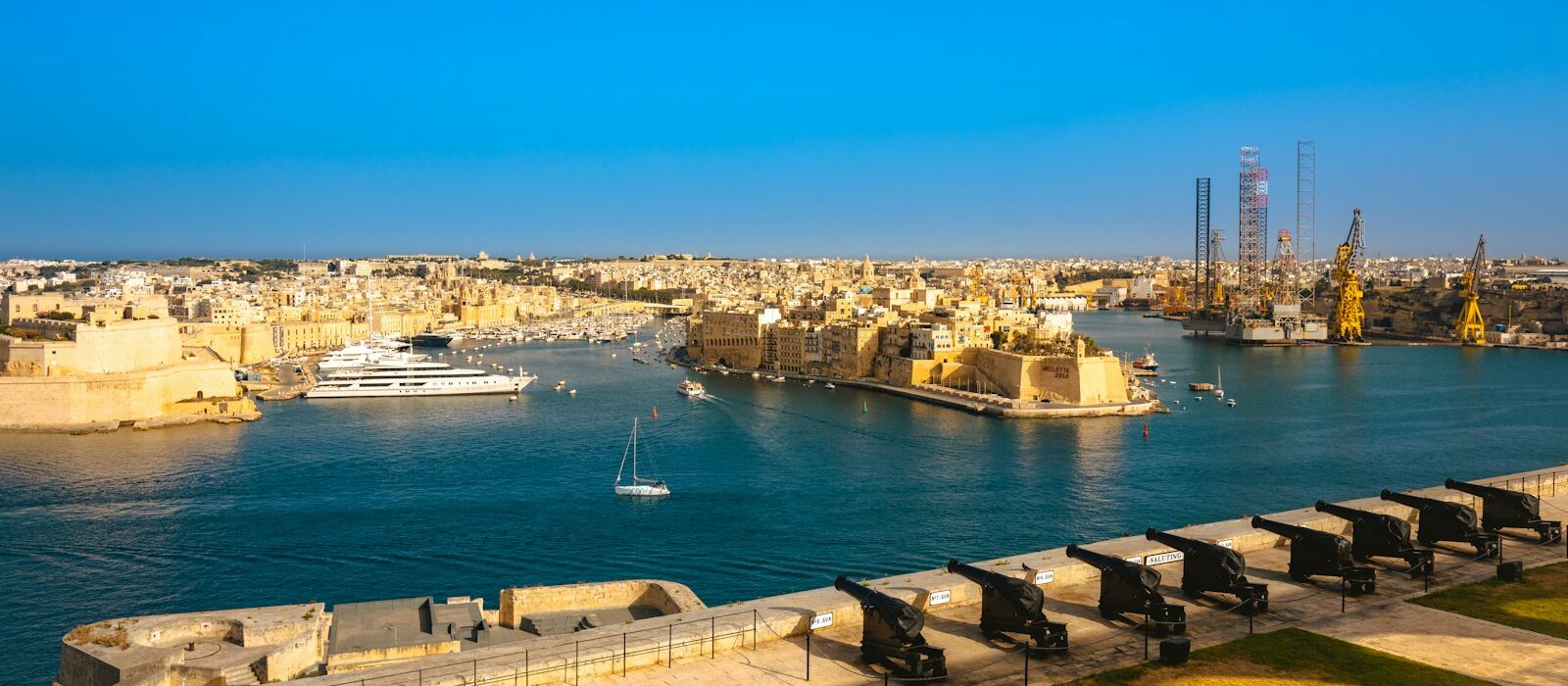
Malta is a Mediterranean island nation known for Valletta's Baroque streets, ancient temples, village feasts and a cuisine shaped by Sicily and North Africa.
📅 Last updated:
🌍 Quick Facts
Malta at a glance
Capital: Valletta
Currency: Euro (EUR)
Language: Maltese, English
Population: About 563,000 (2024)
Time zone: CET (UTC+1); CEST (UTC+2) in summer
Calling code: +356
Internet domain: .mt
Main airport: Malta International Airport (MLA)
Best time to visit: May to June and September to October
🖼️ Malta: Location, History, Culture & Food
✨ Complete Travel Guide
Where Is Malta Located?
Malta is an island country in the central Mediterranean Sea, about 90 kilometres south of Sicily, Italy, and roughly 290 kilometres from the North African coast. It sits between Europe and Africa and is made up of three inhabited islands: Malta, Gozo and Comino.
Last checked: November 2026
The archipelago is one of the smallest countries in Europe, with a total land area of roughly 316 square kilometres. Alongside the three inhabited islands, it includes the small uninhabited islets of Comminotto and Filfla.
Valletta, the capital, lies on the main island of Malta and is the smallest capital city in the European Union by area. The country joined the EU on 1 May 2004 and uses the euro, which makes it straightforward to reach and travel in for visitors coming from Europe.
Most visitors arrive by air at Malta International Airport in Luqa, near the middle of the main island. Our guide to flights to Malta explains the main routes and airlines, and how to get around Malta and Gozo covers buses and ferries once you land. Because everything is close together, the whole country can be explored from a single base.
Introduction to Malta
Malta is a small, densely populated island nation and a member of the European Union, known for its warm Mediterranean setting, the walled capital Valletta, prehistoric temples and a culture that blends Maltese, Italian and British influences. About 563,000 people live on its 316 square kilometres, and the euro is the national currency.
Last checked: November 2026
Maltese and English are both official languages. Maltese is a Semitic language written in the Latin alphabet, with many words borrowed from Italian and English, and many Maltese also speak a third language such as Italian. Visitors rarely have trouble getting by in English.
Malta is a parliamentary republic, and Roman Catholicism is the state religion, which shapes the calendar of feasts and public holidays. Valletta, the Megalithic Temples and the underground Ħal Saflieni Hypogeum are all UNESCO World Heritage Sites, a remarkable amount of heritage for a country this size.
Distances are short, because the main island is only a few tens of kilometres long and Gozo and Comino are a brief ferry ride away. That compactness lets visitors move between fortified towns, limestone cliffs and sheltered bays without long journeys.
Malta has one of the highest population densities in the world, with more than 1,000 people per square kilometre, yet daily life stays relaxed and sociable. Most people live in the eastern part of the main island, while Gozo is greener, quieter and more rural, and Comino is almost entirely undeveloped.
Each of the three inhabited islands has its own character. The main island holds Valletta, the busy resort towns and most of the historic sites, Gozo offers farmland, village life and the Ġgantija temples, and Comino is known for the Blue Lagoon. Together they make a varied destination within a very small area.
Entry rules depend on your passport, and our Malta visa guide explains the Schengen system. To decide what to see first, read our guide to the best places to visit in Malta, and check the best time to visit Malta before you choose your dates.
History of Malta
Malta’s history runs from Neolithic temple builders to Phoenicians, Romans, Arabs, Normans, the Knights of St John, the French and the British. The country became independent from Britain on 21 September 1964, a republic on 13 December 1974, and a member of the European Union on 1 May 2004. Its position in the central Mediterranean explains most of this story.
Last checked: November 2026
Some of the oldest free-standing stone temples in the world were built on the islands thousands of years before the Roman era, and several survive today. The Phoenicians later settled here, Malta became a Punic colony by about 500 BC, and Roman control lasted from 218 BC until 395 AD. Tradition holds that St Paul was shipwrecked on the islands, which is why Christianity is so central to Maltese identity. The Normans of Sicily took control in 1091, ending the Arab period.
In 1530 the Holy Roman Emperor Charles V gave the islands to the Order of the Knights of St John. In 1565 the Knights and the Maltese withstood the Great Siege by the Ottoman Empire, and the Knights then founded Valletta in 1566 as a fortified capital. Their rule ended in 1798, when Napoleon seized the islands, and the Maltese rose against the French, who surrendered in 1800.
Malta then became a British possession and a vital naval base. It endured heavy bombing in the Second World War, and in 1942 King George VI awarded the islands the George Cross for the courage of its people. After independence in 1964 and the republic in 1974, the last British forces left on 31 March 1979, a date marked as Freedom Day. Malta joined the euro area in January 2008.
The Great Siege began when an Ottoman fleet of about 180 ships and a landing force of roughly 30,000 men arrived in 1565. It ended on 8 September, a date Malta still marks as Victory Day, and the victory shaped Valletta as a fortress city. Visitors can trace this story today at the harbour forts, the walled city of Mdina and the museums of Valletta, where each period left visible traces in the architecture.
Culture and Traditions of Malta
Maltese culture is shaped by Catholic faith, close-knit village communities and centuries of Mediterranean influence. The best-known tradition is the village festa, a summer celebration of a parish’s patron saint with processions, brass bands, fireworks and food, which UNESCO has recognised as part of humanity’s intangible cultural heritage.
Last checked: November 2026
The festa tradition is usually traced to the late 18th century, under the Knights of St John. Today Malta and Gozo hold around 80 feasts between spring and early autumn, each with its own church decorations, street lights and band march. Visitors are welcome, and dressing modestly for church services is appreciated.
Other celebrations follow the Catholic calendar and the national story. Carnival is held before Lent, and Nadur in Gozo is known for its own distinctive, irreverent version. Good Friday processions mark Holy Week, Santa Marija is celebrated on 15 August, and Victory Day on 8 September recalls the end of the Great Siege of 1565.
The arts are part of modern tradition as well. Events such as the Malta International Fireworks Festival, Notte Bianca and the Malta Jazz Festival draw both residents and visitors. Everyday life still revolves around family, the parish and the local band club, and that sense of community is what many travellers remember most.
Local limestone is used for churches, houses and fortifications, which gives Maltese towns their honey-coloured look. The enclosed wooden balconies seen on Valletta’s streets are among the best-known features of the local scene, and lace-making and glass-blowing remain long-standing crafts that visitors can still find across the islands.
Food is part of every celebration. Carnival is traditionally marked with prinjolata, a pine-nut cake, and feasts bring brass bands and fireworks to the streets. Maltese is spoken alongside English everywhere, so visitors can get by in English while hearing Maltese all around them.
Food and Cuisine of Malta
Maltese cuisine blends Mediterranean ingredients with Sicilian, North African and British influences. Its best-known dishes are stuffat tal-fenek (rabbit stew), the national dish, flaky pastizzi, ftira bread and seasonal lampuki fish, eaten in casual bakeries, village taverns and harbour restaurants.
Last checked: November 2026
Rabbit is the heart of the traditional fenkata, a long, social meal that is as much a celebration as a dinner. The stew is slow-cooked with wine and garlic, while fenek moqli is fried rabbit with garlic. Rural villages such as Mġarr, Baħrija and Dingli are known places to try it.
For snacks and light meals, look for these signature dishes:
- Stuffat tal-Fenek: rabbit stew cooked slowly in wine, garlic and vegetables.
- Pastizzi: diamond-shaped flaky pastries filled with ricotta or peas.
- Ftira: a rustic, disc-shaped leavened bread, often filled with tuna, olives and capers.
- Ħobż biż-Żejt: Maltese bread rubbed with tomato and olive oil, served as an open sandwich.
- Bigilla: a meat-free dip of mashed broad beans, garlic and olive oil.
- Torta tal-Lampuki: a pie of lampuki (dorado) with spinach, cauliflower and other vegetables.
- Aljotta: a garlicky fish stew.
- Bragioli: beef olives, thin slices of beef rolled around a filling.
- Ġbejniet: small sheep or goat cheeses, served fresh, dried or peppered.
- Zalzett Malti: traditional Maltese sausage.
Lampuki are typically caught in the autumn months, and many restaurants serve them in season. At Easter, look for figolli, iced almond pastries filled with marzipan. Whatever you order, expect generous portions and an unhurried pace.
Maltese wine and local beer pair well with these dishes, and many bakeries and village taverns serve them in a relaxed, family setting. Ready to plan your trip? Our Malta itinerary guide shows how to fit the sights and meals into three to ten days, and our guide to where to stay in Malta compares the best areas.
Explore Malta Travel Guides
Explore our detailed guides to plan every part of your Malta trip.
Malta: Best Places
A guide to Malta's top places, from Valletta and Mdina to Gozo, Comino and the prehistoric temples, with time needed and the...
View Guide ›Malta: Best Time to Visit
When to visit Malta, with month-by-month weather, sea temperatures, festivals and crowd levels so you can match the season to your travel...
View Guide ›Malta: Flights
Flying to Malta: Malta International Airport, main airlines, direct and connecting routes, arrival tips and a pre-flight checklist.
View Guide ›Malta: How to Get Around and Gozo
How to travel around Malta and Gozo by bus, ferry, taxi and rental car, with fares, driving rules, Tallinja cards and the...
View Guide ›Malta: Itineraries
Realistic 3, 5, 7 and 10-day Malta itineraries covering Valletta, Mdina, the Three Cities, Gozo and Comino, with sensible routes and travel...
View Guide ›Malta: Visa
Who can enter Malta visa-free, who needs a Schengen visa, how the 90/180-day rule and EES work, and where to apply through...
View Guide ›Malta: Hotels
Where to stay in Malta: the best areas in Valletta, Sliema, St Julian's, Mellieħa and Gozo, hotel types by budget, and the...
View Guide ›Explore Malta Tours
Discover guided tours and adventures in Malta. Compare itineraries, prices and traveller reviews on TourRadar before you book.
Guided tours & deals
Affiliate partner · Globe Navo may earn a commission from qualifying bookings at no extra cost to you.
❓ Malta FAQ
Where is Malta located?
Malta is an island country in the central Mediterranean Sea, about 90 kilometres south of Sicily and roughly 290 kilometres from North Africa. It has three inhabited islands, Malta, Gozo and Comino, and no land borders.
What is the capital of Malta?
Valletta, on the main island, is the capital. Founded in 1566 by the Knights of St John, it is a UNESCO World Heritage Site and the smallest capital city in the European Union by area.
What languages are spoken in Malta?
Maltese and English are both official languages. Maltese is a Semitic language written in the Latin alphabet, and English is widely used in shops, hotels and restaurants, so visitors rarely struggle to communicate. Many people also understand Italian.
What currency does Malta use?
Malta uses the euro (EUR), which it adopted in January 2008. Cards are widely accepted, though American Express is not accepted everywhere, so carry another card and a little cash for small shops, market stalls and buses.
What is the national dish of Malta?
Stuffat tal-fenek, a rabbit stew slow-cooked with wine and garlic, is regarded as the national dish. It is often eaten at a fenkata, a social rabbit meal. Pastizzi, flaky pastries filled with ricotta or peas, are the best-known snack.
Plan Your Trip to Malta
Your Next Adventure in Malta Awaits!
Explore Deals →🎁 Best deals for Malta
Offers from trusted travel stores for your Malta trip. Compare a few options before you book, and check each store's terms for the final price.
Browse by type: Hotel deals · Flight deals · Travel eSIM · Car rental
More destinations to explore
El SalvadorEl Salvador travel guide covering where the country is, its history, culture, traditions and…
 CzechiaCzechia travel guide covering where the country is, its history, culture and food, with…
 LithuaniaLithuania is a Baltic country of medieval old towns, forests and a sandy coast.…
