 IraqDiscover Iraq: where it is, its history, culture and traditions, and signature dishes, with…
DESTINATION
Lithuania
Lithuania is a Baltic country of medieval old towns, forests and a sandy coast. Explore its location, history, traditions and food.
📅 Last updated:
🌍 Quick Facts
Lithuania at a glance
Capital: Vilnius
Currency: Euro (EUR)
Language: Lithuanian
Population: About 2.8 million
Time zone: Eastern European Time (UTC+2, UTC+3 in summer)
Calling code: +370
Internet domain: .lt
Main airport: Vilnius International Airport (VNO)
Best time to visit: June to August for warm weather and festivals; May and September for fewer crowds
📍 Lithuania Map
🖼️ Lithuania: Location, History, Culture & Food
✨ Complete Travel Guide
Where Is Lithuania Located?
Lithuania is a country in the Baltic region of Northern Europe, on the eastern shore of the Baltic Sea. It borders Latvia to the north, Belarus to the east and south, Poland to the south and Russia’s Kaliningrad Oblast to the southwest. Its capital and largest city is Vilnius.
Last checked: November 2026
Lithuania is the largest of the three Baltic states, with a total area of about 65,300 square kilometres. It lies on the same latitude band as Denmark and southern Sweden, and it also has a maritime border with Sweden across the Baltic Sea.
The country’s coastline is short, and its best-known stretch is the Curonian Spit, a narrow strip of sand dunes and pine forest that separates the Baltic Sea from the Curonian Lagoon. The major port of Klaipėda sits at the northern end of that lagoon, close to the spit.
Most of the land is gently rolling lowland dotted with lakes, rivers and mixed forest, and the highest point is only about 294 metres above sea level. The Nemunas and Neris are the main rivers, and Vilnius sits where the Neris meets the Vilnia in the southeast of the country.
Lithuania is a member of the European Union and NATO and uses the euro. Besides Vilnius, the main cities are Kaunas, Klaipėda, Šiauliai and Panevėžys.
Introduction to Lithuania
Lithuania is the largest of the three Baltic states, known for the well-preserved medieval Old Town of Vilnius, the sand dunes of the Curonian Spit and an easy mix of cities, forests and lakes. Distances are short, so the capital, castles, coast and national parks fit comfortably into one trip.
Last checked: November 2026
The country has a population of roughly 2.8 million people, and Lithuanian is the official language. Lithuanian is one of the oldest living Indo-European languages and is closely related to Latvian. Many younger Lithuanians speak English, and Russian is still widely understood as a second language.
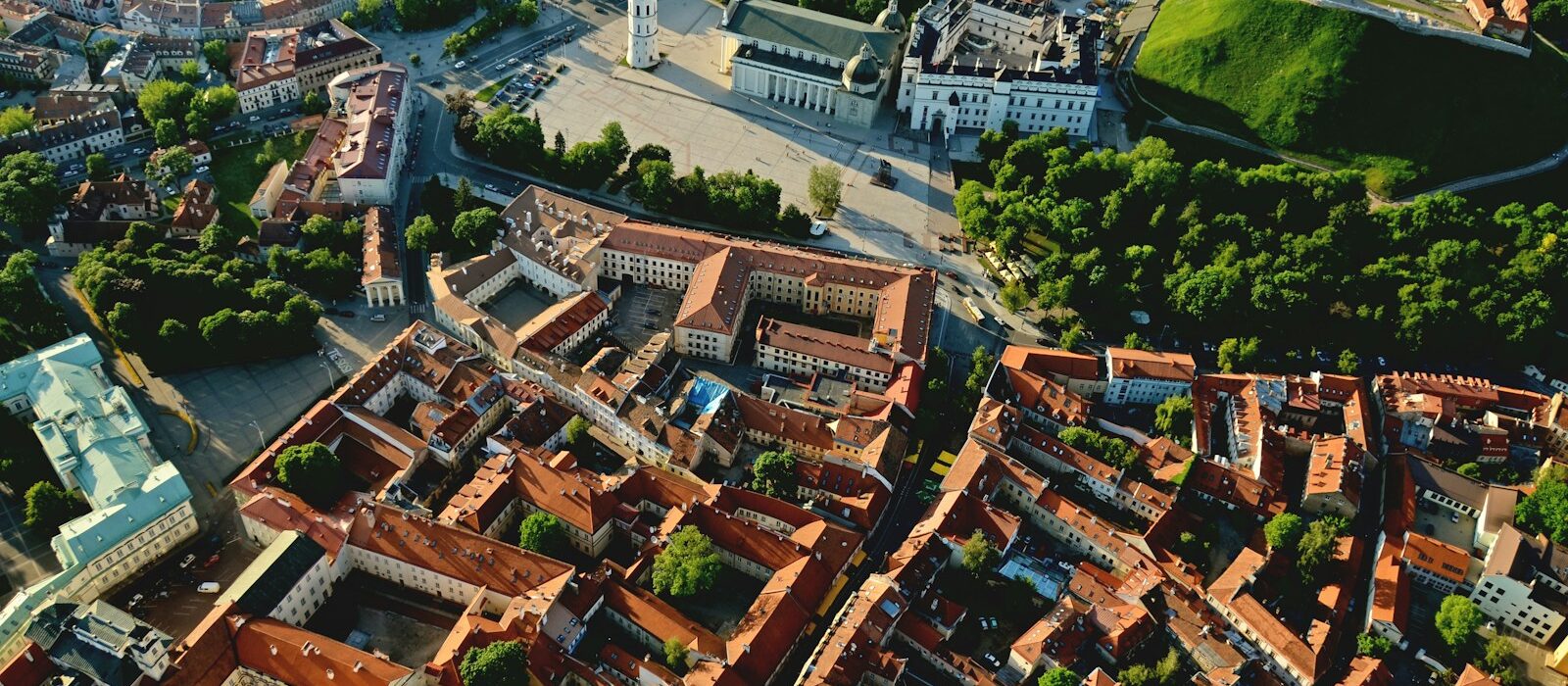
Vilnius is the heart of most trips. Its historic centre has been on the UNESCO World Heritage List since 1994 and mixes Gothic, Renaissance and Baroque buildings along cobbled lanes and courtyards. Nearby, the island castle at Trakai and the ancient hillfort landscape of Kernavė, also a UNESCO site, show how deep the country’s medieval roots go.
Kaunas, the second city, is known for its interwar modernist architecture and lively cafe and museum scene. On the coast, Klaipėda and the Curonian Spit offer beaches, dunes, pine forest and fishing villages such as Nida. Inland, protected areas like Aukštaitija, Dzūkija and Žemaitija national parks give hikers, paddlers and cyclists quiet lakes and forests.
Lithuania also has a strong tradition of pilgrimage and folk heritage, including the Hill of Crosses near Šiauliai. Its modern side shows in a growing tech and start-up scene, and in a welcoming, low-key travel culture that suits independent visitors.
History of Lithuania
Lithuania’s lands were first united in the 1230s under Mindaugas, who was crowned king in 1253 and founded the medieval state. The Grand Duchy of Lithuania that followed grew into one of the largest countries in Europe by the 14th century. In 1990 Lithuania became the first Soviet republic to declare independence.
Last checked: November 2026
Under the Gediminas dynasty, the Grand Duchy expanded far to the south and east, and Vilnius became its capital in the 14th century. A dynastic union with Poland followed in 1385-1386, and the Union of Lublin in 1569 created the Polish-Lithuanian Commonwealth. Vilnius University, founded in 1579, became an important centre of learning in the region.
The Commonwealth was partitioned in 1795, and most Lithuanian lands passed to the Russian Empire. After more than a century without statehood, the Council of Lithuania proclaimed independence on 16 February 1918. The interwar republic used Kaunas as its temporary capital, which is why the city still has a rich collection of 1920s and 1930s architecture.
The Second World War brought Soviet occupation in 1940, then Nazi German occupation from 1941, and a return of Soviet rule in 1944. Lithuania’s large Jewish community was almost destroyed during the Holocaust, and many sites in Vilnius and Kaunas now serve as memorials. Soviet rule lasted until the Act of the Re-Establishment of the State was passed on 11 March 1990.
Since independence, Lithuania has rebuilt as a market democracy. It joined NATO in March 2004 and the European Union in May 2004, and it adopted the euro in 2015.
Culture and Traditions of Lithuania
Lithuanian culture blends ancient Baltic folk heritage with Catholic traditions and a strong choral and craft tradition. Its best-known customs are the UNESCO-listed Song Festival, multipart folk songs called sutartinės, midsummer bonfires on Joninės and the Kaziukas craft fair in Vilnius.
Last checked: November 2026
Music sits at the centre of national identity. The Song Festival (Dainų šventė), first held in 1924, gathers thousands of singers in Vilnius and was recognised by UNESCO in 2003. Sutartinės, a polyphonic singing style from the Aukštaitija region, were added to the UNESCO list in 2010.
The traditional year follows the seasons. Užgavėnės, a Shrovetide festival in late winter, brings masks, bonfires and pancakes to send winter away. Joninės, on 23-24 June, is the midsummer celebration, with bonfires, herbs, flower wreaths and all-night gatherings that keep pre-Christian customs alive alongside the feast of St. John.
Each year around 4 March, the Kaziukas Fair fills the streets of Vilnius with linen, ceramics, wooden toys, amber and the decorated palms called verbos. The fair is linked to St. Casimir, the patron saint of Lithuania, and it is a good place to meet craftspeople from across the country.
Amber is Lithuania’s signature material, and you will find it in jewellery, museums and souvenir stalls along the coast. Many Lithuanians also keep a tradition of sauna (pirtis) and time in nature, so forests, lakes and countryside homestays are a normal part of everyday life. Visitors are generally met with reserved but sincere politeness, and showing interest in the country’s history and language is always appreciated.
Food and Cuisine of Lithuania
Lithuanian food is hearty, built on potatoes, rye bread, dairy, pork, beets and fresh dill. Signature dishes include cepelinai potato dumplings, cold beetroot soup (šaltibarščiai), kugelis, potato pancakes, fried garlic bread and the tree-shaped šakotis cake.
Last checked: November 2026
Cepelinai are large potato dumplings, often filled with minced meat, curd cheese or mushrooms and served with sour cream and bacon bits. They are widely seen as the national dish. Kugelis is a baked grated-potato pudding with milk, eggs and bacon, and bulviniai blynai are crisp potato pancakes served with sour cream or mushroom sauce. Bulviniai vėdarai, potatoes stuffed into sausage casing and baked, are another potato classic you will find on traditional menus.
In summer, šaltibarščiai is the dish to try. This bright pink cold soup is made from beetroot, kefir, cucumber, dill and boiled egg, and it usually comes with hot boiled potatoes on the side. Balandėliai, cabbage rolls stuffed with minced meat and rice, suit colder months.
Kepta duona, strips of dark rye bread fried and rubbed with garlic, is the standard bar snack and is usually eaten with beer and a cheese dip. Kibinai are crescent-shaped baked pastries filled with meat or vegetables, closely linked to the town of Trakai. Skilandis is a traditional smoked and cured pork sausage that you can buy at markets such as Hales Market in Vilnius.
For dessert, look for šakotis, a tall cake baked on a rotating spit that forms branch-like spikes, and tinginys, a no-bake chocolate and biscuit cake. Lithuanians also drink kvass and craft beer, and many traditional restaurants serve these dishes in generous portions at reasonable prices.
When you are ready to plan, start with the Lithuania visa requirements, browse the best places to visit in Lithuania and check the best time to visit Lithuania. You can then follow a ready-made Lithuania itinerary, choose where to stay in Lithuania, compare flights to Lithuania and learn how to get around Lithuania.
Explore Lithuania Travel Guides
Explore our detailed guides to plan every part of your Lithuania trip.
Lithuania: Best Places
A grouped guide to Lithuania's best places: Vilnius, Kaunas, Trakai, Kernavė, the Curonian Spit, national parks and pilgrimage sites, with time needed...
View Guide ›Lithuania: Best Time to Visit
Compare Lithuania's four seasons, regional differences, rainfall, festivals and public holidays to choose the right month for beaches, cities or hiking.
View Guide ›Lithuania: Flights
Which Lithuanian airports to fly into, which airlines serve them, and what to check before departure and on arrival for a smooth...
View Guide ›Lithuania: How to Get Around
How to travel between Lithuanian cities by train, bus and car, plus city transport tips, driving rules and the best option for...
View Guide ›Lithuania: Itineraries
Realistic 3, 5, 7 and 10 day Lithuania itineraries linking Vilnius, Trakai, Kaunas, Klaipėda and the Curonian Spit, with overnight stops and...
View Guide ›Lithuania: Visa
Who can enter Lithuania without a visa, how the Schengen 90/180-day rule works, passport and border-check basics, and where to apply if...
View Guide ›Lithuania: Hotels
Where to stay in Lithuania: the best areas of Vilnius, Kaunas, Klaipėda and Nida, budget to luxury choices and the city tax...
View Guide ›Explore Lithuania Tours
Discover guided tours and adventures in Lithuania. Compare itineraries, prices and traveller reviews on TourRadar before you book.
Guided tours & deals
Affiliate partner · Globe Navo may earn a commission from qualifying bookings at no extra cost to you.
Plan Your Trip to Lithuania
Your Next Adventure in Lithuania Awaits!
Explore Deals →🎁 Best deals for Lithuania
Offers from trusted travel stores for your Lithuania trip. Compare a few options before you book, and check each store's terms for the final price.
Browse by type: Hotel deals · Flight deals · Travel eSIM · Car rental
More destinations to explore
IraqDiscover Iraq: where it is, its history, culture and traditions, and signature dishes, with…
 FijiWhere Is Fiji Located? Fiji is an island nation in the South Pacific Ocean,…