 Azerbaijan
DESTINATION
Armenia
Armenia travel guide covering where the country is, its history, culture and food, plus links to our visa, flights and planning guides.
📅 Last updated:
Armenia: Hotels · Flights · Visa Guide · Deals
🌍 Quick Facts

Armenia at a glance
🏛️
Capital: Yerevan
💱
Currency: Armenian dram (AMD)
💬
Language: Armenian
👥
Population: About 3.1 million
🕒
Time zone: Armenia Time (UTC+4)
📞
Calling code: +374
🌐
Internet domain: .am
✈️
Main airport: Zvartnots International Airport (EVN)
★
Best time to visit: Late May to June and September to October
Food
- Lavash
- Khorovats (Armenian barbecue)
- Dolma
- Armenian wine
- Armenian brandy
Places
- Geghard Monastery
- Garni Temple
- Echmiadzin Cathedral
- Lake Sevan
- Khor Virap
- Noravank
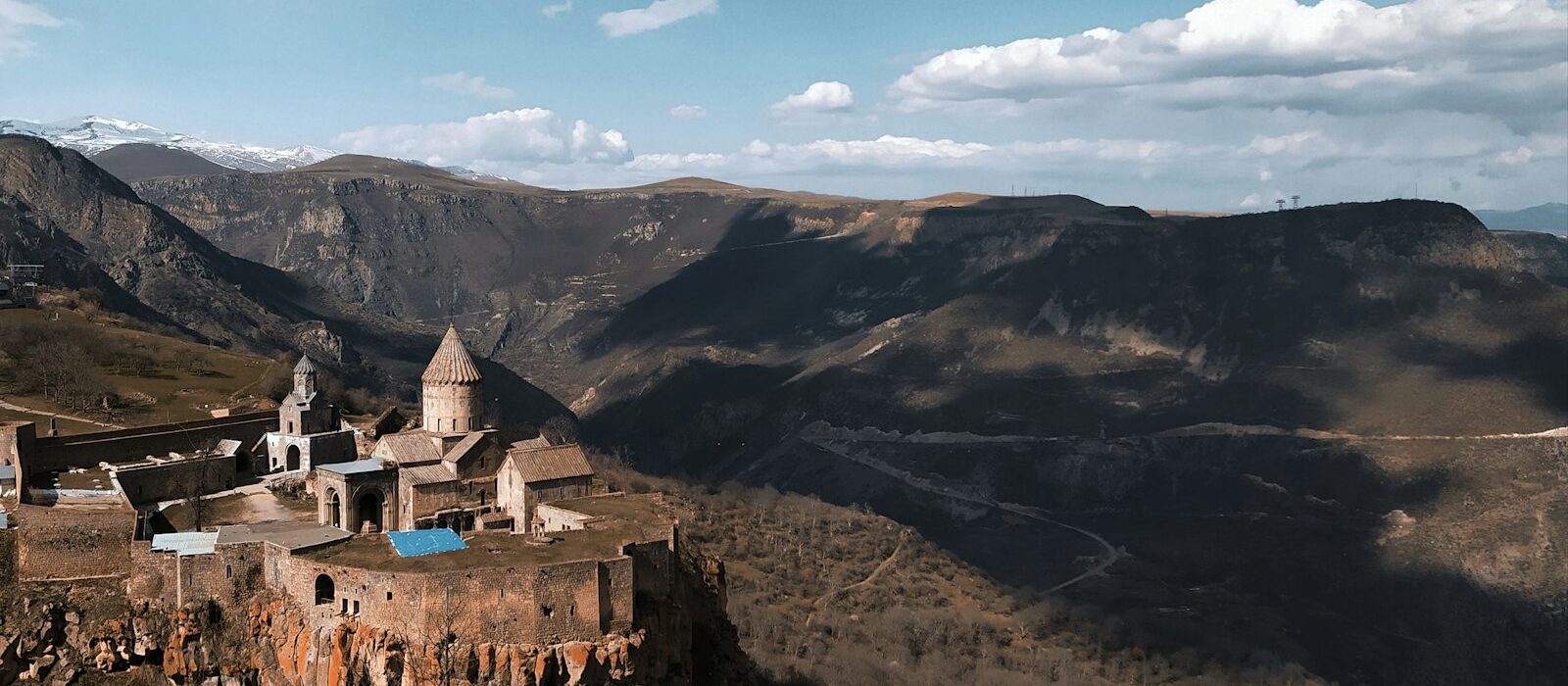
- Tatev Monastery
Weather
Hot, dry summers and cold winters, with wetter spring weather
Culture
Ancient Christian heritage, khachkars, lavash and wine traditions
Cities
- Yerevan
- Gyumri
- Dilijan
- Vagharshapat (Echmiadzin)
- Goris
📍 Armenia Map
📷 Photos of Armenia
Explore Armenia Travel Guides
Explore our detailed guides to plan every part of your Armenia trip.
🗺️
Armenia: Itineraries
Realistic Armenia itineraries for 3, 5, 7 and 10 days from Yerevan, with real travel times, getting around tips and common planning...
View Guide › 🛂Armenia: Visa
Who can enter Armenia without a visa, how the e-visa works and what to check before you fly, based on official Armenian...
View Guide › 📍Armenia: Best Places
The best places to visit in Armenia grouped by history, nature, cities and wine, with distances from Yerevan and how long to...
View Guide › 🌤️Armenia: Best Time to Visit
When to visit Armenia month by month, with weather by region, festivals, what to pack and the best months for hiking, wine...
View Guide › ✈️Armenia: Flights
Which airport to use for flights to Armenia, how to reach Yerevan, airlines and routes, and a Before You Fly checklist.
View Guide › 🚆Armenia: Getting Around
How to get around Armenia by metro, taxi apps, marshrutkas, trains and car, with realistic travel times between Yerevan and the main...
View Guide › 🛌Armenia: Hotels
Where to stay in Armenia: best areas in Yerevan and the regions, types of accommodation, family and halal notes and booking tips.
View Guide ›🖼️ Armenia: Location, History, Culture & Food
✨ Complete Travel Guide
Safety notice for travellers
The UK Foreign, Commonwealth and Development Office (FCDO) advises against all travel within 5 km of Armenia’s entire eastern border with Azerbaijan, and along the M16/H26 road between Ijevan and Noyemberyan.
The US State Department rates Armenia Level 2: Exercise Increased Caution, but lists the border region with Azerbaijan as Level 4: Do Not Travel. It also restricts US Embassy staff from non-essential travel to Gegharkunik east of Vardenis, Syunik east of Goris and Syunik south of Kapan.
This guide is informational only. Read both advisories in full, check the maps, and confirm the latest advice shortly before you travel.
Where Is Armenia Located?
Armenia is a landlocked country in the Armenian Highlands of West Asia, in the South Caucasus region. This Armenia travel guide covers its location, history, culture and food. Armenia borders Georgia to the north, Azerbaijan to the east, Iran to the south and Turkey to the west. Its capital is Yerevan.
Last checked: November 2026
The country covers 29,743 square kilometres, according to the CIA World Factbook. It has no coastline: the Black Sea lies beyond Georgia, and the Caspian Sea lies beyond Azerbaijan. Armenia is also one of the most mountainous countries on Earth, with an average height of about 1,800 metres above sea level. Mount Aragats, at 4,090 metres, is its highest peak.
Yerevan sits on the Hrazdan River in the north-east of the Ararat Plain. Mount Ararat, a national symbol, is visible from the capital on clear days but lies across the border in Turkey. Armenia uses Armenia Time (UTC+4) all year.
The land borders with Turkey and Azerbaijan are closed, according to the US State Department, so road links run mainly through Georgia and Iran. For airports and arrival routes, see our guide to flights to Armenia. For travel inside the country, read getting around Armenia.
Armenia Travel Guide: An Introduction to the Country
Armenia is a small mountainous republic known for ancient monasteries, a Christian tradition dating to 301 AD, winemaking and its capital, Yerevan. Armenian is the official language, and the currency is the Armenian dram (AMD). It is a parliamentary republic, with a president as head of state and a prime minister as head of government.
The Statistical Committee of Armenia put the country’s permanent population at about 3.1 million on 1 July 2026. About 1.12 million of those people live in Yerevan, which is the largest city by a wide margin. Gyumri is the second-largest city. The country has ten provinces, called marzer, plus Yerevan, which has its own status.
A common mix-up is where Armenia belongs on the map. The CIA World Factbook notes that Armenia considers itself part of Europe, while geographers often place it in West Asia. Both labels appear in guidebooks, so don’t be surprised to see either.
Three sites are on UNESCO’s World Heritage List: the Monasteries of Haghpat and Sanahin (inscribed in 1996 and extended in 2000), the Cathedral and Churches of Echmiadzin with the Archaeological Site of Zvartnots (2000), and the Monastery of Geghard and the Upper Azat Valley (2000). The UNESCO World Heritage Centre page for Armenia lists the current sites.
Most first-time visitors use Yerevan as a base and add day trips, so it helps to read about where to stay in Armenia early. Entry rules differ by nationality, so check our Armenia visa guide for tourists before you book.
History of Armenia: From Urartu to Today
Armenian history runs from early settlements in the highlands through the Urartian kingdom, the adoption of Christianity in 301 AD, centuries of foreign rule, Soviet membership and independence in 1991. The country has kept its language, alphabet and church through all of it, so history is easy to see in monasteries and museums.
Early settlement and Urartu
People lived in the Armenian Highlands long before written records. Archaeologists have found an Early Bronze Age settlement at Shengavit, on the site of today’s Yerevan, and the Areni-1 cave in Vayots Dzor holds evidence of very early winemaking. The kingdom of Urartu emerged in the 9th century BC and fell in the 6th century BC. Persian rule followed, and Alexander the Great’s empire absorbed most of Armenia in 331 BC, although local rulers kept considerable autonomy.
Kingdoms and the first Christian state
Around 190 BC, Artaxias I founded the Artaxiad dynasty. Its best-known ruler, Tigranes the Great, reigned from 95 to 55 BC and briefly built an empire that stretched from the Caspian Sea to the Mediterranean. Rome later defeated Armenia, and its kings ruled as Roman clients.
In 301 AD, King Tiridates III and Saint Gregory the Illuminator proclaimed Christianity the state religion, which made Armenia the first state to adopt it officially. In 405 AD, the scholar Mesrop Mashtots created the Armenian alphabet. It had 36 letters at first, and three more were added later.
Division and foreign rule
The ancient kingdom was split between the Byzantine and Sasanian empires in the early 5th century. Later centuries brought a series of regional powers, with a Bagratid kingdom ruling from the 880s to 1045. In 1639, the Ottoman Empire and Persia divided the Armenian lands between them, and in 1828 eastern Armenia joined the Russian Empire.
In 1915, Armenians in the Ottoman Empire faced mass killings and deportations. Armenia and many other countries call these events the Armenian Genocide, while Turkey rejects that description.
Republic, Soviet rule and independence
The First Republic of Armenia was declared on 28 May 1918. Soviet Armenia was established on 29 November 1920 and became a union republic of the Soviet Union in 1936. On 7 December 1988, the Spitak earthquake struck northern Armenia and killed about 25,000 people, with Gyumri and Spitak among the worst-hit towns.
The Supreme Council declared state sovereignty on 23 August 1990, and a referendum on 21 September 1991 backed independence. Armenia marks Independence Day on 21 September every year.
Recent years
A conflict over Nagorno-Karabakh began in 1988 and shaped Armenia’s early years of independence. Fighting returned in 2020, and Azerbaijan took full control of the region on 19 September 2023, after which the region’s ethnic Armenian residents were displaced.
On 8 August 2025, Armenia and Azerbaijan initialled a peace agreement in Washington. As of August 2026 the text remained unsigned, and Azerbaijan has said it wants changes to Armenia’s constitution before a final deal. The border between the two countries is still closed, which is why the safety notice at the top of this page matters. To see where this history is easiest to explore, read our guide to the best places to visit in Armenia.
Armenian Culture: Language, Faith, Music and Customs
Armenian culture rests on a language with its own alphabet, one of the world’s oldest national churches, and strong traditions of family and hospitality. UNESCO lists eight Armenian elements on its intangible heritage list, from the duduk to lavash bread. Most of these traditions are still part of everyday life, not only shown to visitors.
Language and alphabet
Armenian is an Indo-European language with its own script, created by Mesrop Mashtots in 405 AD. The alphabet has 39 letters today. Two standard written forms exist: Eastern Armenian is used in Armenia, and Western Armenian is spoken mostly in diaspora communities. UNESCO added Armenian letter art to its intangible heritage list in 2019.
Religion
Most people in Armenia belong to the Armenian Apostolic Church, the national church. Its spiritual centre, the Mother See of Holy Echmiadzin, is in Vagharshapat near Yerevan, and the head of the church is called the Catholicos of All Armenians.
Festivals
Trndez, in mid-February, is a fire festival in which people jump over bonfires. Vardavar is a summer festival held 14 weeks after Easter, when people throw water at each other in the streets, so visitors should expect to get wet. National holidays include Republic Day on 28 May and Independence Day on 21 September. Festival dates shift, so check our best time to visit Armenia guide for month-by-month events.
Etiquette
Hospitality matters a great deal. Hosts often offer coffee, fruit or a full meal, and it’s polite to accept at least a small portion. Toasts are common at the table, and the host usually starts them. Dress modestly in churches and monasteries, and ask before photographing people or services. Avoid raising the conflict with Azerbaijan or the events of 1915 unless your host brings them up.
Music and arts
The duduk is a double-reed instrument made from apricot wood, and UNESCO listed it in 2008. Komitas (1869 to 1935), a priest and composer, collected and arranged Armenian folk songs. Kochari, a traditional group dance, joined UNESCO’s list in 2017, and the Gyumri blacksmithing tradition followed in 2023.
Khachkars, carved memorial cross-stones, were listed in 2010 and stand at nearly every monastery. In Yerevan, the Matenadaran holds a large collection of ancient manuscripts, and the Sergei Parajanov Museum honours the filmmaker. Traditional dress is now worn mainly for festivals and folk dance, while everyday clothing in the capital is modern and casual.
Armenian Food and Drink: What to Eat and Drink in Armenia
Armenian food centres on grilled meat, fresh herbs, cheese, vegetables, bread and wine. Lavash, the thin flatbread, is on UNESCO’s intangible heritage list and appears at almost every table. Most dishes are simple and seasonal, and meals are meant to be shared. Pork is common on menus, so Muslim travellers should ask before ordering.
Staples
Lavash is baked on the walls of a clay oven called a tonir, and it works as plate, spoon and wrap. Regional differences are small but real: the Ararat Plain is known for fruit, especially apricots, and Vayots Dzor is known for wine.
Signature dishes
- Khorovats: Armenian barbecue of pork, lamb or beef grilled over charcoal.
- Tolma: grape leaves or vegetables stuffed with rice, herbs and often minced meat.
- Harissa: a thick porridge of wheat and meat, cooked for hours.
- Khash: a slow-cooked broth made from cow’s feet, eaten in the colder months with garlic and lavash.
- Ghapama: a whole pumpkin stuffed with rice, dried fruit and nuts, often served at winter celebrations.
- Lahmajun: thin flatbread topped with spiced minced meat and baked quickly.
- Manti: small baked meat dumplings, usually served with yoghurt and a light sauce.
- Basturma: air-dried cured beef coated in a spice paste and sliced thin.
- Spas: a warm yoghurt soup with wheat grains and herbs.
Street food
Quick bites include lavash wraps filled with cheese and herbs, shawarma, lahmajun from neighbourhood bakeries and boiled corn in summer.
Drinks
Wine has deep roots here. The Areni-1 cave complex holds a wine press and storage jars that archaeologists date to about 6,100 years ago. Armenian brandy is a point of national pride, and many producers offer tastings in Yerevan. Armenian coffee is brewed in a small pot and served in small cups, and tan, a salted yoghurt drink, is a popular summer refresher.
Desserts
Gata is a sweet, buttery pastry found in bakeries across the country. Sujukh is a string of walnuts dipped in thickened grape juice, and anoushabour is a sweet pudding made with dried fruit and nuts. If you want to build food stops into a route, our Armenia itineraries show how to fit them into three to ten days.
Explore Hotels & Flights
Search accommodation and flights for your destination with Expedia. Compare available options and continue to Expedia to complete your booking.
Affiliate partner · Globe Navo may earn a commission from qualifying bookings at no extra cost to you.
❓ Armenia FAQ
Do I need a visa to visit Armenia?
UK and US citizens can enter visa-free for up to 180 days in a year. Other nationalities may qualify for visa-free entry, an e-visa at evisa.mfa.am, or an embassy visa. Check your passport on the Armenian Ministry of Foreign Affairs website before booking.
Is Armenia safe to visit?
Crime is relatively low, according to the US State Department, but both the US and UK advise against travel near the Azerbaijan border. The UK also warns against the M16/H26 road between Ijevan and Noyemberyan. Read both advisories before you go.
What is the best time to visit Armenia?
Late May to June and September to October are the most comfortable months for sightseeing and hiking. Summers are hot in Yerevan, winters are cold and snowy, and spring can be wet. Wine events take place in June and early October.
How many days do you need in Armenia?
Five to seven days works well for a first trip: Yerevan, Garni and Geghard, Lake Sevan, Dilijan and the southern wine route. Three days covers the capital and one or two day trips. Tatev and the north need extra time.
Which airport should I fly into for Armenia?
Most visitors fly into Zvartnots International Airport (EVN) near Yerevan. Gyumri Shirak Airport (LWN) is smaller and has few routes. Flights from major European cities take about three to four hours, so check current schedules.
Plan Your Trip to Armenia
Your Next Adventure in Armenia Awaits!
Explore Deals →🎁 Best deals for Armenia
Offers from trusted travel stores for your Armenia trip. Compare a few options before you book, and check each store's terms for the final price.
Browse by type: Hotel deals · Flight deals · Travel eSIM · Car rental
 KkdayFind current Kkday coupons and deals for tours, attraction tickets, transport and first app orders. See minimum spend, discount caps and exclusions before you book.
Get Coupon View Deal
 eSIMFOXeSIMFOX is a travel eSIM provider offering prepaid mobile data plans for single countries and wider regions, delivered digitally so you can connect as soon as you land.
Get Coupon View Deal
 QuibityQuibity is a travel eSIM provider that lets you buy a mobile data plan online and activate it on your phone, so you can get connected abroad without a physical SIM card.
Get Coupon View Deal
 ExpediaDiscover great deals on hotels, flights, vacation packages, car rentals, and activities with Expedia. Compare travel options and plan your next trip with convenient booking choices.
Get Coupon View Deal
 KlookKlook is a travel activities platform where you can book attraction tickets, tours, day trips, transport passes, airport transfers and local experiences in destinations worldwide.
Get Coupon View Deal
 Trip.comTrip.com is a global online travel platform for flights, hotels, train tickets, airport transfers, attraction tickets and travel packages, available on web and mobile app.
Get Coupon View Deal
 TourRadarTourRadar is an online marketplace for multi-day guided tours, small-group trips and tailor-made journeys offered by independent tour operators around the world.
Get Coupon View Deal