 AustriaAustria is a Central European country known for Vienna, Salzburg, Hallstatt and the Alps,…
DESTINATION
Liechtenstein
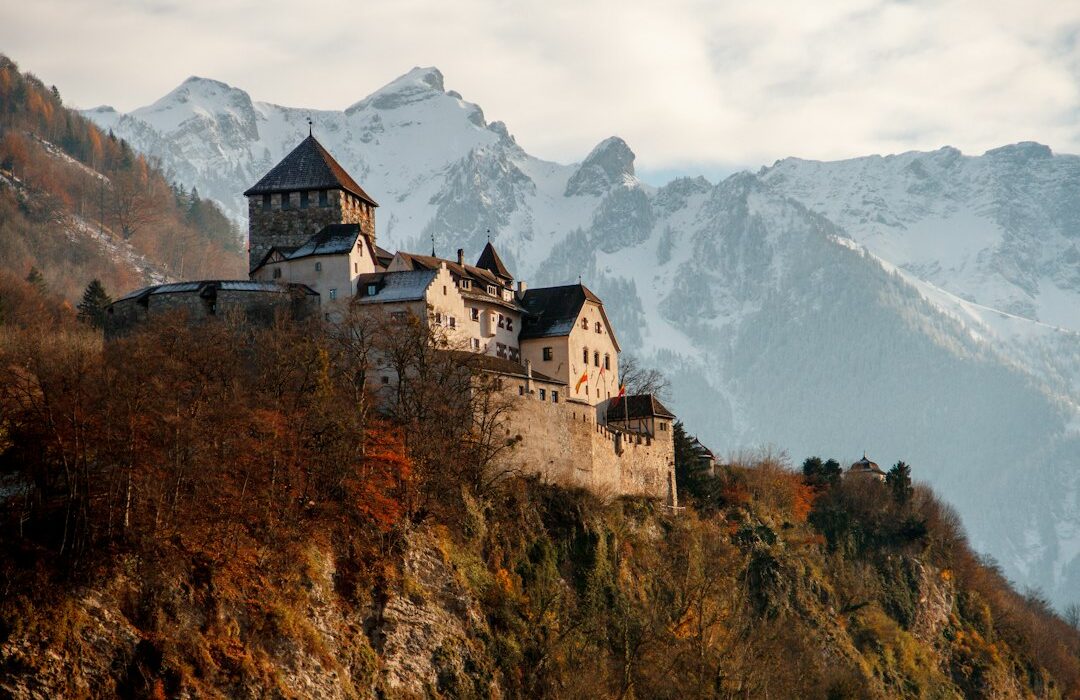
Liechtenstein is an Alpine principality between Switzerland and Austria, known for Vaduz Castle, Alemannic customs and hearty cheese dishes.
📅 Last updated:
🌍 Quick Facts

Liechtenstein at a glance
Capital: Vaduz
Currency: Swiss franc (CHF)
Language: German (official)
Population: About 41,000
Time zone: Central European Time (UTC+1, UTC+2 in summer)
Calling code: +423
Internet domain: .li
Main airport: No airport; nearest is Zurich Airport (ZRH)
Best time to visit: Summer for hiking; winter for skiing in Malbun
📍 Liechtenstein Map
🖼️ Liechtenstein: Location, History, Culture & Food
✨ Complete Travel Guide
Where Is Liechtenstein Located?
Liechtenstein is a small landlocked country in Central Europe, set in the Alps between Switzerland to the west and south and Austria to the north and east. Its capital is Vaduz, and the whole country covers about 160 square kilometres, which makes it the fourth smallest country in Europe.
Last checked: November 2026
The border with Switzerland runs for about 41 kilometres along the cantons of St. Gallen and Graubünden. In the north and east, Liechtenstein shares a border of about 37 kilometres with the Austrian state of Vorarlberg. These figures come from the Liechtenstein Office of Statistics, which publishes the country’s official numbers.
The land rises from the Rhine valley floor to high Alpine ridges. The lowest point is the Ruggeller Riet, at 430 metres above sea level, and the highest is the Grauspitz, at 2,599 metres. Forest covers about 42 percent of the territory, and farmland covers about 32 percent, so much of the country is green space within a short drive of any village.
Liechtenstein has eleven municipalities. Schaan is the largest, with around 6,100 residents, and Vaduz, the capital, has around 5,800, according to the Office of Statistics. The country follows Central European Time, which is UTC+1 in winter, with summer time in use in the warmer months.
Introduction to Liechtenstein
Liechtenstein is a hereditary constitutional monarchy of about 41,000 people, led by a reigning prince and a 25-member parliament called the Landtag. German is the official language, the Swiss franc is the currency, and the country belongs to the Schengen Area and the European Economic Area, though not the European Union.
Last checked: November 2026
The government describes the state as a monarchy on a democratic and parliamentary basis, so power is shared between the prince and the people. Parliament members serve part-time alongside their regular jobs, and citizens can also propose laws and call referendums. The Embassy of Liechtenstein explains how the system works.
The country has eleven municipalities, and its territory is only about 25 kilometres long and 12 kilometres wide at its largest. Around a third of residents are foreign nationals, mainly from Switzerland, Austria and Germany, according to the Office of Statistics. Population estimates for 2025 are between 40,000 and 41,500 depending on the source and method.
Liechtenstein joined the United Nations in 1990, the European Free Trade Association in 1991 and the European Economic Area in 1995. It uses the Swiss franc and has a customs union with Switzerland. It joined the Schengen Area in 2011, so travellers who enter from Switzerland or Austria normally cross no border checks.
The economy is one of the most industrialised in Europe, with strong manufacturing and financial services, and the country has one of the highest incomes per person in the world.
History of Liechtenstein
Liechtenstein was created in 1719, when the Holy Roman Emperor united the lordships of Vaduz and Schellenberg into a principality. It became sovereign in 1806, gained full independence in 1866 when the German Confederation dissolved, and has been governed under its 1921 constitution since, with close ties to Switzerland.
Last checked: November 2026
The two lordships passed to the House of Liechtenstein in 1699 and 1712. Emperor Charles VI then elevated them to an imperial principality in 1719. The family’s main estates were in Austria and Moravia, so no prince set foot in the territory until 1842, according to the Embassy of Liechtenstein in the United States.
When Napoleon dissolved the Holy Roman Empire in 1806, Liechtenstein gained sovereignty by joining the Confederation of the Rhine. After that alliance ended, it joined the German Confederation in 1815, and Prince Johann I granted a limited constitution in 1818. The confederation dissolved in 1866, which left Liechtenstein fully independent. Britannica’s history entry gives the same sequence.
Liechtenstein abolished its army in 1868, and it has had no military since. After the First World War, economic hardship and unrest led to a new constitution, which entered into force in 1921 and allows significant direct democracy. In the 1920s the country also signed a customs treaty with Switzerland and adopted the Swiss franc, which is why Swiss money is used in every shop today.
Over the following century, Liechtenstein changed from a poor farming society into one of the most industrialised countries in the world. Its borders have stayed unchanged for nearly 300 years, and it is often described as the last surviving remnant of the Holy Roman Empire.
Culture and Traditions of Liechtenstein
Liechtenstein’s culture belongs to the Alemannic German-speaking Alpine world that it shares with parts of Switzerland and western Austria. German is the official language, locals speak an Alemannic dialect, and many customs follow Catholic holy days, including Fasnacht carnival, Funkensonntag bonfires and National Day on 15 August.
Last checked: November 2026
Language and religion
Standard German is used in schools and official life, while everyday speech is an Alemannic dialect that varies from village to village. The CIA World Factbook lists German as the first language of about 91.5 percent of residents (2015 estimate), with smaller Italian, Turkish and Portuguese-speaking communities. English is widely understood in tourist areas.
Roman Catholicism is the largest faith, at about 73 percent in the same estimate, and the church calendar shapes many holidays. Protestant, Muslim and Orthodox communities, and people with no religion, make up the rest.
Festivals and customs
Fasnacht, the carnival season, runs from the Thursday before Ash Wednesday to Carnival Tuesday and is called the “fifth season” in local tradition. Funkensonntag follows on the Sunday after Ash Wednesday, when villages light large bonfires to drive away winter. In autumn, cattle are brought down from the mountain pastures in a ceremonial cattle drive, and Vaduz holds a Christmas market each December. These customs are described by Liechtenstein Tourism, the national tourist board.
National Day
National Day falls on 15 August, the date of the Feast of the Assumption. It was first held in 1940 and was linked to the birthday of Prince Franz Josef II on 16 August, and a 1990 law fixed 15 August as the official holiday. The day begins with a state ceremony, and celebrations in Vaduz include a fair and fireworks. The Liechtenstein embassy’s account of National Day explains how the date was chosen.
Arts and everyday life
Liechtenstein has a lively arts scene for its size, with museums, galleries and festivals concentrated around Vaduz. Social life centres on local clubs, bands, choirs and sports associations, and village events bring neighbours together throughout the year.
Food and Cuisine of Liechtenstein
Liechtenstein’s food is hearty Alpine cooking shaped by its neighbours Austria and Switzerland. The best-known dish is Käsknöpfle, small egg dumplings baked with local cheese and served with apple sauce, alongside Ribel, a traditional cornmeal dish that was once a staple of everyday meals.
Last checked: November 2026
Liechtenstein Tourism notes that the national cuisine draws mainly on Austrian and Swiss influences, with some foreign influence on the drinks side. Menus lean on cheese, dairy, maize, barley, game and apples, and many dishes began as simple farm food. You can find them in mountain lodges and traditional restaurants across the country.
Signature dishes
- Käsknöpfle: soft egg dumplings layered with melted cheese, topped with fried onions and served with apple sauce. It is widely called the national dish.
- Ribel (Rebl): a dish made from corn flour that was a staple food in the past and is now a traditional speciality.
- Tüarggarebl: a variant of the classic Ribel, prepared in the gentle Unterland style.
- Hafalaab: a hearty barley soup, usually served in the colder months.
- Rehpfeffer mit Spätzle: a rich venison stew served with spätzle, listed among the classic dishes by Liechtenstein Tourism.
- Kratzer: a traditional pancake-style farmhouse dish.
- Dreikönigskuchen: a Three Kings’ cake, one of the country’s traditional baked specialities.
- Schwartenmagen: a cold cut of pickled meat set in jelly, found on traditional menus.
Planning a visit? Read our guide to Liechtenstein visa and entry requirements before you book, and see the best places to visit in Liechtenstein for castles, museums and mountain villages.
To plan the rest of your trip, check the best time to visit Liechtenstein for hiking and skiing seasons, follow a Liechtenstein itinerary for 3, 5, 7 and 10 days, and compare where to stay in Liechtenstein. You can also read about flights to Liechtenstein and learn how to get around Liechtenstein by bus, train or car once you arrive.
You can browse recipes and background for several of these dishes on the Liechtenstein Tourism food page.
Explore Liechtenstein Travel Guides
Explore our detailed guides to plan every part of your Liechtenstein trip.
Liechtenstein: Best Places
A guide to the best places to visit in Liechtenstein, from Vaduz Castle and Gutenberg Castle to Malbun, Triesenberg and the Schellenberg...
View Guide ›Liechtenstein: Best Time to Visit
Month-by-month weather, seasons and festivals in Liechtenstein, with advice on when to go for hiking, skiing or quiet sightseeing.
View Guide ›Liechtenstein: Flights
Which airports serve Liechtenstein, how far they are, and what to check before you fly, with a simple checklist and quick answers.
View Guide ›Liechtenstein: Getting Around
How to travel inside Liechtenstein by LIEmobil bus, regional train, taxi or car, with the best option for common journeys and a...
View Guide ›Liechtenstein: Hotels
A guide to the best areas to stay in Liechtenstein, from Vaduz and Schaan to Triesenberg and Malbun, with booking tips for...
View Guide ›Liechtenstein: Itineraries
Four ready-to-use routes for 3, 5, 7 and 10 days in Liechtenstein, built around Vaduz, Triesenberg and Malbun with easy day trips.
View Guide ›Liechtenstein: Visa
Liechtenstein entry guide: how Schengen short stays work, what the Entry/Exit System records at the border, ETIAS status and where to check...
View Guide ›Explore Liechtenstein Tours
Discover guided tours and adventures in Liechtenstein. Compare itineraries, prices and traveller reviews on TourRadar before you book.
Guided tours & deals
Affiliate partner · Globe Navo may earn a commission from qualifying bookings at no extra cost to you.
❓ Liechtenstein FAQ
Where is Liechtenstein located?
Liechtenstein is a small landlocked country in Central Europe, in the Alps between Switzerland to the west and south and Austria to the north and east. Its capital is Vaduz, and it covers about 160 square kilometres, making it the fourth smallest country in Europe.
Is Liechtenstein part of the European Union?
No. Liechtenstein is a member of the European Economic Area and the Schengen Area, but not the European Union. It has a customs union with Switzerland and uses the Swiss franc, so everyday life is closely linked to both neighbours.
What language do people speak in Liechtenstein?
German is the official language and is used in schools and official life. Everyday speech is an Alemannic dialect that varies from village to village, and English is widely understood in tourist areas.
What is the national dish of Liechtenstein?
Käsknöpfle is widely called the national dish. It is made of soft egg dumplings layered with melted local cheese, topped with fried onions and served with apple sauce. Ribel, a traditional corn flour dish, is another classic.
When is Liechtenstein National Day?
National Day is held on 15 August, the date of the Feast of the Assumption. It begins with a state ceremony, and celebrations in Vaduz include a fair and fireworks. A 1990 law fixed the date as the official holiday.
Plan Your Trip to Liechtenstein
Your Next Adventure in Liechtenstein Awaits!
Explore Deals →🎁 Best deals for Liechtenstein
Offers from trusted travel stores for your Liechtenstein trip. Compare a few options before you book, and check each store's terms for the final price.
Browse by type: Hotel deals · Flight deals · Travel eSIM · Car rental
More destinations to explore
AustriaAustria is a Central European country known for Vienna, Salzburg, Hallstatt and the Alps,…
 FinlandFinland is a Nordic country in Northern Europe known for its forests, lakes, archipelagos,…
 AfghanistanAfghanistan's location, history, culture and food, with the current US and UK government travel…