 Cambodia
DESTINATION
Afghanistan
Afghanistan's location, history, culture and food, with the current US and UK government travel advice to read before anything else.
📅 Last updated:
Afghanistan: Hotels · Flights · Visa Guide · Deals
🌍 Quick Facts

Afghanistan at a glance
🏛️
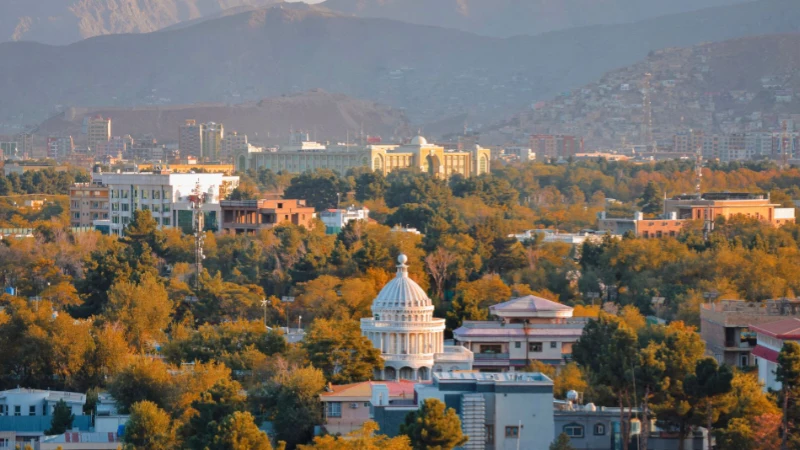
Capital: Kabul
💱
Currency: Afghani
💬
Language: Dari (Afghan Persian) and Pashto, both official
👥
Population: About 45 million as of 2026 (UN estimate)
🕒
Time zone: Afghanistan Time (AFT), UTC+4:30, no daylight saving
📞
Calling code: +93
🌐
Internet domain: .af
✈️
Main airport: Kabul International Airport (KBL)
★
Best time to visit: Spring and autumn, roughly April to June and September to October, according to World Travel Guide. Please note that the US and UK governments currently advise against all travel to Afghanistan.
Food
- Kabuli pulao (national dish)
- Mantu
- Ashak
- Bolani
- Kebabs
- Afghan tandoor bread
Places
- Minaret of Jam
- Bamiyan Valley
- Band-e Amir
- Wakhan Valley
- Blue Mosque
- Mazar-i-Sharif
Weather
The climate is mountainous and much colder than the country's latitude suggests. Because Afghanistan is landlocked, temperatures swing sharply between summer and winter and between day and night. The southern lowlands are the most extreme, with very hot summers and severe winters.
Culture
Afghan culture blends Persian, Buddhist, Islamic and Turkic influences. Poetry and proverbs are central to daily life. Buzkashi, a horseback sport, is popular. Nowruz (the spring New Year) is celebrated with samanak, the Guli Surkh festival and games.
Cities
- Kabul
- Herat
- Mazar-i-Sharif
- Kandahar
- Jalalabad
📍 Afghanistan Map
📷 Photos of Afghanistan
Explore Afghanistan Travel Guides
Explore our detailed guides to plan every part of your Afghanistan trip.
🗺️
Afghanistan: Itineraries
Afghanistan itineraries of 3, 5 and 7 days, built as reference outlines, with planning notes for essential trips and current advisories.
View Guide › 🛂Afghanistan: Visa
How the Afghanistan visa works: who needs one, the 2026 tourist e-Visa, documents and entry checks, plus the advisories to read first.
View Guide › 📍Afghanistan: Best Places
The best places to visit in Afghanistan, from Bamiyan and Band-e Amir to Herat and Mazar-i-Sharif, with access limits and warnings.
View Guide › 🌤️Afghanistan: Best Time to Visit
Best time to visit Afghanistan month by month, with weather by region, Nowruz and Ramadan, and the government advisories to read first.
View Guide › ✈️Afghanistan: Flights
Which airports and airlines serve Afghanistan, how to reach Kabul from the airport, and what to check before booking under current advisories.
View Guide › 🚆Afghanistan: Getting Around
How to get around Afghanistan: domestic flights, roads, buses, taxis and city transport, with travel times and a safety checklist.
View Guide › 🛌Afghanistan: Hotels
Where to stay in Afghanistan by city, which stay types exist, and the security and payment checks to make before booking under...
View Guide ›🖼️ Afghanistan: Location, History, Culture & Food
✨ Complete Travel Guide
Safety notice. The US Department of State rates Afghanistan at Level 4, Do Not Travel, and says not to travel for any reason. The UK Foreign, Commonwealth and Development Office advises against all travel, even with an organised tour group. Both warn of terrorism, kidnapping, wrongful detention and almost no consular help. The warnings cover the whole country, including Kabul, Bamiyan, Herat, Mazar-i-Sharif and Kandahar. This Afghanistan travel guide is for information only.
Where Is Afghanistan Located?
Afghanistan is a landlocked country in South and Central Asia, with its capital at Kabul. It borders Pakistan, Iran, Turkmenistan, Uzbekistan, Tajikistan and, through the narrow Wakhan Corridor, China. The Hindu Kush mountains run through the centre, and the land area is about 652,230 square kilometres.
Last checked: November 2026
No sea touches the country. The nearest coastlines lie on the Arabian Sea in Pakistan and on the Gulf of Oman in Iran, so people and goods depend on land and air routes. Kabul sits at about 1,800 metres above sea level in a valley ringed by mountains. Travellers sorting out arrival airports can read the guide to flights to Afghanistan.
The Hindu Kush peaks at Noshaq, about 7,500 metres high, on the border with Pakistan. North of the range, plains lead to the Amu Darya (Oxus) river, which marks much of the northern frontier. In the south and southwest, the Registan desert and the Helmand River valley dominate the landscape.
Afghanistan uses a single time zone, Afghanistan Time (UTC+4:30), with no daylight saving. The half-hour offset trips up many people reading flight schedules. Labels also differ: the United Nations groups the country with Southern Asia, while many historians treat it as a Central Asian crossroads. For how the main cities connect inside the country, see the getting around Afghanistan guide.
Afghanistan Travel Guide: An Introduction to the Country
Afghanistan is an Asian country of about 45 million people as of 2026, according to United Nations estimates. Kabul is the capital, Dari and Pashto are the official languages, and the currency is the afghani. Since August 2021 the Taliban have governed as the de facto authorities, calling the state the Islamic Emirate of Afghanistan.
The population figure covers the whole country, not a single city. No recent census exists, and the statistics authority run by the Taliban estimates about 37 million for 2026. Pashtuns form the largest ethnic group, followed by Tajiks, Hazaras and Uzbeks, among others. Shares are disputed because no full census has been completed in decades, which is a common misunderstanding: Afghanistan is not one language or one people.
The country is known for the Hindu Kush, Silk Road trading towns, the Buddhist remains of Bamiyan, the blue lakes of Band-e Amir and a long tradition of Persian-language poetry. Two places hold UNESCO World Heritage status: the Minaret and Archaeological Remains of Jam, inscribed in 2002, and the Cultural Landscape and Archaeological Remains of the Bamiyan Valley, inscribed in 2003. UNESCO lists both as World Heritage in Danger. Readers comparing sites can use the best places to visit in Afghanistan.
Practical identifiers are short: the international calling code is +93 and the internet domain is .af. The head of state is the Taliban’s supreme leader, Hibatullah Akhundzada. Entry rules, including the online tourist e-Visa introduced in 2026, are explained in the Afghanistan visa guide.
History of Afghanistan: From Early Settlements to Today
Afghanistan’s history stretches from Bronze Age farming settlements to the present day. The land sat on trade routes between Persia, Central Asia and India, so empires such as the Achaemenids, Kushans, Ghaznavids, Timurids and Durranis ruled parts of it. Modern Afghanistan took shape with the Durrani Empire in 1747.
Early settlement and ancient empires
Farming villages appeared here thousands of years ago, and the Bronze Age site of Mundigak near Kandahar shows organised settlement by the third millennium BCE. The Achaemenid Persian Empire absorbed the area in the sixth century BCE. Alexander the Great crossed the region between 330 and 327 BCE and founded several cities. The Kushan Empire, strongest between the first and third centuries CE, ruled from Bactria and backed both Buddhism and Silk Road trade.
Buddhism, Islam and the medieval dynasties
Buddhism flourished at Bamiyan, where two huge standing Buddhas were carved into a cliff, usually dated to the sixth century CE. Arab armies brought Islam in the seventh century, and conversion spread over the following centuries. The Ghaznavids built an empire from Ghazni in the eleventh century. The Ghurids followed, and their Minaret of Jam, about 65 metres tall, dates to the late twelfth century. Mongol armies devastated cities such as Balkh and Herat in the early 1220s.
Timurids, Mughals and the Durrani Empire
Herat became a centre of art and learning under the Timurids in the fifteenth century, when Queen Gawhar Shad sponsored a mosque and a religious school there. Babur, who founded the Mughal dynasty, took Kabul in 1504 and is buried in a Kabul garden that bears his name. In 1747 Ahmad Shah Durrani, a Pashtun commander, founded the Durrani Empire at Kandahar, usually seen as the start of the modern Afghan state.
The Great Game, independence and monarchy
Britain and Russia competed for influence in the nineteenth century, a rivalry called the Great Game. Britain fought three wars in Afghanistan, in 1839-1842, 1878-1880 and 1919. A common misunderstanding is that Britain colonised the country; it controlled Afghan foreign policy from 1879 until 1919 but never ruled it directly. Independence Day is marked on 19 August. King Zahir Shah reigned from 1933 until a coup in 1973. Readers who want to see how these periods map onto places can follow the Afghanistan itineraries page.
War, Taliban rule and the present
A communist coup in April 1978 was followed by the Soviet invasion in December 1979, and Soviet troops left in February 1989. Civil war continued. The Taliban ruled most of the country from 1996 to 2001 and destroyed the Bamiyan Buddhas in March 2001. After a US-led intervention began in October 2001, a republic led first by Hamid Karzai and later by Ashraf Ghani governed until the Taliban entered Kabul on 15 August 2021. They have held power since then.
Culture of Afghanistan: Language, Religion, Festivals and Arts
Afghan culture combines Persian, Turkic, Central Asian and Islamic traditions. Dari and Pashto are the main languages, Islam is the dominant religion, and hospitality toward guests is a core social value. Poetry, carpets, music and community festivals such as Nowruz shape everyday life across ethnic and regional lines.
Language
Dari, the Afghan form of Persian, is the common language of trade and government. Pashto is the mother tongue of the largest ethnic group. Uzbek, Turkmen, Balochi and several other languages are spoken regionally, and many people use more than one in daily life.
Religion
Most Afghans are Muslim, and most follow the Sunni Hanafi school. A Shia minority, mostly Hazara, lives chiefly in central Afghanistan, including Bamiyan. Small Sikh and Hindu communities have dwindled in recent decades.
Festivals
Nowruz, the Persian New Year, falls on the spring equinox around 21 March. Families mark it with samanak, a sweet wheat pudding, and a table of symbolic foods. Under Taliban authorities Nowruz is not an official holiday and public events have been restricted, and local media report that the large Jahenda Bala banner ceremony in Mazar-i-Sharif has not been held in recent years. Eid al-Fitr and Eid al-Adha are the main national festivals, and dates follow the moon. Anyone planning around holidays can check the best time to visit Afghanistan.
Etiquette
Greetings are formal and unhurried, often with a hand placed over the heart. Visitors remove shoes before entering homes and use the right hand to eat and pass items. Modest clothing is expected, and women are subject to strict public dress rules set by the authorities.
Music and arts
The rubab, a lute with a deep, plucked sound, is regarded as the national instrument. The attan, a group circle dance, is performed at weddings and festivals. Afghan carpets, lapis lazuli jewellery and miniature painting from Herat are well-known crafts. Rumi, one of the most widely read poets in the world, was born in Balkh in 1207, and Persian-language verse remains part of daily speech. Public music and many forms of performance have been restricted since 2021.
Food in Afghanistan: Staples, Signature Dishes and Drinks
Afghan food centres on rice, tandoor bread, lamb, yogurt and seasonal vegetables, seasoned gently with cumin, coriander and cardamom rather than chilli. Meals are shared from common dishes, and bread acts as both plate and spoon. The national dish is Kabuli pulao, spiced rice topped with carrots, raisins and lamb.
Staples
Naan, baked on the walls of a clay tandoor, appears at every meal. Rice, lamb, chicken, yogurt, onions, spinach and dried fruit and nuts fill out most menus. Hotels and guesthouses that cater to visitors often serve set meals; the guide on where to stay in Afghanistan explains how lodging is arranged.
Signature dishes
- Kabuli pulao: rice cooked in stock and topped with carrots, raisins and tender lamb.
- Mantu: steamed dumplings filled with spiced minced meat, served with yogurt and a tomato-lentil sauce.
- Aushak: leek-filled dumplings under yogurt and a meat sauce, with dried mint.
- Bolani: thin flatbread stuffed with potato, leek or pumpkin and fried on a griddle.
- Borani banjan: fried aubergine layered with garlic yogurt and tomato.
- Sabzi: a slow-cooked spinach stew, usually eaten with rice.
- Qorma: a meat or vegetable stew simmered with onion and spices.
- Shorwa: a thin lamb and vegetable soup, served with bread.
- Kebab: skewered lamb or chicken grilled over charcoal.
- Kofta: spiced meatballs simmered in tomato sauce and eaten with rice or bread.
Street food
Stalls grill kebabs, fry bolani and sell samosas. Boiled corn and fresh fruit are common in summer.
Drinks
Green tea flavoured with cardamom is served constantly, and black tea is also common. Doogh is a salted yogurt drink, popular in warm months. Alcohol is banned by law, so restaurants and hotels do not serve it.
Desserts
Firni is a milk pudding scented with cardamom and topped with pistachios. Jalebi are syrup-soaked fried spirals, and qatlama is a layered pastry. For Nowruz, families make haft mewa, a compote of seven dried fruits and nuts.
Regional differences are clear: Herat is known for saffron, Kandahar for pomegranates and grapes, the north for dumplings such as mantu and aushak, and Bamiyan for its potatoes.
Explore Hotels & Flights
Search accommodation and flights for your destination with Expedia. Compare available options and continue to Expedia to complete your booking.
Affiliate partner · Globe Navo may earn a commission from qualifying bookings at no extra cost to you.
❓ Afghanistan FAQ
Is it safe to travel to Afghanistan?
Most governments advise against it. The US State Department lists Afghanistan at Level 4 (Do not travel) and the UK Foreign, Commonwealth and Development Office advises against all travel. The main risks include terrorism, kidnapping, wrongful detention, landmines, crime and natural disasters, and consular help is very limited. Read your own government advice first.
Do I need a visa for Afghanistan?
Yes, almost all visitors need a visa before they travel. Afghanistan has introduced an online tourist e-Visa, and visas are also issued by Afghan embassies and consulates abroad. Reports describe a single-entry tourist visa for a stay of about 30 days. Check the official Ministry of Foreign Affairs portal for current rules and fees.
When is the best time to visit Afghanistan?
In terms of weather, spring (April to June) and autumn (September to October) are the most comfortable. Summers are very hot in the south and east, and winters are cold with heavy snow in the mountains. Security conditions matter far more than the season, so check official advice before any plan.
What currency is used in Afghanistan, and do cards work?
The currency is the afghani (AFN). International bank cards and ATMs generally do not work, so visitors usually carry cash, often in US dollars, which is exchanged locally. Keep cash secure and in small amounts.
Is Afghan food spicy?
Usually not very. Afghan cooking uses less chile than neighboring Pakistani and Indian cooking, and it relies more on aromatic spices and balanced flavors.
What is the difference between Dari and Farsi?
They are close relatives. Dari, Iranian Farsi and Tajik all developed from a common medieval language. Some everyday words differ. For example, "notebook" is kitābča in Dari but daftar in Farsi and Tajik.
What is Nowruz in Afghanistan?
It is the Afghan New Year, celebrated with the spring equinox. Traditions include samanak (a sweet made from wheat germ), the Guli Surkh festival, egg fighting and buzkashi tournaments.
Is there a recent guidebook for Afghanistan?
Yes. The Bradt Guide to Afghanistan, written by James Willcox, was reported as the first mainstream guidebook for the country in 20 years.
What is the difference between mantu and ashak?
Both are dumplings eaten across Afghanistan. They differ in shape and filling, and mantu are the steamed ones filled with spiced meat and onions.
Plan Your Trip to Afghanistan
Your Next Adventure in Afghanistan Awaits!
Explore Deals →🎁 Best deals for Afghanistan
Offers from trusted travel stores for your Afghanistan trip. Compare a few options before you book, and check each store's terms for the final price.
Browse by type: Hotel deals · Flight deals · Travel eSIM · Car rental
 KkdayFind current Kkday coupons and deals for tours, attraction tickets, transport and first app orders. See minimum spend, discount caps and exclusions before you book.
Get Coupon View Deal
 eSIMFOXeSIMFOX is a travel eSIM provider offering prepaid mobile data plans for single countries and wider regions, delivered digitally so you can connect as soon as you land.
Get Coupon View Deal
 QuibityQuibity is a travel eSIM provider that lets you buy a mobile data plan online and activate it on your phone, so you can get connected abroad without a physical SIM card.
Get Coupon View Deal
 ExpediaDiscover great deals on hotels, flights, vacation packages, car rentals, and activities with Expedia. Compare travel options and plan your next trip with convenient booking choices.
Get Coupon View Deal
 KlookKlook is a travel activities platform where you can book attraction tickets, tours, day trips, transport passes, airport transfers and local experiences in destinations worldwide.
Get Coupon View Deal
 Trip.comTrip.com is a global online travel platform for flights, hotels, train tickets, airport transfers, attraction tickets and travel packages, available on web and mobile app.
Get Coupon View Deal
 TourRadarTourRadar is an online marketplace for multi-day guided tours, small-group trips and tailor-made journeys offered by independent tour operators around the world.
Get Coupon View Deal