 MoldovaDiscover Moldova, a landlocked Eastern European country of rolling vineyards, medieval monasteries, Orthodox traditions…
DESTINATION
Madagascar
A traveller's overview of Madagascar: where the island sits in the Indian Ocean, its peoples and history, Malagasy traditions and signature dishes.
📅 Last updated:
🌍 Quick Facts
Madagascar at a glance
Capital: Antananarivo
Currency: Malagasy ariary (MGA)
Language: Malagasy, French
Population: About 31 million (estimates vary)
Time zone: UTC+3 (East Africa Time)
Calling code: +261
Internet domain: .mg
Main airport: Ivato International Airport (TNR)
Best time to visit: May to October (dry season); September to November for wildlife
📍 Madagascar Map
🖼️ Madagascar: Location, History, Culture & Food
✨ Complete Travel Guide
Safety notice: As of November 2026 the US State Department rates Madagascar Level 2, “Exercise Increased Caution”, citing crime, unrest and health risks; the advisory was issued in December 2025 after an earlier Level 3 rating. Reports on the current text say it still asks travellers to reconsider travel to a few specific areas, including the area in and around Tsaratanana in the Betsiboka Region, so read the full advisory on travel.state.gov. The UK government no longer advises against all but essential travel to Madagascar as a whole, but its FCDO travel advice lists regional risks. Last checked: November 2026.
Where Is Madagascar Located?
Madagascar is an island country in the southwestern Indian Ocean, off the southeast coast of Africa. It is separated from Mozambique by the Mozambique Channel, covers about 587,000 square kilometres and is generally ranked as the world’s fourth-largest island. Its capital, Antananarivo, sits in the central highlands.
Last checked: November 2026
The island lies roughly between 12°S and 26°S, with its centre near 20°S, 47°E. It has no land borders, and its closest neighbours are island nations and territories such as the Comoros, Réunion and Mauritius. Because it stretches about 1,580 kilometres from north to south, a trip here usually means choosing a region rather than trying to see everything.
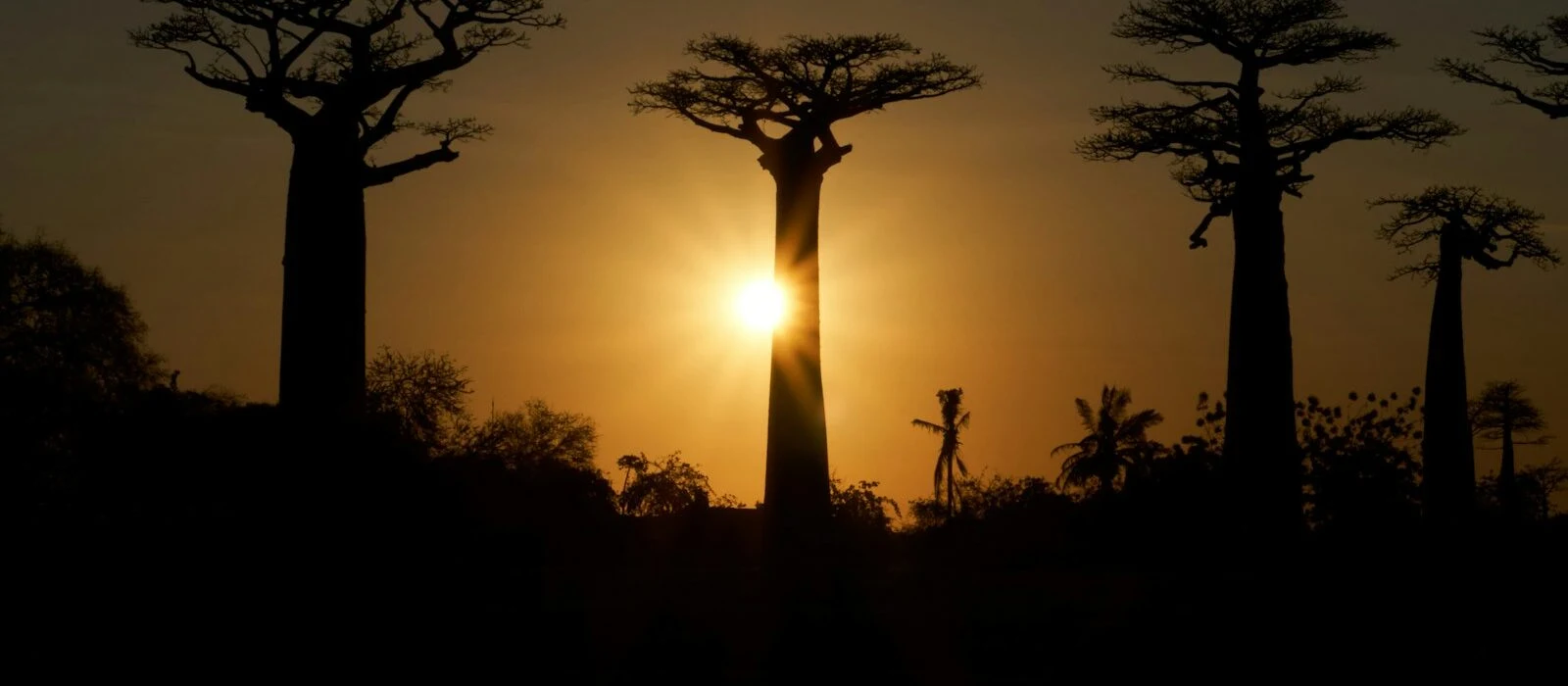
Geography falls into distinct bands. A spine of central highlands, home to Antananarivo and Antsirabe, drops to a narrow, humid rainforest strip along the east coast. The west is drier, with baobab country and river plains, while the far south is arid. The CIA World Factbook describes the climate as tropical along the coast, temperate inland and arid in the south.
Administratively the country is divided into 24 regions. Ivato International Airport, about 16 kilometres north-west of Antananarivo, handles most international arrivals.
For planning purposes, it helps to read the island as a set of regions. The central highlands around Antananarivo are the cultural and political heart, the eastern rainforest belt holds protected areas such as Andasibe-Mantadia and Ranomafana, and the west is known for the baobabs near Morondava and the Tsingy de Bemaraha. The arid south leads towards Isalo, while islands such as Nosy Be in the north-west and Île Sainte-Marie in the east add a coastal side to the map.
Introduction to Madagascar
Madagascar is a semi-presidential republic of roughly 31 million people, where Malagasy and French are the official languages and the currency is the Malagasy ariary. Long isolation has produced wildlife found nowhere else, including lemurs, and a culture that blends Southeast Asian, African and Arab influences.
Last checked: November 2026
Population estimates vary by source, from about 29.5 million in a 2024 estimate to around 32 million in a recent UN-based figure, so treat any single number as approximate. Antananarivo, known as Tana, is the political and economic hub, with a metropolitan population estimated near 3.9 million by the CIA World Factbook.
The island is best known for biodiversity. Its rainforests, dry forests and limestone landscapes shelter many species that exist only here, which is why wildlife travel is the main draw. UNESCO recognises three World Heritage Sites: the Tsingy de Bemaraha reserve (extended in 2023 as the Andrefana Dry Forests), the Royal Hill of Ambohimanga, and the Rainforests of the Atsinanana, which have been on the List of World Heritage in Danger since 2010.
Madagascar is also one of the world’s least-developed countries, so travel can be slow and facilities limited outside the main hubs. Domestic flights are often cancelled and road journeys take longer than distances suggest, which is why realistic planning matters.
Tourism here is closely tied to nature. Many visitors build a trip around a few protected areas and a short stay on the coast rather than a long list of towns, and licensed guides are recommended in the national parks. Outside the main cities, accommodation and services can be simple, so a flexible attitude is as useful as a good itinerary.
History of Madagascar
Madagascar was one of the last large habitable landmasses settled by humans, with early settlers arriving from Southeast Asia and later arrivals from Africa. Kingdoms developed in the highlands and on the coast before France conquered the island in 1896, and Madagascar regained independence on 26 June 1960.
Last checked: November 2026
The Malagasy language belongs to the Malayo-Polynesian family, a clue to the island’s Southeast Asian roots. Over the centuries, migrants from the African mainland and traders from across the Indian Ocean added to the mix, making Madagascar an important hub in transoceanic trade. Most Malagasy people today are of mixed heritage, spread across 18 main ethnic groups.
In the late 17th and early 18th centuries the island was a stronghold for pirates. During the 19th century the Merina kingdom of the central highlands extended its rule over much of the island, until French forces made it a colony in 1896.
Since independence the country has seen several periods of political instability, including a crisis between 2009 and 2013. In late 2025, protests over poor water and electricity services grew into a wider political crisis: the president was ousted, a military leader was sworn in, and the African Union suspended Madagascar’s membership. Always check current official advice before you travel.
Several threads from this past are still visible today. French remains an official language alongside Malagasy, a legacy of the colonial period that lasted from 1896 until independence in 1960. The Royal Hill of Ambohimanga, a UNESCO World Heritage Site inscribed in 2001, is the best-known reminder of the highland kingdoms that shaped the island before the French arrived.
Culture and Traditions of Madagascar
Malagasy culture blends Southeast Asian, African, Arab and French influences, united by a single Malagasy language spoken across the island. Ancestor veneration, local taboos known as fady and ceremonies such as famadihana shape daily life, while music, crafts and woodcarving express strong regional identities.
Last checked: November 2026
Respect for ancestors is central to Malagasy life. In parts of the highlands, families hold famadihana, often called the turning of the bones, in which ancestors’ remains are rewrapped in fresh cloth during a lively family gathering. Visitors should attend only by invitation or with a respectful local guide.
Fady are community taboos that differ from region to region and may restrict certain foods, days, places or actions. The UK FCDO advises visitors to learn about local fady, and asking your guide before entering a forest, village or sacred site is good practice.
Religious life mixes Christianity, indigenous beliefs and Islam, according to the CIA World Factbook. Creative traditions include the valiha, a bamboo tube zither, hiragasy performances in the highlands, and the intricate Zafimaniry woodcarving of the central-eastern highlands, which UNESCO recognises as intangible heritage. Independence Day on 26 June brings parades and festivities, especially in Antananarivo.
Language is another shared thread. Although regional dialects exist, Malagasy is understood across the island, and learning a few greetings is a courteous way to begin conversations with guides, drivers and hosts. Local markets and craft workshops are good places to see woodcarving and other handmade work, and buying directly from makers helps keep these traditions alive.
Food and Cuisine of Madagascar
Rice is at the centre of every Malagasy meal, served with a stew, leafy greens or grilled zebu. Signature dishes include romazava, ravitoto and vary amin’anana, with street snacks such as mofo gasy and sweet koba. Coastal areas add seafood and coconut, and sakay chilli sauce adds heat.
Last checked: November 2026
Meals usually pair rice with a main of meat, poultry or fish and a vegetable side, and the cooking is flavourful without being heavily spiced. Small local eateries called hotely serve everyday food, while markets are the best place for breakfast and snacks. Ten dishes worth looking for:
- Romazava: a stew of zebu or other meat with leafy greens, widely seen as the national dish.
- Ravitoto: pounded cassava leaves cooked with pork or zebu.
- Vary amin’anana: rice porridge cooked with leafy greens, often eaten at breakfast with grilled meat.
- Henakisoa: pork dishes that reflect the importance of pork in Malagasy cooking.
- Kitoza: seasoned strips of meat, grilled or dried, often served with vary amin’anana.
- Lasary: a fresh side dish served alongside main meals.
- Akoho sy voanio: chicken simmered in coconut milk, popular in coastal regions.
- Koba: a sweet of mashed banana and peanuts, often wrapped in banana leaf.
- Mofo gasy: small rice-flour cakes, a staple breakfast.
- Mofo anana: savoury fritters with leafy greens, a favourite street snack.
Eat where food is freshly cooked and busy, and ask for sakay on the side if you prefer mild dishes.
Most of these dishes are home cooking, so they often appear as the daily special in a hotely rather than on a fixed menu; if a dish is not listed, ask what is being served that day. Travellers who avoid pork should check ravitoto and henakisoa before ordering, and vegetarians can ask for greens-based dishes such as vary amin’anana without meat.
Ready to plan your trip? Start with the Madagascar visa requirements and the best time to visit Madagascar, then explore the best places to visit in Madagascar and our Madagascar itinerary ideas. For logistics, see where to stay in Madagascar, flights to Madagascar and how to get around Madagascar.
Explore Madagascar Travel Guides
Explore our detailed guides to plan every part of your Madagascar trip.
Madagascar: Best Places
A region-by-region look at Madagascar’s standout places, from heritage sites and wildlife parks to coastlines and cities, with access notes.
View Guide ›Madagascar: Best Time to Visit
Understand Madagascar’s seasons before you book: how climate differs between highlands, coast and south, and when wildlife, whales and festivals peak.
View Guide ›Madagascar: Flights
Your guide to reaching Madagascar by air: the main international airport, which airlines serve it, arrival tips and a short checklist before...
View Guide ›Madagascar: How to Get Around
Compare the ways to move around Madagascar, from domestic flights and shared taxis to trains and hired cars, with tips on picking...
View Guide ›Madagascar: Itineraries
Four sample routes through Madagascar, from a short highland break to a ten-day loop, built around realistic transfer times and sensible overnight...
View Guide ›Madagascar: Visa
What travellers should know before entering Madagascar: visa routes, passport rules, health entry checks, extensions and where to confirm the latest rules.
View Guide ›Madagascar: Hotels
A planning guide to accommodation in Madagascar covering where to base yourself, what each style of stay offers and how to book...
View Guide ›Explore Madagascar Tours
Discover guided tours and adventures in Madagascar. Compare itineraries, prices and traveller reviews on TourRadar before you book.
Guided tours & deals
Affiliate partner · Globe Navo may earn a commission from qualifying bookings at no extra cost to you.
❓ Madagascar FAQ
Where is Madagascar located?
Madagascar is an island country in the southwestern Indian Ocean, off the southeast coast of Africa and separated from Mozambique by the Mozambique Channel. It covers about 587,000 square kilometres and is generally ranked as the world fourth-largest island, with Antananarivo as its capital.
What languages are spoken in Madagascar?
Malagasy and French are the official languages, and Malagasy is spoken across the whole island. Malagasy belongs to the Malayo-Polynesian family, which reflects the settlement of Madagascar by people from Southeast Asia. The currency is the Malagasy ariary (MGA).
What is Madagascar known for?
Madagascar is best known for wildlife found nowhere else, including lemurs, living in rainforests, dry forests and limestone landscapes. It also has three UNESCO World Heritage Sites and a culture blending Southeast Asian, African, Arab and French influences.
What is the national dish of Madagascar?
Romazava, a stew of zebu or other meat with leafy greens, is widely seen as the national dish. It is usually served with rice, which sits at the centre of every Malagasy meal. Other favourites include ravitoto, vary amin anana and kitoza.
What are fady in Malagasy culture?
Fady are community taboos that differ from region to region and may restrict certain foods, days, places or actions. Visitors should ask their guide about local fady before entering a forest, village or sacred site, and follow local advice respectfully.
Plan Your Trip to Madagascar
Your Next Adventure in Madagascar Awaits!
Explore Deals →🎁 Best deals for Madagascar
Offers from trusted travel stores for your Madagascar trip. Compare a few options before you book, and check each store's terms for the final price.
Browse by type: Hotel deals · Flight deals · Travel eSIM · Car rental
More destinations to explore
MoldovaDiscover Moldova, a landlocked Eastern European country of rolling vineyards, medieval monasteries, Orthodox traditions…
 BulgariaPlan a trip to Bulgaria with top destinations, UNESCO sites, the best time to…
 MauritaniaA traveller's overview of Mauritania: its Sahara and Atlantic setting, ancient desert towns, Hassaniya…