 Guinea-BissauDiscover Guinea-Bissau: where this small West African country sits on the Atlantic coast, plus…
DESTINATION
Indonesia
Learn where Indonesia is, how its history unfolded, what shapes its culture and which dishes to try, with links to seven travel guides.
📅 Last updated:
🌍 Quick Facts

Indonesia at a glance

Capital: Jakarta (new capital Nusantara under construction)
Currency: Indonesian rupiah (IDR)
Language: Indonesian (Bahasa Indonesia)
Population: About 284 million (2025 estimate)
Time zone: UTC+7 (Western), UTC+8 (Central), UTC+9 (Eastern)
Calling code: +62
Internet domain: .id
Main airport: Soekarno-Hatta International (CGK), Jakarta; Ngurah Rai International (DPS), Bali
Best time to visit: Bali, Java and Komodo: Apr to Oct; Raja Ampat and Maluku: Oct to Apr
📍 Indonesia Map
🖼️ Indonesia: Location, History, Culture & Food
✨ Complete Travel Guide
Safety Notice: The US Department of State rates Indonesia Level 2, “Exercise Increased Caution”, citing terrorism and natural disasters. It advises Do Not Travel (Level 4) to the provinces of Central Papua (Papua Tengah) and Highland Papua (Papua Pegunungan) because of civil unrest. This applies to those two provinces only, not to the rest of the country, including Bali, Java and the other main tourist areas. Read the full text on the US Department of State’s Indonesia travel advisory and check your own government’s advice before you book. The UK FCDO also advises against all travel to parts of Indonesia, including exclusion zones around certain volcanoes and specific areas of Papua. Last checked: November 2026
Where Is Indonesia Located?
Indonesia is an archipelagic country in Southeast Asia, lying between the Indian and Pacific Oceans and straddling the equator. It shares land borders with Malaysia on Borneo, Papua New Guinea on New Guinea and Timor-Leste on Timor. Jakarta, on the island of Java, is its capital.
Last checked: November 2026
Indonesia is the world’s largest island country, with more than 17,000 islands scattered across a distance equal to roughly one-eighth of the globe’s circumference. Only about 6,000 of those islands are inhabited. The total area is around 1.9 million square kilometres, much of it sea, which is why distances here are measured in flights and ferry hours rather than road kilometres.
Five large landmasses make up most of the country: Sumatra, Java, Kalimantan (the Indonesian part of Borneo), Sulawesi and Papua (the western half of New Guinea). Between them lie smaller groups such as Bali, Lombok, Flores, the Maluku Islands and the Raja Ampat archipelago. Java covers only about 7 percent of the land but holds more than half of the population, including Jakarta on its northwestern coast.
Indonesia sits on the Pacific Ring of Fire, so it has hundreds of volcanoes, many of them active, and earthquakes are a regular part of life. Jakarta remains the working capital, while the government is building a new capital called Nusantara in East Kalimantan on Borneo, with the move being phased in over several years.
Introduction to Indonesia
Indonesia is a unitary presidential republic of more than 280 million people, the fourth most populous country in the world. Jakarta is the capital, Indonesian (Bahasa Indonesia) is the official language and the rupiah is the currency. Its national motto, Bhinneka Tunggal Ika, means “Unity in Diversity”.
Last checked: November 2026
That motto reflects a country made of hundreds of ethnic and language groups. Javanese is the largest group at around 40 percent of the population, followed by Sundanese and many others, and more than 700 regional languages are spoken alongside the national language. Indonesian is widely understood as a shared language, so visitors can expect it to work from Sumatra to Papua, even where local languages dominate at home.
Islam is the majority religion, followed by roughly 87 percent of Indonesians, which makes Indonesia the world’s most populous Muslim-majority country. Christian, Hindu and Buddhist communities are also significant, and Bali is a well-known Hindu island. Religious festivals, mosque calls to prayer, temple offerings and church services all form part of ordinary life, and the difference from one island to the next can be striking.
Independence was proclaimed on 17 August 1945, and Prabowo Subianto has been president since 2024. Visitors come for volcanoes, rainforest, coral reefs, ancient temples, surf beaches and lively cities, often combining several islands in one trip. Because each region has its own climate, customs and travel logistics, it helps to plan by island group rather than by country as a whole.
History of Indonesia
Indonesia’s history runs from the maritime kingdom of Srivijaya and the Hindu-Buddhist empire of Majapahit through Islamic sultanates and about 350 years of Dutch influence. Independence was proclaimed on 17 August 1945, the Netherlands recognised it in December 1949, and democratic reform began after President Suharto resigned in 1998.
Last checked: November 2026
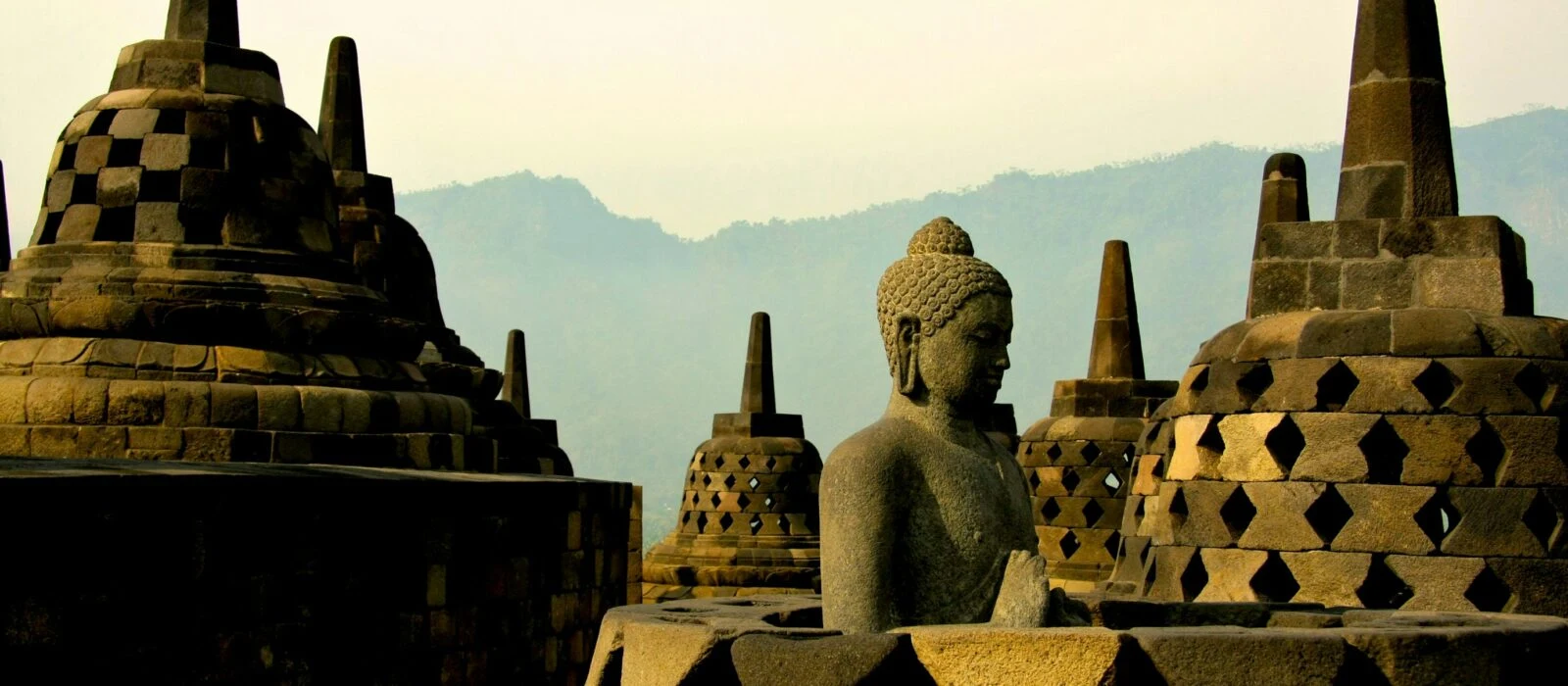
Long before European ships arrived, the archipelago sat on the sea route between India and China. Srivijaya, based on Sumatra, controlled trade through the Strait of Malacca from around the 7th century, while kingdoms on Java built great temples such as Borobudur and Prambanan. The Majapahit Empire, founded in East Java in 1293, became the most powerful state of the Hindu-Buddhist era and extended its influence across much of the archipelago. Islam spread through trading ports from the 13th century onward and became the dominant faith in most regions, although Bali kept its Hindu traditions.
The Portuguese arrived in 1512 in search of cloves, nutmeg and mace. The Dutch East India Company followed in 1602 and founded Batavia, today’s Jakarta, in 1619. The Dutch state took over from the company in 1800 and ruled the Dutch East Indies until the Second World War, including under the forced-cultivation system on Java in the 19th century. Resistance never stopped, and regions such as Aceh and Bali fought colonial control well into the early 20th century.
Japan occupied the islands in 1942. Two days after Japan’s surrender in 1945, Sukarno and Mohammad Hatta proclaimed independence in Jakarta, and a four-year National Revolution followed before Dutch recognition in 1949. Sukarno led the country until the mid-1960s, and Suharto’s “New Order” government then ruled for 32 years, bringing economic growth but tight political control.
The Asian financial crisis of 1997 and 1998 and mass protests forced Suharto to resign in May 1998. The Reformasi period that followed brought free elections, regional autonomy and, in 2004, the first direct presidential election. Many places that carry this heritage, from the temples of Central Java to the old port of Jakarta, are covered in our guide to the best places to visit in Indonesia.
Culture and Traditions of Indonesia
Indonesian culture blends hundreds of regional traditions held together by a shared language, the value of mutual cooperation (gotong royong) and strong religious life. Batik cloth, wayang shadow puppetry, gamelan orchestras, angklung and pencak silat are all on UNESCO’s intangible heritage lists. Customs differ from island to island, so local etiquette is worth learning.
Last checked: November 2026
On Java and Bali, much of the traditional arts revolve around gamelan, an ensemble of gongs and metal percussion that accompanies dance, ceremonies and wayang performances, where a puppeteer tells stories from the Ramayana and Mahabharata behind a lit screen. Batik, the wax-resist dyeing of cloth, is worn for formal occasions and everyday office wear, and the patterns of towns such as Yogyakarta, Solo and Pekalongan are each distinct. Bamboo angklung comes from West Java, the Saman dance from Aceh and the pinisi sailing ship from the Bugis of South Sulawesi.
Religious calendars shape the year. Muslims across the country observe Ramadan and celebrate Eid al-Fitr, known locally as Lebaran, when millions travel home to their families. In Bali, Hindu life is visible in daily offerings and temple ceremonies, and Nyepi, the Day of Silence, brings the island to a quiet stop for 24 hours each year. Christian communities celebrate Christmas and Easter, especially in North Sulawesi, North Sumatra, Flores and Papua.
Indonesians are generally polite and indirect, and a smile goes a long way. Use your right hand for giving and receiving, dress modestly at mosques and temples, remove shoes before entering homes and places of worship, and avoid pointing with your index finger. Because Ramadan, Lebaran and Nyepi can change opening hours and transport availability, check dates before you book.
Food and Cuisine of Indonesia
Indonesian food is built on rice, coconut, chilli, peanuts and aromatic spices, with each region adding its own character. In 2018 the government named five national dishes: nasi goreng, rendang, sate, gado-gado and soto. Sambal, a chilli relish, appears on almost every table, so ask for it on the side if you prefer less heat.
Last checked: November 2026
Meals are often served as many small shared dishes with rice, and eating from street stalls, warungs and food courts is part of daily life. Spice levels, sweetness and ingredients change as you move from Sumatra’s rich coconut curries to Java’s sweeter flavours and Bali’s herb-heavy dishes. Halal food is widely available across most of the country, while pork dishes are easier to find in Bali, North Sulawesi and Christian-majority areas.
Signature dishes worth looking for include:
- Nasi goreng: fried rice with sweet soy sauce, usually topped with a fried egg and pickles.
- Mie goreng: the stir-fried noodle counterpart, sold from street carts and restaurants alike.
- Rendang: beef slow-cooked in coconut milk and spices until dry and deeply flavoured, from the Minangkabau of West Sumatra.
- Sate: skewered, char-grilled meat served with peanut sauce or sweet soy, with regional versions such as Madura’s sate and Bali’s sate lilit.
- Gado-gado: blanched vegetables, egg, tofu and tempeh in peanut sauce.
- Soto: a family of fragrant soups, including soto betawi from Jakarta and soto lamongan from East Java.
- Nasi padang: steamed rice served with an array of curries, fried dishes and sambal.
- Bakso: meatball soup, often sold from pushcarts with noodles and fried shallots.
- Tempeh: fermented soybean cake from Java, served fried, braised or in stir-fries.
- Ayam betutu: a slow-cooked, spiced chicken or duck dish from Bali.
For drinks, try fresh juices, es teler (a coconut and fruit dessert drink), sweet iced tea and Indonesian coffee, which is grown on Sumatra, Java, Sulawesi and Bali. Street food is generally safe when it is cooked fresh and served hot, so choose busy stalls with high turnover.
Plan Your Trip to Indonesia
Use our detailed guides to turn this overview into a plan. Start with the Indonesia visa guide to check entry rules, then compare the best places to visit with the best time to visit Indonesia. Our 3, 5, 7 and 10 day itineraries show how to combine regions.
When you are ready to book, read about where to stay in Indonesia, flights to Indonesia and getting around Indonesia.
Explore Indonesia Travel Guides
Explore our detailed guides to plan every part of your Indonesia trip.
Indonesia: Best Places
The best places to visit in Indonesia, grouped by historic sites, nature, beaches, cities, culture, food and national parks, with time needed...
View Guide ›Indonesia: Best Time to Visit
When to visit Indonesia: dry and wet seasons, regional differences for Bali, Java, Komodo, Raja Ampat and Maluku, holidays, peak months and...
View Guide ›Indonesia: Flights
Which airports serve international flights to Indonesia, which airlines fly there, how to connect from different regions and what to prepare before...
View Guide ›Indonesia: Getting Around
How to travel between and within Indonesia's islands: domestic flights, trains, ferries, buses, driving rules, ride-hailing and city transport, with tips on...
View Guide ›Indonesia: Itineraries
Realistic Indonesia itineraries for 3, 5, 7 and 10 days, combining Bali, Yogyakarta, Mount Bromo and Komodo with sensible routes and overnight...
View Guide ›Indonesia: Visa
Who can enter Indonesia visa-free, who needs the 30-day visa on arrival, how to apply for the e-VOA, and what to complete...
View Guide ›Indonesia: Hotels
Where to stay in Indonesia: the best areas in Bali, Java and beyond, hotel types for every budget, family-friendly and halal-friendly options...
View Guide ›Explore Indonesia Tours
Discover guided tours and adventures in Indonesia. Compare itineraries, prices and traveller reviews on TourRadar before you book.
Guided tours & deals
Affiliate partner · Globe Navo may earn a commission from qualifying bookings at no extra cost to you.
❓ Indonesia FAQ
Where is Indonesia located?
Indonesia is an archipelago in Southeast Asia between the Indian and Pacific Oceans, straddling the equator. It shares land borders with Malaysia on Borneo, Papua New Guinea on New Guinea and Timor-Leste on Timor, and includes more than 17,000 islands.
What is the capital of Indonesia?
Jakarta, on the northwest coast of Java, is the capital and largest city. The government is building a new capital called Nusantara in East Kalimantan on Borneo and is phasing in the move, so Jakarta continues to serve as the working capital.
What language is spoken in Indonesia?
Indonesian (Bahasa Indonesia) is the official national language and is understood almost everywhere. More than 700 regional languages are also spoken, including Javanese, Sundanese and Balinese, so many Indonesians speak at least two languages.
What is the currency of Indonesia?
The Indonesian rupiah (IDR) is the currency. Prices are quoted in thousands, so a meal may cost tens of thousands of rupiah. Carry some cash for markets, small stalls and rural areas where cards may not be accepted.
What are the national dishes of Indonesia?
In 2018 the government named five national dishes: nasi goreng (fried rice), rendang (spiced coconut beef), sate (grilled skewers), gado-gado (vegetables in peanut sauce) and soto (soup). Many regional specialities, such as nasi padang and bakso, are equally popular.
Plan Your Trip to Indonesia
Your Next Adventure in Indonesia Awaits!
Explore Deals →🎁 Best deals for Indonesia
Offers from trusted travel stores for your Indonesia trip. Compare a few options before you book, and check each store's terms for the final price.
Browse by type: Hotel deals · Flight deals · Travel eSIM · Car rental
More destinations to explore
Guinea-BissauDiscover Guinea-Bissau: where this small West African country sits on the Atlantic coast, plus…
 GabonGabon is a rainforest and Atlantic-coast country in Central Africa. Learn where it is,…
 Côte d’IvoireCôte d'Ivoire travel guide covering where the country is, its history, culture, traditions and…