 IrelandIreland travel guide: where the country is, its history, culture and traditions, and signature…
DESTINATION
Guyana
📅 Last updated:
🌍 Quick Facts

Guyana at a glance
Capital: Georgetown
Currency: Guyanese dollar (GYD)
Language: English (official), Guyanese Creole
Population: About 800,000 (approximate)
Time zone: GYT (UTC-4)
Calling code: +592
Internet domain: .gy
Main airport: Cheddi Jagan International Airport (GEO)
Best time to visit: February to April and mid-August to November (dry seasons)
📍 Guyana Map
🖼️ Guyana: Location, History, Culture & Food
✨ Complete Travel Guide
Where Is Guyana Located?
Guyana is located on the northern coast of South America. It is bordered by the Atlantic Ocean to the north, Suriname to the east, Brazil to the south and southwest, and Venezuela to the west. Its capital, Georgetown, sits on the Atlantic coast at the mouth of the Demerara River.
Last checked: November 2026
The country covers about 215,000 square kilometres (roughly 83,000 square miles) and has a coastline of around 459 kilometres, which makes it one of the smaller nations on the continent. Although it lies on the mainland, Guyana identifies culturally with the English-speaking Caribbean and is a member of CARICOM, whose secretariat is based in Georgetown.
Geographically, Guyana falls into distinct zones. A narrow, fertile coastal plain holds roughly nine in ten Guyanese, and much of it sits near sea level behind sea defences and dikes. Further inland, belts of white sand and clay hills give way to dense rainforest, the Pakaraima and Kanuku mountain ranges, and the open savannas of the south.
The name Guyana is commonly translated as “Land of Many Waters”, and rivers shape the landscape everywhere. The Essequibo, at around 1,000 kilometres, is the longest, while Mount Roraima, near the point where Guyana, Venezuela and Brazil meet, is the highest point at roughly 2,750 metres.
Introduction to Guyana
Guyana is a small English-speaking country on the northern coast of South America, known for Kaieteur Falls, vast rainforest, wildlife-rich savannas and a Caribbean-influenced culture. Its capital is Georgetown, its currency is the Guyanese dollar (GYD), and English is the official language.
Last checked: November 2026
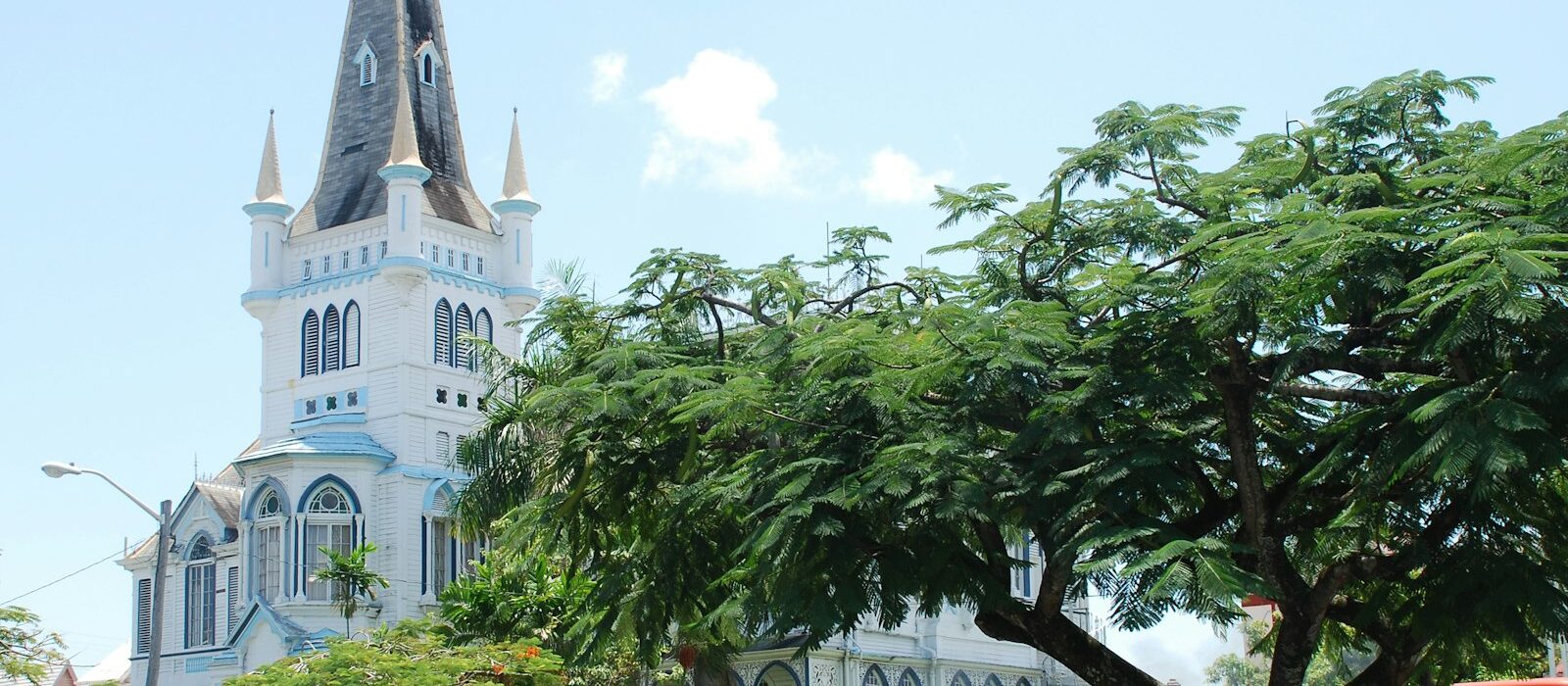
Guyana is the only country in South America where English is the official language, a legacy of its past as British Guiana. Roughly 800,000 people live here, which gives it one of the lowest population densities on the continent, and most of them live along the Atlantic coast. Georgetown, the capital and largest city, is known for its colonial architecture, the busy Stabroek Market and its sea wall.
The interior is the main draw for visitors. Kaieteur Falls, on the Potaro River, drops roughly 225 metres in a single plunge inside Kaieteur National Park, surrounded by forest. The Iwokrama rainforest and the Rupununi savannas are known for birdwatching and wildlife, while Shell Beach on the northwest coast is a nesting area for sea turtles. These places are remote, and many are reached only with a local operator.
Guyana suits travellers who want nature, small-scale eco-lodges and cultural variety rather than resort holidays. The population includes Indo-Guyanese, Afro-Guyanese, Indigenous peoples and communities of European and Chinese descent, and this mix shapes everything from festivals to the dinner table. The sections below look at the country’s history, culture and food, and our planning guides cover Guyana visa requirements, the best places to visit, the best time to visit, sample itineraries, where to stay, flights to Guyana and getting around the country.
History of Guyana
Guyana’s history runs from the Indigenous Arawak and Carib peoples through Dutch and British colonial rule to independence on 26 May 1966 and republic status on 23 February 1970. Sugar plantations, enslaved African labour and later Indian indentured workers shaped the population that Guyana has today.
Last checked: November 2026
Long before Europeans arrived, the area was home to Arawak (Lokono) and Carib (Kalina) peoples, who gave the region the name Guiana, usually translated as “land of many waters”. Nine Indigenous nations are recognised in Guyana today, including the Wapishana, Macushi, Patamona and Akawaio. The Dutch were the first Europeans to settle permanently, founding the colonies of Essequibo, Berbice and Demerara, where enslaved Africans worked on coffee, cotton and sugar estates.
Britain took control during the wars of the late 18th century, and the Dutch formally ceded the colonies in 1814. They were merged into a single colony, British Guiana, in 1831. Slavery was abolished in the 1830s, after which indentured labourers, most of them from India, were brought in under contracts that lasted until 1917. A monument in Georgetown commemorates the 1763 slave uprising led by Cuffy, which remains a national symbol of resistance.
Local self-government began in 1953, and British Guiana became independent in May 1966. The country declared itself a republic on 23 February 1970, the anniversary of the 1763 uprising, and it joined CARICOM in 1973. The legacy of this layered past is still visible in Guyana’s languages, religions, architecture and borders.
Culture and Traditions of Guyana
Guyanese culture blends Indigenous, African, Indian, European and Chinese influences, and it shows in the country’s festivals, music and faiths. Mashramani, Phagwah, Diwali, Eid and Emancipation Day are shared celebrations, while cricket, Creole speech and Caribbean music tie communities together.
Last checked: November 2026
Christianity, Hinduism and Islam are all widely practised, and the national holiday calendar reflects that. Mashramani, held around Republic Day on 23 February, is the biggest street celebration, with costume parades, steel drums and calypso, and its name comes from an Indigenous word. Hindu communities mark Phagwah (Holi) in spring and Diwali in autumn, Muslim communities celebrate Eid, and Emancipation Day on 1 August honours African heritage. Indian Arrival Day on 5 May and Amerindian Heritage Month in September recognise the other roots of the nation.
Everyday language and music carry the same mix. English is the official language, but most people speak Guyanese Creole at home, and Indigenous languages such as Wapishana, Macushi and Akawaio are still spoken in the interior. Calypso, soca, reggae and steelpan sit alongside Indian devotional and film music. In the Rupununi, the Easter rodeo in Lethem shows a ranching tradition that is very different from the coast.
Cricket is the national passion. Guyanese players have long featured in the West Indies team, and Guyana hosted matches during the 2007 Cricket World Cup. Hospitality matters as much as sport, so visitors are often welcomed with food, conversation and a good deal of teasing humour. Respectful behaviour at religious sites and in Indigenous villages is appreciated everywhere.
Food and Cuisine of Guyana
Guyanese cuisine combines Indigenous, African, Indian, Portuguese, Chinese and British influences into hearty, spice-led dishes. Pepperpot, cook-up rice, curry with roti, metemgee and bake with saltfish are the best-known meals, and chilli pepper sauce usually sits on the table.
Last checked: November 2026
Because several communities shaped the national table, one meal can bring Indian curry, African-rooted one-pot cooking and Chinese noodles together. Rice, cassava, plantain, coconut milk and fresh seafood are everyday staples, while cassareep, a savoury syrup made from cassava, gives pepperpot its dark colour and flavour. Many dishes are tied to a season or occasion, so Christmas, Eid, Diwali and Phagwah each bring their own specialities.
Signature Guyanese dishes to try
- Pepperpot: a slow-cooked meat stew flavoured with cassareep and spices, traditionally served at Christmas.
- Cook-up rice: a one-pot dish of rice, peas or beans, coconut milk and meat.
- Metemgee: a coconut-based stew of root vegetables, plantain and dumplings.
- Curry and roti: chicken, duck, goat or fish curry eaten with soft flatbread.
- Dhal puri: a flatbread filled with ground split peas, often served with curry.
- Bake and saltfish: fried dough with sautéed salted cod, a classic breakfast.
- Guyanese chow mein: stir-fried noodles with vegetables and meat, adapted from Chinese cooking.
- Garlic pork: a Portuguese-influenced dish of marinated pork, popular at Christmas.
- Pholourie: small fried split-pea dough balls served with a tangy chutney.
- Black cake: a dark, rum-soaked fruit cake baked for Christmas and celebrations.
For drinks, try ginger beer, sorrel or peanut punch, and if you enjoy rum, ask about locally produced bottles. Georgetown’s markets and puri shops are good places to sample home-style cooking, while eco-lodges in the interior usually serve set meals with local ingredients.
Safety Notice
The US State Department currently rates Guyana Level 3, “Reconsider travel”, because of crime, and advises using only Guyana Tourism Authority-approved tour companies. It does not advise against travel to any specific region. Check the latest advice on travel.state.gov and the UK FCDO website before you travel. Last checked: November 2026.
Explore Guyana Travel Guides
Explore our detailed guides to plan every part of your Guyana trip.
Guyana: Best Places
The best places to visit in Guyana, from Georgetown's colonial landmarks to Kaieteur Falls, the Iwokrama rainforest, the Rupununi and Shell Beach.
View Guide ›Guyana: Best Time to Visit
When to visit Guyana: the two dry seasons, month-by-month rainfall and temperatures, regional differences, festivals and packing advice.
View Guide ›Guyana: Flights
Flights to Guyana: the main airports, airlines and routes from North America, the Caribbean, Europe and South America, plus arrival tips and...
View Guide ›Guyana: Getting Around
How to get around Guyana: domestic flights, interior roads, ferries and boats, minibuses, taxis, car rental, driving rules and the best option...
View Guide ›Guyana: Itineraries
Realistic Guyana itineraries for 3, 5, 7 and 10 days, with routes, overnight stops, verified travel times and practical planning advice.
View Guide ›Guyana: Visa
Who can enter Guyana without a visa, what a visitor visa costs, passport rules, extensions and the official sources to check before...
View Guide ›Guyana: Hotels
Where to stay in Guyana: the best areas of Georgetown, interior eco-lodges, options by budget and family needs, taxes and booking tips.
View Guide ›Explore Guyana Tours
Discover guided tours and adventures in Guyana. Compare itineraries, prices and traveller reviews on TourRadar before you book.
Guided tours & deals
Affiliate partner · Globe Navo may earn a commission from qualifying bookings at no extra cost to you.
❓ Guyana FAQ
Where is Guyana located?
Guyana is on the northern coast of South America, bordered by the Atlantic Ocean, Suriname, Brazil and Venezuela. Its capital, Georgetown, lies at the mouth of the Demerara River, and most of the population lives on the narrow coastal plain.
What language is spoken in Guyana?
English is the official language, making Guyana the only English-speaking country in South America. Most people also speak Guyanese Creole, and Indigenous languages such as Wapishana, Macushi and Akawaio are still used in the interior.
What currency does Guyana use?
Guyana uses the Guyanese dollar (GYD). Prices in Georgetown shops and markets are quoted in GYD, although some tour operators and lodges also quote in US dollars, so confirm the currency before booking.
What is Guyana best known for?
Guyana is best known for Kaieteur Falls, one of the world's tallest single-drop waterfalls, plus vast rainforest, the Rupununi savannas and rich wildlife. Its Caribbean-influenced culture and mix of communities also set it apart from other South American countries.
What are the main Guyanese dishes to try?
Pepperpot, cook-up rice, curry with roti, metemgee and bake with saltfish are the best-known dishes. They reflect Indigenous, African, Indian, Portuguese and Chinese influences, and pepper sauce is usually served on the side.
Plan Your Trip to Guyana
Your Next Adventure in Guyana Awaits!
Explore Deals →🎁 Best deals for Guyana
Offers from trusted travel stores for your Guyana trip. Compare a few options before you book, and check each store's terms for the final price.
Browse by type: Hotel deals · Flight deals · Travel eSIM · Car rental
More destinations to explore
IrelandIreland travel guide: where the country is, its history, culture and traditions, and signature…
 EthiopiaEthiopia is a landlocked country in the Horn of Africa, known for ancient heritage,…
 BeninBenin is a West African country known for Vodun culture, the Royal Palaces of…