Last checked: October 2026
Safety note: street crime is common in tourist areas and strikes can disrupt trains. See the Belgium travel guide before you plan.
What are the best places to visit in Belgium?
The best places to visit in Belgium are Brussels, Bruges, Ghent and Antwerp for city sightseeing, plus UNESCO-listed béguinages, belfries and mining sites for heritage. Wallonia adds Liège, Namur and the Ardennes. Because trains are frequent, most places work as day trips from Brussels. Our guide to getting around Belgium covers tickets, city transport and journey planning.
Quick comparison: train time and time needed
| Place | Fastest direct train from Brussels | Time to allow |
|---|---|---|
| Brussels | Base | 2 days |
| Ghent | 35 minutes | 1 day |
| Antwerp | 41 minutes | 1 day |
| Bruges | 1 hour 1 minute | 1 day or an overnight stay |
| Liège | 55 minutes | Half to a full day |
| Namur | 1 hour 1 minute | Half to a full day |
| Mons | 51 minutes | Half to a full day |
| Ostend | 1 hour 17 minutes | Half to a full day |
Journey times come from the national railway SNCB/NMBS. Real times vary with the train you catch.
Which cities are worth visiting?
Brussels
Brussels is the capital and the centre of the Belgian rail network. The Grand-Place is a World Heritage square surrounded by guildhalls and the Gothic Town Hall. The city also has Art Nouveau townhouses by Victor Horta and Stoclet House, which UNESCO recognises. The Atomium is another landmark that the official city pass includes.
Bruges
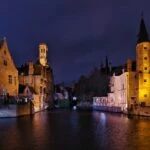
The Historic Centre of Brugge was inscribed in 2000. Canals, the belfry and compact lanes make it easy to explore on foot. The city is also home to one of the Flemish béguinages on the UNESCO list.
Ghent and Antwerp
Ghent is Belgium’s third-largest city after Brussels and Antwerp, with a large university population. Antwerp is a port city, and the Plantin-Moretus house-workshops-museum there is described by UNESCO-listing guides as the only museum on the World Heritage List.
Leuven and Mechelen
Both towns have Flemish béguinages that are part of the 1998 UNESCO inscription, and both are a short train ride from Brussels. They suit a quieter day than Bruges or Ghent.
Which heritage sites should you prioritise?
- Flemish Béguinages (1998): 13 sites including Bruges, Ghent, Leuven, Mechelen and Lier.
- La Grand-Place, Brussels (1998): the city’s central square.
- Four Lifts on the Canal du Centre (1998): historic boat lifts at La Louvière and Le Roeulx.
- Belfries of Belgium and France (1999, extended 2005): 33 of the 56 belfries are in Belgium.
- Neolithic flint mines at Spiennes and Notre-Dame Cathedral in Tournai (2000): both are in Wallonia.
- Major Mining Sites of Wallonia (2012): Grand-Hornu, Bois-du-Luc, Bois du Cazier and Blegny-Mine.
- First World War funerary and memory sites: a Western Front property that UNESCO lists for Belgium and France.
Check the current list on the UNESCO World Heritage Centre page for Belgium.
Where is the best nature and countryside?
Wallonia’s Ardennes is the main upland area. It is more seasonal than Flanders, and some attractions close in winter, so April to October is the safer window. In spring, forests such as Hallerbos near Brussels are known for carpets of wild blue flowers, though bloom timing changes with the weather. The coast around Ostend is the other regional option.
What food and drink experiences are worth planning?
Belgian beer culture is on UNESCO’s intangible heritage list, so a brewery visit or traditional café is a good cultural stop. Chocolate shops are especially concentrated around the Grand-Place and Sablon area, and waffles and fries are easy to find. In Brussels, the official Brussels Card gives free entry to 48 museums and discounts on attractions, with optional public transport.
Which places should you choose? A decision guide
- Choose Bruges if you want the classic medieval canal-town day.
- Choose Ghent if you prefer a livelier, less polished city.
- Choose Antwerp if you like museums, fashion and port-city energy.
- Choose Leuven or Mechelen for a short, calm day with béguinages.
- Choose Mons, Tournai or the mining sites if UNESCO heritage and industrial history interest you.
- Choose Liège or Namur if you want Wallonia without a long journey.
Common mistakes
- Treating Bruges as the only highlight and skipping Ghent or Antwerp.
- Forgetting that strike days can cut train services sharply, so check before you travel.
- Leaving valuables in a bag at station platforms or crowded squares.
- Heading to the Ardennes in winter without checking what is open.
Best places in Belgium FAQs
How many days do you need in Belgium?
Four to seven days works for a first visit. Two days in Brussels plus day trips to Bruges, Ghent and Antwerp cover the headline sights. Add Leuven, Mons or Liège if you have a week or more. See our Belgium itineraries.
Is Bruges worth visiting?
Yes, especially if you want a compact medieval centre that UNESCO listed in 2000. It is about an hour from Brussels by train. It gets busy in peak season, so go early or stay overnight to enjoy the quieter hours.
What are Belgium’s UNESCO sites?
They include the Flemish Béguinages, the Grand-Place in Brussels, the Canal du Centre boat lifts, the Belfries, Bruges’ historic centre, Horta’s town houses, Spiennes flint mines, Tournai cathedral and the Wallonia mining sites. Check UNESCO for the current list.
Can you visit Ghent and Bruges in one day?
It is possible by train, but it makes a rushed day. Ghent is 35 minutes from Brussels and Bruges about an hour. Most travellers get more from either city by giving each a half to a full day.