 Malaysia
DESTINATION
Belgium
A Belgium travel guide to the country's location, history, culture and food, from Brussels and Bruges to Wallonia and the North Sea coast.
📅 Last updated:
Belgium: Hotels · Flights · Visa Guide · Deals
🌍 Quick Facts

Belgium at a glance
🏛️
Capital: Brussels
💱
Currency: Euro (EUR)
💬
Language: Dutch, French and German
👥
Population: About 11.9 million
🕒
Time zone: Central European Time (UTC+1, UTC+2 in summer)
📞
Calling code: +32
🌐
Internet domain: .be
✈️
Main airport: Brussels Airport (BRU)
★
Best time to visit: April to June and September to October
Food
- Waffles
- Chocolate
- Fries
- Carbonnade flamande
- Belgian beer
Places
- Grand-Place, Brussels
- Historic Centre of Bruges
- Atomium
- Gravensteen, Ghent
- Plantin-Moretus Museum, Antwerp
- Dinant
Weather
Mild and changeable, with rain possible all year
Culture
Medieval cities, beer culture, chocolate and carnivals
Cities
- Brussels
- Bruges
- Ghent
- Antwerp
- Liège
📍 Belgium Map
📷 Photos of Belgium
Explore Belgium Travel Guides
Explore our detailed guides to plan every part of your Belgium trip.
🗺️
Belgium: Itineraries
Realistic Belgium itineraries for 3, 5, 7 and 10 days by train from Brussels, with real journey times, getting around tips and...
View Guide › 🛂Belgium: Visa
Who can enter Belgium without a visa, how the Schengen C visa works, and what to know about EES, ETIAS and the...
View Guide › 📍Belgium: Best Places
The best places to visit in Belgium grouped by cities, UNESCO heritage, nature and food, with train times from Brussels and how...
View Guide › 🌤️Belgium: Best Time to Visit
When to visit Belgium month by month, with weather by region, festivals, Christmas market dates, what to pack and the best months...
View Guide › ✈️Belgium: Flights
Which airport to use for flights to Belgium, how to reach Brussels by train or bus, strike risks and a Before You...
View Guide › 🚆Belgium: Getting Around
How to get around Belgium by train, tram, bus, car and taxi, with journey times between main cities, ticket tips and a...
View Guide › 🛌Belgium: Hotels
Where to stay in Belgium: the best areas in Brussels and other cities, types of accommodation, family and halal notes, and booking...
View Guide ›🖼️ Belgium: Location, History, Culture & Food
✨ Complete Travel Guide
Where Is Belgium Located?
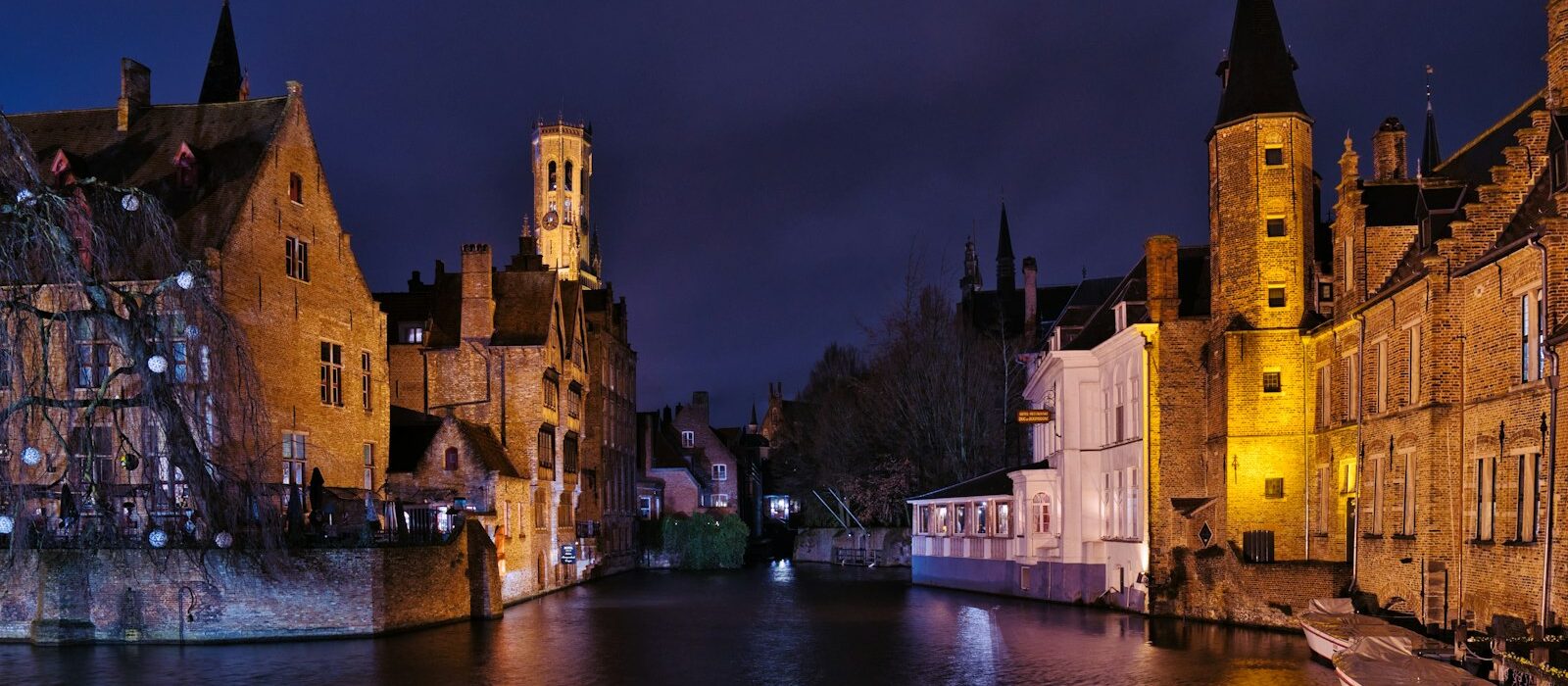
Belgium is a country in Western Europe, and this Belgium travel guide starts with where it sits. It borders France, Germany, Luxembourg and the Netherlands, and its short coast faces the North Sea. The capital, Brussels, lies in the middle of the country.
Last checked: November 2026
Statbel, the Belgian statistics office, puts the total area at about 30,690 square kilometres in 2025. The Flemish Region in the north covers about 13,626 square kilometres, the Walloon Region in the south about 16,901, and the Brussels-Capital Region only 162.
The land is low and flat in the northwest, where polders and sandy beaches meet the sea. It rises gently across the central plateau to the forested hills of the Ardennes in the southeast. The Scheldt and the Meuse are the two main rivers, and both shaped cities along their banks, from Antwerp and Ghent to Namur and Dinant.
Belgium keeps Central European Time (UTC+1), and clocks move to UTC+2 in summer. Our Belgium itineraries show how to plan a first visit, and our guide to getting around Belgium covers trains, trams and driving. Most long-haul visitors land at Brussels Airport, which our flights to Belgium guide explains.
Belgium Travel Guide: What Is the Country Known For?
Belgium is known for medieval cities such as Bruges and Ghent, the Grand-Place in Brussels, and a food culture built on beer, chocolate, waffles and fries. It also hosts the headquarters of the North Atlantic Treaty Organization (NATO) and many European Union institutions. It is a densely populated country with three official languages and a federal system.
The official languages are Dutch, French and German, and the currency is the euro. Belgium is a federal parliamentary constitutional monarchy, and Brussels is its capital. Statbel counted 11,867,634 residents on 1 January 2026, so the population is about 11.9 million. The Brussels-Capital Region accounts for about 1.26 million of them. That figure covers the whole region, not the city centre, and the City of Brussels itself covers only 33 square kilometres.
The country has three regions, Flanders, Wallonia and Brussels-Capital, and three language communities: Flemish, French and German-speaking. Each has its own powers, which is why signs, schools and place names change by area. A common misunderstanding is that Flemish is a separate language. People in Flanders speak Dutch with regional accents and words, and the written standard is the same as in the Netherlands.
Entry rules depend on your passport, and our Belgium visa guide for tourists explains who can visit without a visa. Heritage sites sit close together here, so many travellers combine several in one trip. Our guide to the best places to visit in Belgium groups them by type.
Belgium History: From Roman Conquest to a Federal State
Belgium has existed as an independent state since 1830, but its history is much older. Roman armies conquered the Belgae tribes around 57 BC, the area later passed through Burgundian, Spanish, Austrian and French rule, and the modern country emerged from a revolution against Dutch rule in 1830 and 1831.
Early Settlement and Roman Rule
Celtic tribes settled the region from about 500 BC, and the first coins appeared around 150 BC. Julius Caesar’s campaigns brought the Belgae under Roman control, and the area became part of the province of Gallia Belgica. Tongeren, in the east, is often described as Belgium’s oldest town. After the Western Roman Empire fell, Germanic tribes, especially the Franks, settled the land.
Medieval Cities and the Burgundian Netherlands
Cloth production made Ghent and Bruges major trading centres in the Middle Ages, and Antwerp grew into another leading city. In the 15th and 16th centuries the Burgundian Netherlands united many of the territories that make up today’s Belgium. The Habsburg dynasty inherited the region after the Burgundian line ended.
Foreign Rule, 1568 to 1815
The southern provinces stayed under Spanish control during the Eighty Years’ War, which began in 1568. The Peace of Utrecht gave them to the Austrian Habsburgs in 1713, creating the Austrian Netherlands. Revolutionary France annexed the territory in 1795. After Napoleon’s defeat at Waterloo, just south of Brussels, on 18 June 1815, the Congress of Vienna joined the region to the Netherlands under King William I.
Independence and the Colonial Era
A revolution began in August 1830, and the provisional government declared independence on 4 October 1830. The National Congress adopted a constitution on 7 February 1831. Leopold I of Saxe-Coburg took the oath as the first King of the Belgians on 21 July 1831, the date now kept as Belgium’s National Day. The Netherlands accepted independence in the Treaty of London on 19 April 1839.
In 1885 King Leopold II took personal control of the Congo Free State. An international outcry over abuses there forced the Belgian state to annex it in 1908 as the Belgian Congo. The Congo became independent in 1960, and Ruanda-Urundi followed two years later.
Two World Wars and a Federal State
Germany invaded Belgium in 1914 and again in 1940, and the German-speaking areas around Eupen and Malmedy joined Belgium after the First World War. Belgium was a founding member of NATO, and Brussels now hosts the alliance’s headquarters. Between 1970 and 1993 a series of constitutional reforms turned the unitary state into a federal one. The federal portal belgium.be has a longer timeline of the country since 1830.
Culture in Belgium: Languages, Festivals, Etiquette and Arts
Culture in Belgium is shaped by its three official languages, its Catholic traditions, a strong local festival calendar and a long record in painting, comics and music. Daily life differs between Flanders, Wallonia and Brussels, so customs and language change as you cross regional lines.
Language
Dutch is the main language in Flanders and French in Wallonia, while Brussels is officially bilingual in French and Dutch. German is official too. The German-speaking Community in the east had about 77,500 residents in 2019, according to the European Commission’s Eurydice network, which is around 0.7 percent of the national population.
Religion
Belgium has no official state religion. Christianity, mainly Catholicism, is the largest tradition and shapes public holidays such as Ascension Day. The country also has Muslim, Protestant, Orthodox and Jewish communities.
Festivals
Many festivals are tied to a single town and a fixed date in the church or civic calendar. UNESCO lists several as intangible heritage:
- Carnival of Binche: held on the Sunday, Monday and Tuesday before Ash Wednesday, with costumed performers called Gilles, and listed by UNESCO in 2008.
- Procession of the Holy Blood, Bruges: held every Ascension Day and listed by UNESCO in 2009.
- Ommegang of Brussels: a historical procession and popular festival, listed by UNESCO in 2019.
- Shrimp fishing on horseback, Oostduinkerke: a coastal tradition listed by UNESCO in 2013.
National Day falls on 21 July and marks Leopold I’s oath in 1831. Exact dates change each year, so our guide to the best time to visit Belgium lists what falls in each month.
Etiquette
Greetings are polite but relaxed. A handshake is usual in formal settings, and friends often greet each other with cheek kisses, with the number varying by region. Do not assume everyone speaks French. In Flanders, a polite question in English usually works better than starting in French. Menu prices normally include service, so tipping is optional, and rounding up the bill is a friendly gesture.
Music and Arts
Belgian painting stretches from Jan van Eyck, who completed the Ghent Altarpiece in 1432, to Pieter Bruegel the Elder and Peter Paul Rubens, who worked in Antwerp, and René Magritte. Victor Horta’s Art Nouveau townhouses in Brussels are on UNESCO’s World Heritage list. Adolphe Sax, born in Dinant in 1814, invented the saxophone, and Belgian musicians later made jazz their own. Hergé’s Tintin, first published in 1929, helped make comics a major art form here.
Food and Drink in Belgium: Dishes, Waffles, Chocolate and Beer
Belgian food is hearty and built around potatoes, beef, seafood and beer, with clear differences between Flanders, Wallonia and Brussels. Fries, waffles, chocolate and beer are the best-known staples, and many classic dishes are stews or seafood from the North Sea coast.
Staples
Potatoes come as fries, mash or gratins, and beef is often slow-cooked in beer or stock. Chicory, known as endive or witloof, is a common winter vegetable.
Signature Dishes
- Moules-frites: mussels cooked in broth and served with fries.
- Carbonnade flamande: beef stewed slowly in Belgian beer with onions, with a sweet and sour taste.
- Waterzooi: a creamy chicken or fish stew from Ghent, thickened with egg yolks and cream.
- Stoemp: mashed potatoes mixed with vegetables such as carrots or leeks, often served with sausage.
- Boulets à la liégeoise: pork and beef meatballs in a sweet and tangy sauce made with Liège syrup.
- Chicons au gratin: endive wrapped in ham and baked in a creamy cheese sauce.
- Grey shrimp croquettes: crisp fried croquettes filled with small North Sea shrimp.
- Vol-au-vent: a puff pastry case filled with chicken and mushrooms in a creamy sauce.
- Filet américain: seasoned raw minced beef, usually spread on bread.
- Paling in het groen: eel simmered in a green herb sauce, a traditional dish in Flanders.
Regions cook differently. Flanders favours beer stews and coastal seafood, Wallonia is linked to Liège dishes such as boulets and fruit syrup, and Brussels is known for stoemp and waffles. Beer appears in dishes such as carbonnade, so ask about ingredients if you avoid alcohol. If you plan to cook for yourself or need halal options, our guide on where to stay in Belgium covers areas and types of stay.
Street Food
Fries are sold hot in paper cones, and Belgians usually eat them with mayonnaise, though many other sauces are available. Waffles come warm from stands and cafés, and they are the other everyday street snack.
Drinks
UNESCO added Belgian beer culture to its intangible heritage list on 30 November 2016. The listing covers the culture of brewing, serving and enjoying beer, not only the beer itself. Around 1,500 types of beer are produced in the country. Styles include pale ales, lambics, Flemish red ales, sour brown ales, strong ales and stouts.
Desserts
- Brussels waffle: rectangular, light and crisp, usually dusted with powdered sugar or topped with fruit and cream.
- Liège waffle: smaller, denser and sweeter, with caramelised pearl sugar baked into the dough.
- Speculoos: a crisp, spiced biscuit with a caramel flavour, eaten with coffee or spread on toast.
There is no single "Belgian waffle" in Belgium, only these two main kinds, so ask which one a stand sells. Chocolate shops cluster around the Grand-Place and Sablon area in Brussels, and many sell pralines by weight.
Explore Hotels & Flights
Search accommodation and flights for your destination with Expedia. Compare available options and continue to Expedia to complete your booking.
Affiliate partner · Globe Navo may earn a commission from qualifying bookings at no extra cost to you.
❓ Belgium FAQ
Do I need a visa to visit Belgium?
UK, US, Canadian and Japanese citizens, among others, can visit without a visa for up to 90 days in any 180-day period under Schengen rules. Other nationalities may need a Schengen visa. Check the Belgian Foreign Affairs website before you book.
Is Belgium safe to visit?
The US State Department rates Belgium Level 2, exercise increased caution, citing crime, terrorism and unrest. Pickpocketing is common at stations and crowded places, and strikes can disrupt transport. Neither the US nor the UK lists a part of Belgium to avoid.
What is the best time to visit Belgium?
April to June and September to October are the most comfortable months, with mild days and fewer crowds than midsummer. Winter brings Christmas markets and quiet museums. Weather can change quickly, so pack layers and a rain jacket in any season.
How many days do you need in Belgium?
Four to seven days works well, based in Brussels or Bruges. Trains link Brussels with Ghent in about 35 minutes, Antwerp in about 41 minutes and Bruges in about an hour, so day trips are easy.
Which airport should I fly into for Belgium?
Most international visitors use Brussels Airport (BRU), which has a direct rail link to the main Brussels stations. Brussels South Charleroi Airport is further out and needs a bus and train or a shuttle. Check strike notices before airport transfers.
Plan Your Trip to Belgium
Your Next Adventure in Belgium Awaits!
Explore Deals →🎁 Best deals for Belgium
Offers from trusted travel stores for your Belgium trip. Compare a few options before you book, and check each store's terms for the final price.
Browse by type: Hotel deals · Flight deals · Travel eSIM · Car rental
 KkdayFind current Kkday coupons and deals for tours, attraction tickets, transport and first app orders. See minimum spend, discount caps and exclusions before you book.
Get Coupon View Deal
 eSIMFOXeSIMFOX is a travel eSIM provider offering prepaid mobile data plans for single countries and wider regions, delivered digitally so you can connect as soon as you land.
Get Coupon View Deal
 QuibityQuibity is a travel eSIM provider that lets you buy a mobile data plan online and activate it on your phone, so you can get connected abroad without a physical SIM card.
Get Coupon View Deal
 ExpediaDiscover great deals on hotels, flights, vacation packages, car rentals, and activities with Expedia. Compare travel options and plan your next trip with convenient booking choices.
Get Coupon View Deal
 KlookKlook is a travel activities platform where you can book attraction tickets, tours, day trips, transport passes, airport transfers and local experiences in destinations worldwide.
Get Coupon View Deal
 Trip.comTrip.com is a global online travel platform for flights, hotels, train tickets, airport transfers, attraction tickets and travel packages, available on web and mobile app.
Get Coupon View Deal
 TourRadarTourRadar is an online marketplace for multi-day guided tours, small-group trips and tailor-made journeys offered by independent tour operators around the world.
Get Coupon View Deal