 CyprusCyprus travel guide covering where the island is, how it is governed, its history,…
DESTINATION
Kuwait
Discover Kuwait: where it is, its history, culture and traditions, and signature dishes, with links to every travel guide.
📅 Last updated:
🌍 Quick Facts
Kuwait at a glance
Capital: Kuwait City
Currency: Kuwaiti dinar (KWD)
Language: Arabic (official); English widely used
Population: About 5.1 million (PACI, June 2025)
Time zone: UTC+3 (Arabia Standard Time)
Calling code: +965
Internet domain: .kw
Main airport: Kuwait International Airport (KWI)
Best time to visit: November to March
📍 Kuwait Map
🖼️ Kuwait: Location, History, Culture & Food
✨ Complete Travel Guide
Safety Notice: The US Department of State rates Kuwait Level 3, Reconsider Travel (advisory issued August 28, 2026), citing the threat of armed conflict, landmines and crime. Within that, the desert areas north of the Mutla’a Ridge and near the Iraqi border are rated Level 4, Do Not Travel, because unexploded ordnance from the 1990–91 Gulf War remains there. The UK Foreign, Commonwealth and Development Office (FCDO) advises against all but essential travel to Kuwait, on its GOV.UK page (public update date October 27, 2026), and warns that airports and airspace can close at short notice. This does not mean the whole country is unsafe or closed: the most serious ground-level warning applies to specific border areas. Read the full advisories on travel.state.gov and the UK FCDO travel advice before you book, and check your airline and travel insurance terms, because conditions can change quickly. Last checked: November 2026.
Where Is Kuwait Located?
Kuwait is a small country in the Middle East, at the head of the Persian Gulf. It lies between Iraq to the north and Saudi Arabia to the south, and its capital, Kuwait City, sits on the Gulf coast. The country covers about 17,818 square kilometres, slightly smaller than the US state of New Jersey.
Last checked: November 2026
Kuwait has only two land neighbours. Its land borders total roughly 475 kilometres, with about 254 kilometres shared with Iraq and about 221 kilometres with Saudi Arabia. To the east lies the Persian Gulf, where Kuwait has a coastline of about 499 kilometres.
The country’s approximate centre is at 29°30′ N, 45°45′ E. The terrain is a flat to gently undulating desert plain, with the lowest point at sea level on the Gulf and the highest point at only about 300 metres, near the Al-Salmi border post in the west.
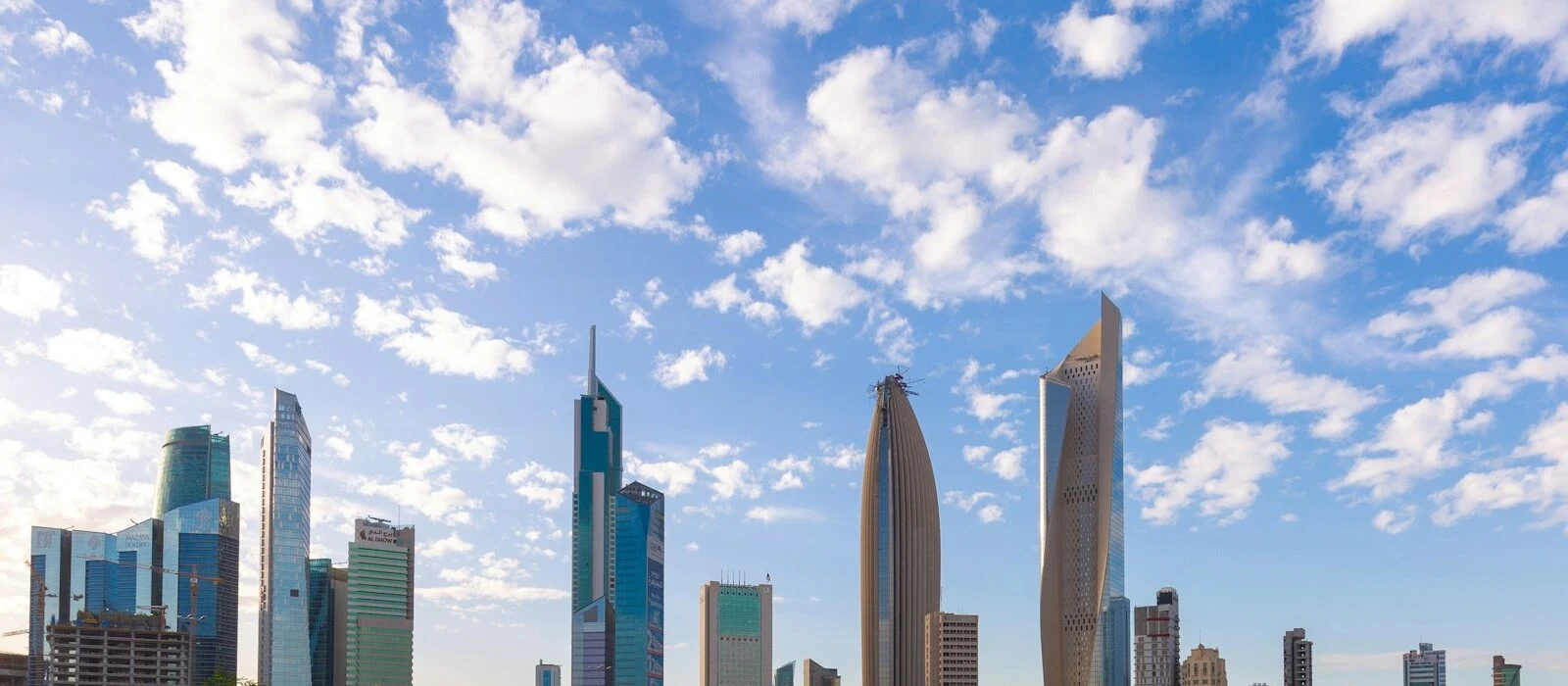
Kuwait’s position at the northern tip of the Gulf has shaped its history as a trading and maritime hub. Kuwait City looks out over Kuwait Bay, and the country also includes several Gulf islands, of which Bubiyan is the largest.
Introduction to Kuwait
Kuwait, officially the State of Kuwait, is an Arab emirate on the northwestern shore of the Persian Gulf, and its capital is Kuwait City. Arabic is the official language and English is widely used. The currency is the Kuwaiti dinar (KWD), and about 4.9 million people live there, most of them foreign residents.
Last checked: November 2026
Kuwait is a constitutional emirate that has been ruled by the Al-Sabah family since the 18th century. It is small in area but important in the region, largely because of its petroleum, which is its main natural resource. The Kuwaiti dinar is often described as one of the highest-valued currencies in the world.
The population is unusually international. According to Kuwait’s Public Authority for Civil Information, as reported in 2022, non-Kuwaitis made up nearly two-thirds of residents, many of them Arab and South Asian workers and their families. Islam is the official religion, and a Christian minority also lives in the country, so visitors will meet a wide mix of nationalities in daily life.
A few practical basics help set the scene. The international calling code is +965, Kuwait uses UTC+3 (Arabian Standard Time) all year, and its internet domain is .kw. Most signs are in both Arabic and English, which makes the main cities easy to navigate for international travellers.
Kuwait’s modern shape, from its pearling and trading past to independence in 1961, is the story the next section tells.
History of Kuwait
Kuwait developed from a small trading and fishing settlement into an emirate led by the Al-Sabah family from the mid-18th century. It was a British protectorate from 1899 until independence on 19 June 1961, was invaded by Iraq on 2 August 1990, and was liberated on 26 February 1991.
Last checked: November 2026
In the early 18th century the area was under the Bani Khalid clan. The Al-Sabah family’s rule is usually dated to 1752, although some sources give a slightly later year. The port gradually grew into a regional trading and maritime centre linking Arabia, India and the wider Gulf, with pearling, fishing and shipbuilding at the core of its economy.
In January 1899 Sheikh Mubarak Al-Sabah signed an agreement under which Britain oversaw Kuwait’s foreign relations and defence, while the Al-Sabah family continued to govern internally. Oil was found in the 1930s, and the discovery transformed the country’s economy over the following decades. Kuwait became fully independent on 19 June 1961, when Sheikh Abdullah Al-Salem Al-Sabah exchanged letters with the British Political Resident that ended the 1899 arrangement. Kuwait’s first National Assembly was inaugurated in January 1963.
On 2 August 1990 Iraqi forces invaded and occupied the country. The UN Security Council demanded an immediate withdrawal, and a US-led international coalition began military operations on 17 January 1991. Kuwait City was liberated on 26 February 1991. Today Kuwaitis remember these events each year, with National Day on 25 February and Liberation Day on 26 February.
Culture and Traditions of Kuwait
Kuwaiti culture is rooted in Arab and Islamic traditions and in the hospitality of the desert and the sea. Visitors will notice Arabic coffee served with dates, social gatherings known as diwaniyas, and Bedouin crafts such as Sadu weaving. Family, courtesy and respect for religious customs shape daily life.
Last checked: November 2026
Hospitality is the tradition most travellers meet first. Guests are commonly offered gahwa, Arabic coffee flavoured with cardamom, poured into small cups and served with dates, nuts or sweets. Accepting the offer is a polite way to return the welcome, and tea is just as common as coffee.
The diwaniya is a distinctly Kuwaiti institution: a reception room or hall, often attached to a family home, where friends, relatives and neighbours gather to talk about everyday life, business and politics. The host usually provides coffee, tea and dates. Visitors are welcome when invited, provided they dress and behave respectfully.
Kuwait’s Bedouin heritage lives on in Sadu, a woven textile made on a traditional ground loom, and Bayt Al-Sadu (Sadu House) in Kuwait City runs workshops that keep the craft alive. Sadu weaving has also gained international recognition as intangible cultural heritage. Traditional performances such as the ardah, a dance that features swords and sung poetry, and Nabati folk verse remain part of cultural events.
The calendar brings the year’s biggest celebrations. National Day and Liberation Day in late February are marked with parades, fireworks and festive events, and Eid al-Fitr and Eid al-Adha are central family occasions. Kuwait is a Muslim-majority country, so modest dress and respect for religious customs are expected in public life.
Food and Cuisine of Kuwait
Kuwaiti cuisine blends Arabian, Persian, Indian and Mediterranean influences, with rice, wheat, seafood, lamb and fragrant spices at its core. Signature dishes include machboos, widely regarded as the national dish, mutabbaq samak, margoog, jireesh, harees and gers ogaily, usually shared family-style with Arabic coffee or tea.
Last checked: November 2026
Lunch is traditionally the main meal of the day and is often built around a large platter of spiced rice. Seafood is important thanks to Kuwait’s Gulf coast, while wheat-based dishes such as harees and jireesh are associated with winter and Ramadan. Dried black limes (loomi), saffron, cardamom and turmeric give many dishes their distinctive flavour.
Ten dishes to look for:
- Machboos: spiced rice cooked with chicken, lamb or fish, often with dried limes and served with a tomato sauce called dakoos.
- Murabyan: a coastal rice dish with shrimp, onions, turmeric, coriander and dried lime.
- Mutabbaq samak: fried or grilled fish, often zubaidi (silver pomfret), served over seasoned rice.
- Margoog: a hearty stew of meat and vegetables cooked with thin rolled wheat dough.
- Jireesh: crushed wheat cooked with chicken or lamb and tomatoes into a thick, comforting dish.
- Harees: wheat and meat slow-cooked until creamy, often eaten during Ramadan.
- Balaleet: sweet saffron-scented vermicelli topped with a savoury omelette, a classic breakfast.
- Gers ogaily: a light cake flavoured with cardamom, saffron and rose water, served with tea.
- Luqaimat: fried yeast dumplings topped with sweet syrup.
- Zalabia: swirled fried dough soaked in saffron syrup.
For traditional eateries and atmosphere in Kuwait City, Souk Al-Mubarakiya is a popular place to start. Dish names and recipes vary from family to family and between the Gulf countries, so ask locally about each restaurant’s speciality.
Plan your trip with our detailed guides: Kuwait visa requirements, best places to visit in Kuwait, best time to visit Kuwait, Kuwait itinerary ideas, where to stay in Kuwait, flights to Kuwait and how to get around Kuwait.
Explore Kuwait Travel Guides
Explore our detailed guides to plan every part of your Kuwait trip.
Kuwait: Best Places
The best places to visit in Kuwait, grouped by interest: landmarks, culture, markets, coast and islands, with realistic time needed and practical...
View Guide ›Kuwait: Best Time to Visit
When to visit Kuwait: winter is the most comfortable season, summer is extremely hot. Month-by-month temperatures, rainfall, holidays and Ramadan planning.
View Guide ›Kuwait: Flights
Flights to Kuwait: Kuwait International Airport, airlines serving it, terminal changes to check, arrival tips and a Before You Fly checklist.
View Guide ›Kuwait: How to Get Around
How to get around Kuwait: taxis, ride-hailing, buses, car rental and driving rules, with the best option for each journey and common...
View Guide ›Kuwait: Itineraries
Realistic Kuwait itineraries for 3, 5, 7 and 10 days, built around Kuwait City, with pacing, overnight bases and practical planning advice.
View Guide ›Kuwait: Visa
How tourists get a visa for Kuwait: who needs one, online and on-arrival options, passport validity, border checks and where to confirm...
View Guide ›Kuwait: Hotels
Where to stay in Kuwait: the best areas, hotel types and budgets, family and halal-friendly tips, and what to check about service...
View Guide ›Explore Kuwait Tours
Discover guided tours and adventures in Kuwait. Compare itineraries, prices and traveller reviews on TourRadar before you book.
Guided tours & deals
Affiliate partner · Globe Navo may earn a commission from qualifying bookings at no extra cost to you.
❓ Kuwait FAQ
What is the capital of Kuwait?
Kuwait City is the capital of Kuwait. It sits on the Persian Gulf coast and looks out over Kuwait Bay. The city is the country’s main centre for government, business and culture, and it is where most visitors base themselves during a trip.
What language do people speak in Kuwait?
Arabic is the official language of Kuwait, and English is widely used, especially in hotels, shops and business. Most signs in the main cities are in both Arabic and English, which makes it fairly easy for international travellers to find their way around.
What currency does Kuwait use?
Kuwait uses the Kuwaiti dinar, abbreviated KWD. It is often described as one of the highest-valued currencies in the world. Check the current exchange rate before you travel, because it changes daily, and keep some cash for small purchases.
What is the national dish of Kuwait?
Machboos is widely regarded as Kuwait’s national dish. It is spiced rice cooked with chicken, lamb or fish, often flavoured with dried limes, and it is usually served with a tomato sauce called dakoos. It is typically shared family-style at lunch.
When are Kuwait’s National Day and Liberation Day?
Kuwait celebrates National Day on 25 February and Liberation Day on 26 February. Liberation Day marks the end of the Iraqi occupation in 1991. Both are public celebrations with parades and fireworks, and some shops and attractions may change their hours.
Plan Your Trip to Kuwait
Your Next Adventure in Kuwait Awaits!
Explore Deals →🎁 Best deals for Kuwait
Offers from trusted travel stores for your Kuwait trip. Compare a few options before you book, and check each store's terms for the final price.
Browse by type: Hotel deals · Flight deals · Travel eSIM · Car rental
More destinations to explore
CyprusCyprus travel guide covering where the island is, how it is governed, its history,…

 IcelandIceland travel guide: where the country is, its history, culture and food, from Reykjavík…