 France
DESTINATION
Brunei
Plan a trip to Brunei with its location, history, culture and food, plus links to guides on visas, best places, flights and getting around.
📅 Last updated:
Brunei: Hotels · Flights · Visa Guide · Deals
🌍 Quick Facts

Brunei at a glance
🏛️
Capital: Bandar Seri Begawan
💱
Currency: Brunei dollar (BND)
💬
Language: Malay
👥
Population: About 458,600
🕒
Time zone: UTC+8 (Brunei Darussalam Time)
📞
Calling code: +673
🌐
Internet domain: .bn
✈️
Main airport: Brunei International Airport (BWN)
★
Best time to visit: February to March (driest months)
Food
- Ambuyat
- Nasi katok
- Grilled fish
- Noodles
Places
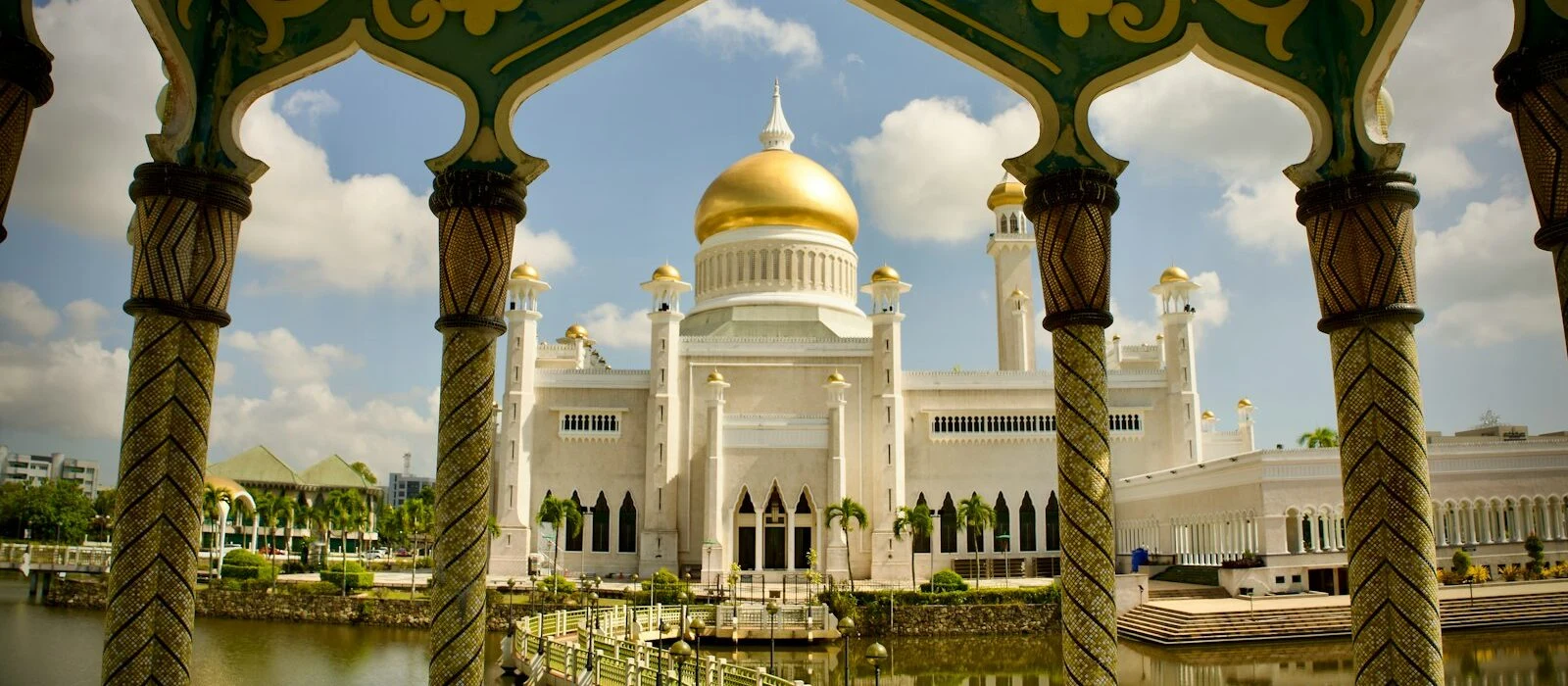
- Sultan Omar Ali Saifuddien Mosque
- Kampong Ayer
- Jame Asr Hassanil Bolkiah Mosque
- Royal Regalia Museum
- Gadong night market
- Ulu Temburong National Park
- Tutong coast
Weather
Hot and humid all year, wetter from late October to January
Culture
Islamic Malay monarchy with water-village heritage
Cities
- Bandar Seri Begawan
- Kuala Belait
- Seria
- Tutong
- Bangar
📍 Brunei Map
📷 Photos of Brunei
Explore Brunei Travel Guides
Explore our detailed guides to plan every part of your Brunei trip.
📍
Brunei: Best Places
Compare the best places to visit in Brunei, from Bandar Seri Begawan and Kampong Ayer to Ulu Temburong National Park and the...
View Guide › 🌤️Brunei: Best Time to Visit
Plan the best time to visit Brunei with month-by-month weather, wet and dry periods, National Day, Ramadan effects and what to pack.
View Guide › 🗺️Brunei: Itineraries
Choose a 3, 5, 7 or 10 day Brunei itinerary, with realistic travel advice, ideas for adding Sarawak and Sabah, and common...
View Guide › 🛂Brunei: Visa
Find out who needs a visa for Brunei, how the E-Arrival Card works and what to check before you travel.
View Guide › ✈️Brunei: Flights
Plan flights to Brunei with the main airport, Royal Brunei Airlines, airport transfers, time zone facts and a pre-flight checklist.
View Guide › 🚆Brunei: Getting Around
Plan how to get around Brunei by bus, taxi, ride-hailing, rental car, water taxi and ferry, with travel times and common mistakes.
View Guide › 🛌Brunei: Hotels
Find where to stay in Brunei, from central Bandar Seri Begawan and Gadong to Jerudong, Muara and Temburong, with stay types, family...
View Guide ›🖼️ Brunei: Location, History, Culture & Food
✨ Complete Travel Guide
Where Is Brunei Located?
Brunei is a small country on the northern coast of the island of Borneo in Southeast Asia. This Brunei travel guide starts with its position: the South China Sea lies to the north, and the Malaysian state of Sarawak surrounds the rest. The capital is Bandar Seri Begawan, in the larger western part.
Last checked: November 2026
The country covers 5,765 square kilometres and has a coastline of about 161 kilometres, according to the CIA World Factbook. Limbang, a district of Sarawak, separates the two parts. The larger western part holds the Brunei-Muara, Tutong and Belait districts. The smaller eastern part is the Temburong district.
The land rises from a flat coastal plain to low hills in the west and mountains in the east. The highest point is Bukit Pagon, at 1,850 metres, in the east. Most of the country’s undisturbed rainforest lies in Temburong. The Brunei River flows through the north and empties into Brunei Bay, close to the capital. Muara and Kuala Belait are the two main ports.
Brunei uses Brunei Darussalam Time, which is UTC+8, the same as Singapore and Kuala Lumpur. Since March 2020, the Sultan Haji Omar ‘Ali Saifuddien Bridge, usually called the Temburong Bridge, has joined Temburong to the rest of the country by road, so drivers no longer cross Malaysia. Our guide to getting around Brunei explains how roads, buses and boats link these areas, and the page on flights to Brunei covers the main airport.
Brunei Travel Guide: An Introduction to the Sultanate
Brunei Darussalam is a sultanate known for oil and gas wealth, large mosques, the water village of Kampong Ayer and protected rainforest. Malay is the official language, English is widely understood, and the currency is the Brunei dollar. The country is small, quiet and easy to cover in a few days.
The capital is Bandar Seri Begawan. Sultan Hassanal Bolkiah serves as both head of state and head of government. About 458,600 people lived in the country as of 2025, according to the Department of Economic Planning and Statistics, and that figure covers the whole country, not only the capital. Roughly two-thirds of residents are Malay and about one-tenth are Chinese, according to Britannica. The rest include other indigenous peoples and people of Indian origin.
The Brunei dollar (BND) is pegged one to one with the Singapore dollar. Petroleum and natural gas fields are the source of one of the highest per capita incomes in Asia, which explains the country’s modern roads, public buildings and high living standards.
The national ideology is Melayu Islam Beraja, which means Malay Islamic Monarchy. It joins Malay language and customs, Islamic values and loyalty to the monarchy, and it shapes public life, dress and celebrations. Many people expect only oil wealth and palaces. The main sights are quieter: mosques, markets, a river village and protected rainforest. Start with the best places to visit in Brunei, check entry rules in the Brunei visa guide for tourists, and use the official Brunei Tourism website for current visitor information.
Brunei History: From Medieval Sultanate to Independence
Brunei has been ruled by one royal family for more than six centuries, according to the CIA World Factbook. It grew from a 14th-century sultanate into a regional power, lost land to colonial-era rivals, became a British protectorate in 1888 and regained full independence on 1 January 1984.
The early sultanate, 14th to 16th centuries
Historians date the Bruneian sultanate to the 14th century. At its height, its influence spread along the northern coast of Borneo and towards the Philippines. The expedition led by Ferdinand Magellan reached Brunei in 1521 and brought the first Europeans to the sultanate.
Decline and lost territory, 1800s
Disputes over royal succession, piracy and European expansion weakened the sultanate. Sarawak passed to James Brooke in 1841, Labuan went to Britain in 1846, and Sabah was ceded to a British company in 1878. By 1890 Brunei had shrunk to roughly its present size, and the loss of Limbang left the country in two parts.
British protection and oil, 1888 to 1983
Brunei became a British protectorate in 1888 and gained a British Resident in 1906, whose advice the sultan had to accept, according to Britannica. Oil was found at Seria in 1929 and began to restore the country’s importance. Japan occupied Brunei from 1941 to 1945. A written constitution in 1959 introduced internal self-government, and a rebellion in 1962 was ended with British help. Brunei chose to stay outside the Malaysian federation.
Independence and the modern sultanate, 1984 to today
Brunei became fully independent on 1 January 1984, and the country celebrates National Day on 23 February. Sultan Hassanal Bolkiah has reigned since 1967, and 2017 marked the 50th anniversary of his accession. Oil and gas remain the base of the economy. Our Brunei itineraries show how to fit the museums and mosques that explain this story into three to ten days.
Culture in Brunei: Language, Religion, Festivals and Etiquette
Brunei’s culture is Malay and Islamic at its core. Malay is the official language, Islam is the official religion, and the national ideology, Melayu Islam Beraja, joins Malay customs, Islamic values and the monarchy. Chinese, indigenous and other communities add their own languages, festivals and foods to everyday life.
Language
Malay is the official language, and English is widely understood, especially in business, education and tourism. Chinese is spoken within the Chinese community, and several indigenous languages are also heard in homes and villages.
Religion
Islam sets the weekly rhythm. Friday midday prayers are the main weekly service, and some offices, shops and sights adjust their hours around them. Buddhist, Christian and other communities also live in the country. The best-known mosques are the Sultan Omar Ali Saifuddien Mosque and the Jame’ Asr Hassanil Bolkiah Mosque, both in or near the capital.
Festivals
Dates for Islamic festivals move each year with the lunar calendar. The main occasions are:
- Hari Raya Aidilfitri: the festival that ends Ramadan, with family visits, open houses and money gifts for children.
- Hari Raya Aidiladha: the second major Islamic festival of the year.
- National Day, 23 February: ceremonies and parades.
- The Sultan’s birthday, 15 July: national celebrations with fireworks.
Local media report that the Sultan’s palace, Istana Nurul Iman, opens to the public during Hari Raya Aidilfitri. Our month-by-month guide to the best time to visit Brunei shows how these dates affect a trip.
Etiquette
Social manners are gentle and restrained. A common greeting is a light handshake followed by placing the right hand over the heart. With someone of the opposite sex, wait for them to offer a hand, or use the hand-on-heart gesture alone. Eat, pass food and give or receive items with the right hand. Accept a little food or drink when it is offered, and remove your shoes when you enter a home or a mosque. Dress neatly, with shoulders and knees covered. To point, use the thumb of your right hand instead of a finger.
Music and arts
Traditional music includes the gulintangan, an instrumental ensemble, and the adai-adai, a work song once sung by fishermen. Craft traditions include songket weaving, silversmithing and brass-smithing. Formal dress, such as the baju Melayu for men and the baju kurung for women, is often made from songket cloth. To see how these customs shape daily life, read our guide to where to stay in Brunei, which covers halal and family-friendly options.
Brunei Food: Staples, Signature Dishes and Drinks
Bruneian food is Malay at its core, built on rice, noodles, sago, fish, chicken and chilli. The national dish is ambuyat, a sticky sago starch eaten with a bamboo fork. Nasi katok, rice with fried chicken and sambal, is the everyday favourite. Food is generally halal, and alcohol is not sold.
Staples
Rice is the base of most meals, with noodles, sago, fish, chicken and beef served alongside. Sambal, a chilli paste, and sour or spicy gravies provide much of the flavour. Brunei’s cooking overlaps with Malaysian and Indonesian food, but a few dishes belong to Brunei, ambuyat above all.
Signature dishes
- Ambuyat: a sticky ball of sago starch twirled on a bamboo fork and dipped in a sour, spicy sauce, with side dishes.
- Nasi katok: rice, fried chicken and sambal, sold at stalls and shops across the country. The name means knock rice.
- Nasi lemak: rice cooked in coconut milk and served with sambal and small accompaniments.
- Beef rendang: beef cooked slowly in a spiced coconut gravy.
- Pajeri nanas: a sweet and tangy pineapple curry.
- Kelupis: glutinous rice rolls wrapped in nyirik leaves.
- Mi goreng: fried noodles, a common meal at stalls and night markets.
- Bamboo chicken: chicken cooked in bamboo, a traditional Iban dish served at festivals such as Gawai.
- Grilled fish: a regular choice at night markets, usually served with sambal.
Street food
Gadong night market is the best-known place for cheap local snacks, noodles, skewers and kuih. Tamu Kianggeh, a morning market beside the Brunei River, sells fresh produce and traditional snacks. Stalls around the country also sell satay, roti john (a meat-and-egg sandwich) and murtabak (a stuffed pancake). Our list of the best places in Brunei includes the night market.
Drinks
Teh tarik, or pulled tea, and fresh coconut water are everyday drinks, along with coffee and fruit juices. The sale of alcohol is banned, so drinks menus focus on tea, coffee, juices and soft drinks.
Desserts
Brunei has a wide range of kuih-muih, which are small traditional cakes and snacks. Cucur is a deep-fried snack, and kuih cincin is a crisp ring made from rice flour and palm sugar. Wajid, a sweet of glutinous rice and palm sugar, appears at celebrations. Durians turn up in markets when the fruit is in season.
Food also changes with the occasion. Everyday meals are modest, while Hari Raya brings special cookies, sweets and large family dishes, and the Iban community prepares bamboo chicken for the Gawai festival.
Explore Hotels & Flights
Search accommodation and flights for your destination with Expedia. Compare available options and continue to Expedia to complete your booking.
Affiliate partner · Globe Navo may earn a commission from qualifying bookings at no extra cost to you.
❓ Brunei FAQ
Do I need a visa to visit Brunei?
It depends on your passport. Many nationalities can enter visa-free for 14, 30 or 90 days, and some can get a visa on arrival, while others must apply in advance. All foreign visitors must also complete the E-Arrival Card. Check the official Brunei Tourism visa page for your nationality.
What is the best time to visit Brunei?
February and March are usually the driest months, and National Day is on 23 February. Brunei is hot, humid and rainy all year, with late October to January the wettest, when heavy rain can limit access to Temburong.
Is Brunei safe for tourists?
The US State Department rates Brunei Level 1, exercise normal precautions, and describes it as generally safe. Crime is low, but Sharia Penal Code rules apply and penalties can be severe. Crocodiles live in rivers and coastal waters, so follow warning signs and local advice.
How many days do you need in Brunei?
Two days covers the capital, and three to four days adds Ulu Temburong National Park and Kampong Ayer. Longer stays make sense if you combine Brunei with Sarawak or Sabah in Malaysian Borneo.
Can I drink alcohol in Brunei?
The sale of alcohol is banned. The UK FCDO says non-Muslims aged 17 and over may import a limited amount, and the US State Department says you must declare it to customs on arrival. Check the current allowance before you travel.
Plan Your Trip to Brunei
Your Next Adventure in Brunei Awaits!
Explore Deals →🎁 Best deals for Brunei
Offers from trusted travel stores for your Brunei trip. Compare a few options before you book, and check each store's terms for the final price.
Browse by type: Hotel deals · Flight deals · Travel eSIM · Car rental
 KkdayFind current Kkday coupons and deals for tours, attraction tickets, transport and first app orders. See minimum spend, discount caps and exclusions before you book.
Get Coupon View Deal
 eSIMFOXeSIMFOX is a travel eSIM provider offering prepaid mobile data plans for single countries and wider regions, delivered digitally so you can connect as soon as you land.
Get Coupon View Deal
 QuibityQuibity is a travel eSIM provider that lets you buy a mobile data plan online and activate it on your phone, so you can get connected abroad without a physical SIM card.
Get Coupon View Deal
 ExpediaDiscover great deals on hotels, flights, vacation packages, car rentals, and activities with Expedia. Compare travel options and plan your next trip with convenient booking choices.
Get Coupon View Deal
 KlookKlook is a travel activities platform where you can book attraction tickets, tours, day trips, transport passes, airport transfers and local experiences in destinations worldwide.
Get Coupon View Deal
 Trip.comTrip.com is a global online travel platform for flights, hotels, train tickets, airport transfers, attraction tickets and travel packages, available on web and mobile app.
Get Coupon View Deal
 TourRadarTourRadar is an online marketplace for multi-day guided tours, small-group trips and tailor-made journeys offered by independent tour operators around the world.
Get Coupon View Deal