 Bangladesh
DESTINATION
Bosnia and Herzegovina
Explore Bosnia and Herzegovina: where it is, its history, culture and food, from Sarajevo's old town to Mostar's bridge and the Neretva valley.
📅 Last updated:
Bosnia and Herzegovina: Hotels · Flights · Visa Guide · Deals
🌍 Quick Facts

Bosnia and Herzegovina at a glance
🏛️
Capital: Sarajevo
💱
Currency: Convertible mark (BAM)
💬
Language: Bosnian, Croatian and Serbian
👥
Population: About 3.1 million
🕒
Time zone: UTC+1 (CET), UTC+2 in summer
📞
Calling code: +387
🌐
Internet domain: .ba
✈️
Main airport: Sarajevo International Airport (SJJ)
★
Best time to visit: Spring and early autumn
Food
- Ćevapi
- Burek
- Bosnian coffee
- Baklava
Places
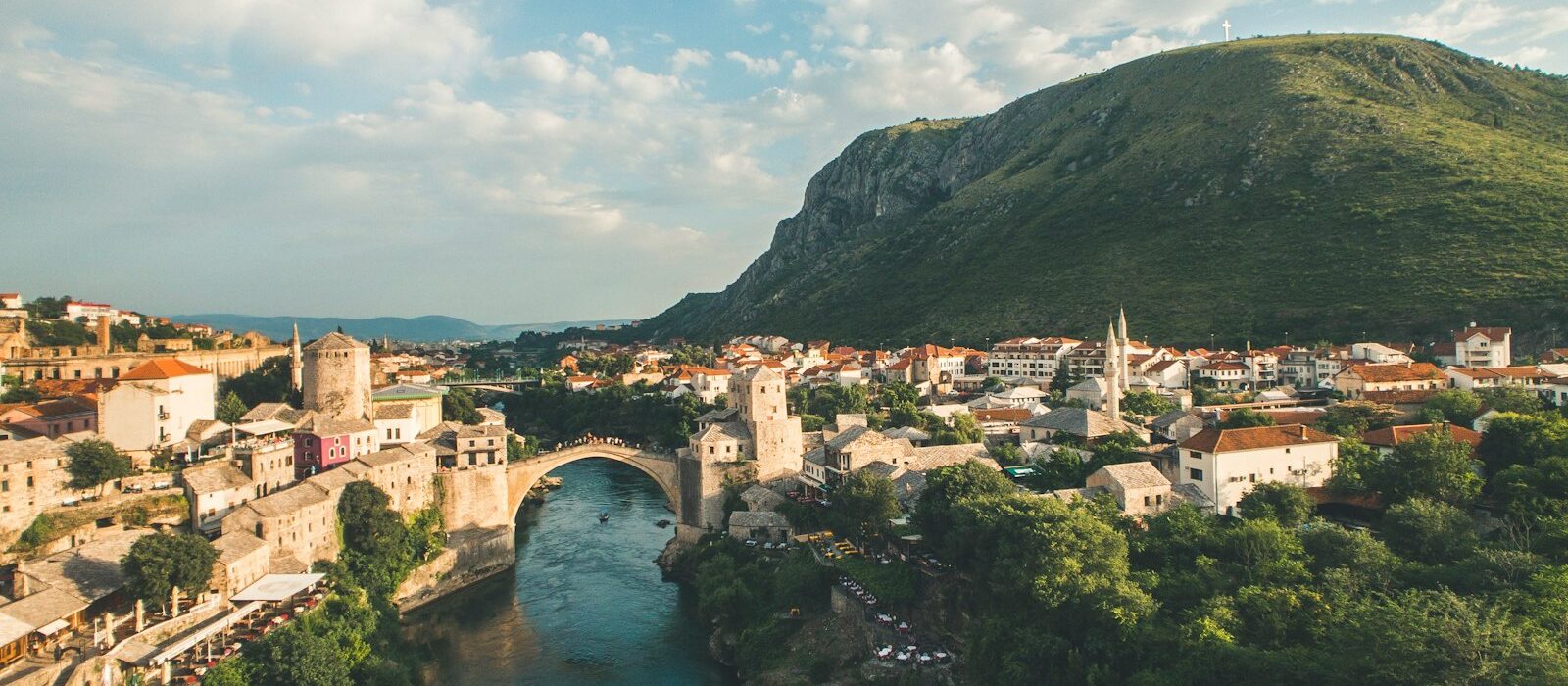
- Old Bridge, Mostar
- Baščaršija, Sarajevo
- Kravice waterfall
- Blagaj
- Počitelj
- Jajce
- Una National Park
Weather
Hot summers, cold and snowy mountain winters
Culture
Ottoman, Austro-Hungarian and Slavic heritage
Cities
- Sarajevo
- Mostar
- Banja Luka
- Jajce
- Bihać
📍 Bosnia and Herzegovina Map
📷 Photos of Bosnia and Herzegovina
Explore Bosnia and Herzegovina Travel Guides
Explore our detailed guides to plan every part of your Bosnia and Herzegovina trip.
📍
Bosnia and Herzegovina: Best Places
Compare the best places to visit in Bosnia and Herzegovina, from Sarajevo and Mostar to waterfalls and medieval towns, with how long...
View Guide › 🌤️Bosnia and Herzegovina: Best Time to Visit
Plan the best time to visit Bosnia and Herzegovina with month-by-month weather, festivals, ski season, holiday effects and what to pack.
View Guide › 🗺️Bosnia and Herzegovina: Itineraries
Choose a 3, 5, 7 or 10 day Bosnia and Herzegovina itinerary with realistic travel times, getting-around tips and safety reminders.
View Guide › 🛂Bosnia and Herzegovina: Visa
Find out who needs a visa for Bosnia and Herzegovina, which travellers can enter visa-free, what documents to carry and where to...
View Guide › ✈️Bosnia and Herzegovina: Flights
Plan flights to Bosnia and Herzegovina with the main airports, how to reach each city, airlines, time zone and a pre-flight checklist.
View Guide › 🚆Bosnia and Herzegovina: Getting Around
How to travel inside Bosnia and Herzegovina by train, bus, car and taxi, with city transport tips, travel times and a short...
View Guide › 🛌Bosnia and Herzegovina: Hotels
Find where to stay in Bosnia and Herzegovina, from Sarajevo's Old Town and Mostar to mountain lodges, with halal and family notes...
View Guide ›🖼️ Bosnia and Herzegovina: Location, History, Culture & Food
✨ Complete Travel Guide
Bosnia and Herzegovina Travel Guide: Where Is the Country Located?
Bosnia and Herzegovina is a country in southeastern Europe, in the western Balkans. It borders Croatia to the north, west and south, Serbia to the east and Montenegro to the southeast. The capital is Sarajevo, and the country covers about 51,200 square kilometres.
Last checked: November 2026
This Bosnia and Herzegovina travel guide starts with the map, because the geography explains most of what follows. The Dinaric Alps run through the country, and the highest peak, Maglić, reaches 2,386 metres on the Montenegrin border. Rivers shape the towns: the Sava marks the northern border, the Drina runs through the east, the Una flows through the northwest and the Neretva cuts south toward the Adriatic.
The country has a coastline of only about 20 kilometres, around the town of Neum, which splits Croatia’s southern coast in two. The northern and central part is called Bosnia, and the southern part is called Herzegovina. There is no official border between the two, and the names describe regions, not separate states.
Inland areas have cold, snowy winters and warm summers, while Herzegovina feels more Mediterranean. Our guide to the best time to visit Bosnia and Herzegovina breaks this down month by month. The country follows Central European Time (UTC+1), and moves to UTC+2 during daylight saving time.
Politically, the country has two entities, the Federation of Bosnia and Herzegovina and Republika Srpska, plus the self-governing Brčko District. Most visitors arrive by air, and the guide to flights to Bosnia and Herzegovina lists the airports. Distances are short on the map but mountain roads are slow, so the getting around Bosnia and Herzegovina guide gives realistic travel times.
What Is Bosnia and Herzegovina Known For?
Bosnia and Herzegovina is known for stone bridges, Ottoman and Austro-Hungarian old towns, green rivers and mountain scenery. It uses the convertible mark as its currency, and its official languages are Bosnian, Croatian and Serbian. The country has about 3.1 million people, according to a 2026 United Nations estimate.
That population figure covers the whole country. Sarajevo is much smaller, with an urban area of roughly a quarter of a million people. The country is a federal parliamentary republic with a three-member presidency, which reflects its three main constituent peoples: Bosniaks, Croats and Serbs.
Two common misunderstandings are worth clearing up. The country does not use the euro, even though the convertible mark (KM) is fixed to it at about 1.96 marks per euro. And Bosnia and Herzegovina is not in the European Union or the Schengen Area, so entry rules differ from those of its neighbour Croatia. The Bosnia and Herzegovina visa guide explains who needs a visa.
The country has five UNESCO World Heritage listings, according to the UNESCO World Heritage Centre:
- The Old Bridge Area of the Old City of Mostar (2005).
- The Mehmed Paša Sokolović Bridge in Višegrad (2007).
- The Stećci medieval tombstone graveyards (2016), shared with Croatia, Montenegro and Serbia.
- The Ancient and Primeval Beech Forests of the Carpathians and Other Regions of Europe, which includes the Janj forest (added in 2021).
- Vjetrenica Cave, near Ravno (2024).
The best places to visit in Bosnia and Herzegovina are covered in a separate guide, and the Bosnia and Herzegovina itineraries show how to combine them. The national tourism portal is a good official starting point.
A Short History of Bosnia and Herzegovina
Bosnia and Herzegovina has been settled since prehistory. It was ruled in turn by Illyrian tribes, Rome, a medieval Bosnian kingdom, the Ottoman Empire and Austria-Hungary, then became part of Yugoslavia. It declared independence on 3 March 1992 and fought a war that ended in December 1995.
Early settlement and the medieval kingdom
People farmed and built settlements here in the Neolithic period, and Illyrian tribes lived in the region before Roman conquest. Rome took control after the Great Illyrian Revolt, which ended in AD 9, and made the area part of its provinces of Illyricum and later Dalmatia. Slavic groups settled from the sixth and seventh centuries.
The medieval state of Bosnia grew under rulers called bans. Ban Kulin governed from about 1180 to 1204, and Tvrtko I was crowned the first king of Bosnia in 1377. This is also the age of the stećci, the carved limestone tombstones that date from the twelfth to sixteenth centuries.
Ottoman and Austro-Hungarian rule
The Ottomans conquered Bosnia in 1463 and Herzegovina in 1482. They shaped the towns that visitors see today: bazaars, mosques, hammams and bridges. Mostar’s Old Bridge was completed in 1566, and Sarajevo grew into the main Ottoman city of the region.
After the Congress of Berlin in 1878, Austria-Hungary occupied the country and formally annexed it in 1908. The new rulers added tram lines, public buildings and parks, which is why Sarajevo’s centre mixes Ottoman and central European styles. On 28 June 1914, Archduke Franz Ferdinand was assassinated in Sarajevo, an event that led to the First World War.
Yugoslavia, war and independence
After 1918, the country became part of the Kingdom of Serbs, Croats and Slovenes, later called Yugoslavia. After the Second World War it became one of the six republics of socialist Yugoslavia. Sarajevo hosted the Winter Olympics in February 1984.
A referendum was held on 29 February and 1 March 1992, and independence was declared on 3 March. The war that followed lasted from April 1992 to December 1995, and Sarajevo was besieged for nearly four years. In July 1995, more than 8,000 Bosniak men and boys were killed at Srebrenica, which courts have ruled to be genocide. Mostar’s Old Bridge was destroyed in November 1993 and reopened after reconstruction in July 2004.
The Dayton Agreement was initialled in November 1995 and signed in Paris on 14 December 1995. It created the present two-entity structure. The European Council granted the country EU candidate status in December 2022 and agreed in March 2024 to open accession negotiations, which are still ongoing.
Culture in Bosnia and Herzegovina: People, Faiths and Traditions
Culture in Bosnia and Herzegovina reflects Slavic, Ottoman and central European influences. Bosniaks, Serbs and Croats live in the country, with Muslim, Orthodox and Catholic communities and a small Jewish community. Coffee, music, hospitality and shared festivals shape everyday life.
Language and religion
Bosnian, Croatian and Serbian are standard varieties of one language, and speakers understand each other easily. Both the Latin and Cyrillic alphabets are used, with Latin more common in the Federation and Cyrillic more visible in Republika Srpska. The 2013 census is the most recent, and it counted three main groups: Bosniaks, Serbs and Croats.
Sarajevo is often called the ‘Jerusalem of Europe’ because a mosque, an Orthodox church, a Catholic cathedral and a synagogue stand within a short walk of each other. The Sarajevo Haggadah, a medieval Jewish manuscript kept in the National Museum, is one of the city’s best-known treasures.
Festivals
The Sarajevo Film Festival takes place every August and was founded in 1995, while the city was still under siege. Baščaršija Nights fill the old bazaar with concerts and events in July. In Mostar, divers jump from the Old Bridge in a summer competition, usually held in July.
Religious holidays also shape the calendar. Muslim communities mark Ramadan and the Bajram holidays, Catholics celebrate Christmas on 25 December and Orthodox Christians on 7 January. Dates for events change, so check each festival’s official website.
Etiquette
- Remove your shoes when you enter a home, and expect to be offered coffee.
- Dress modestly in mosques and churches, and ask before photographing people.
- Avoid casual questions about the 1992 to 1995 war and about which group someone belongs to.
- A coffee invitation is a social gesture, so accept it and take your time.
Music and arts
Sevdah, or sevdalinka, is the traditional love song of the region, with Ottoman-era melodies and a slow, emotional style. Writer Ivo Andrić won the Nobel Prize in Literature in 1961, and his novel The Bridge on the Drina is set around the Višegrad bridge. In Sarajevo’s Baščaršija, coppersmiths still hammer trays and Bosnian coffee sets by hand.
Food in Bosnia and Herzegovina: Dishes, Drinks and Desserts
Bosnian food is built on grilled meat, filled pies, stuffed vegetables, bread and dairy, with Ottoman and Mediterranean influences. The best-known dishes are ćevapi and burek. Coffee, usually served with a sweet, is a ritual in its own right.
Staples and signature dishes
Bread, meat, dairy and seasonal vegetables are the base of most meals. Somun, a soft round flatbread, comes with grilled meat, and kajmak is a creamy dairy spread served alongside. A local rule is worth knowing: in Bosnia, burek is only the meat version, while the same pastry with cheese, spinach or potato has other names.
- Ćevapi: small grilled minced-meat sausages served in somun with chopped onion.
- Burek: coiled filo pastry filled with minced meat.
- Sirnica and zeljanica: pies filled with cheese or spinach.
- Begova čorba: a chicken and okra soup, often called Bey’s soup.
- Sogan-dolma: onions stuffed with minced meat and rice.
- Japrak: vine leaves rolled around a meat and rice filling.
- Bosanski lonac: a slow-cooked Bosnian pot of meat and vegetables.
- Klepe: small meat-filled dumplings served with yoghurt and garlic.
- Pršut: dry-cured ham from Herzegovina.
- Lamb on the spit: a roast served in central Bosnia and Herzegovina.
Regional differences are clear. Herzegovina is known for pršut, figs and wine, while central and northern Bosnia are known for dairy and pies. Trappist cheese comes from the Banja Luka area.
Street food
Ćevapi shops and bakeries serve most quick meals. A bakery, called a pekara, sells pies by weight, usually with plain yoghurt on the side. Pljeskavica, a flat grilled meat patty, is another popular choice.
Drinks
Bosnian coffee is boiled in a small copper pot called a džezva and poured into small cups, with a lump of sugar or Turkish delight on the side. Boza is a thick, lightly fermented millet drink found in Sarajevo, and kiselo mlijeko is a sour milk drink. Rakija is a fruit brandy, often made from plums, and Žilavka is a white wine and Blatina a red wine from Herzegovina. Alcohol is widely available, though many people do not drink it.
Desserts
Baklava is layered pastry with nuts and syrup. Tufahija is an apple stuffed with walnuts and topped with cream, and hurmašice are syrup-soaked semolina cookies. Rahat-lokum (Turkish delight) and tulumba, a fried dough in syrup, are also common. For where to eat and sleep in each city, see our guide on where to stay in Bosnia and Herzegovina, and the local guide on Visit Sarajevo for restaurant listings.
Explore Hotels & Flights
Search accommodation and flights for your destination with Expedia. Compare available options and continue to Expedia to complete your booking.
Affiliate partner · Globe Navo may earn a commission from qualifying bookings at no extra cost to you.
❓ Bosnia and Herzegovina FAQ
Do I need a visa to visit Bosnia and Herzegovina?
It depends on your passport. US citizens and citizens of many other countries can stay up to 90 days without a visa, while others must apply first. Some travellers with a valid multiple-entry Schengen, EU or US visa or residence permit can enter under conditions. Check the official Bosnian government page.
What is the best time to visit Bosnia and Herzegovina?
May to June and September to early October are usually best for cities and day trips. July and August can be very hot, especially around Mostar. Winter suits skiing in the mountains but can bring fog and poor air quality in valley cities.
Is Bosnia and Herzegovina safe for tourists?
The US State Department lists it at Level 2, exercise increased caution, because of crime, terrorism and landmines. The UK FCDO also warns that landmines remain a danger in isolated areas. Stay on paved roads and marked paths, and avoid political demonstrations.
How many days do you need in Bosnia and Herzegovina?
Three days covers Sarajevo, and five days lets you add Mostar with a day trip. Seven to ten days allows central Bosnia or the northwest. Mountain roads are slow, so avoid packing too many stops into a short trip.
How do I get around Bosnia and Herzegovina?
Buses are the main public transport between cities, and a scenic train links Sarajevo and Mostar. Sarajevo to Mostar is about 129 km and takes roughly two hours by car. A car helps for villages and waterfalls, but stay on paved roads.
Plan Your Trip to Bosnia and Herzegovina
Find Hotels in Bosnia and Herzegovina
Compare Flight Deals
Car Rental Options
Visa Guide for Tourists
Your Next Adventure in Bosnia and Herzegovina Awaits!
Explore Deals →🎁 Best deals for Bosnia and Herzegovina
Offers from trusted travel stores for your Bosnia and Herzegovina trip. Compare a few options before you book, and check each store's terms for the final price.
Browse by type: Hotel deals · Flight deals · Travel eSIM · Car rental
 KkdayFind current Kkday coupons and deals for tours, attraction tickets, transport and first app orders. See minimum spend, discount caps and exclusions before you book.
Get Coupon View Deal
 eSIMFOXeSIMFOX is a travel eSIM provider offering prepaid mobile data plans for single countries and wider regions, delivered digitally so you can connect as soon as you land.
Get Coupon View Deal
 QuibityQuibity is a travel eSIM provider that lets you buy a mobile data plan online and activate it on your phone, so you can get connected abroad without a physical SIM card.
Get Coupon View Deal
 ExpediaDiscover great deals on hotels, flights, vacation packages, car rentals, and activities with Expedia. Compare travel options and plan your next trip with convenient booking choices.
Get Coupon View Deal
 KlookKlook is a travel activities platform where you can book attraction tickets, tours, day trips, transport passes, airport transfers and local experiences in destinations worldwide.
Get Coupon View Deal
 Trip.comTrip.com is a global online travel platform for flights, hotels, train tickets, airport transfers, attraction tickets and travel packages, available on web and mobile app.
Get Coupon View Deal
 TourRadarTourRadar is an online marketplace for multi-day guided tours, small-group trips and tailor-made journeys offered by independent tour operators around the world.
Get Coupon View Deal