 Italy
DESTINATION
Bangladesh
Bangladesh is a South Asian country on the Bay of Bengal. Read about its location, history, culture and food, with links to our planning guides.
📅 Last updated:
Bangladesh: Hotels · Flights · Visa Guide · Deals
🌍 Quick Facts

Bangladesh at a glance
🏛️
Capital: Dhaka
💱
Currency: Bangladeshi taka (BDT)
💬
Language: Bengali (Bangla)
👥
Population: About 170 million (2022 census)
🕒
Time zone: UTC+6 (no daylight saving)
📞
Calling code: +880
🌐
Internet domain: .bd
✈️
Main airport: Hazrat Shahjalal International (DAC), Dhaka
★
Best time to visit: November to February
Food
- Kacchi biryani
- Hilsa (ilish) in mustard sauce
- Bhorta (mashed vegetables or fish)
- Mishti doi (sweet yoghurt)
- Seven-layer tea
Places
- Old Dhaka and Lalbagh Fort
- Sundarbans mangrove forest
- Cox's Bazar beach
- Historic Mosque City of Bagerhat
- Paharpur Buddhist Vihara
- Sreemangal tea gardens
Weather
Hot, humid summers, a monsoon from June to October and a cooler dry winter
Culture
Bengali is the official language, and tea is part of everyday life, especially in Sylhet. Dress modestly, especially at mosques and in rural areas, and avoid demonstrations and political gatherings.
Cities
- Dhaka
- Chattogram
- Cox's Bazar
- Sylhet
- Sreemangal
- Khulna
📍 Bangladesh Map
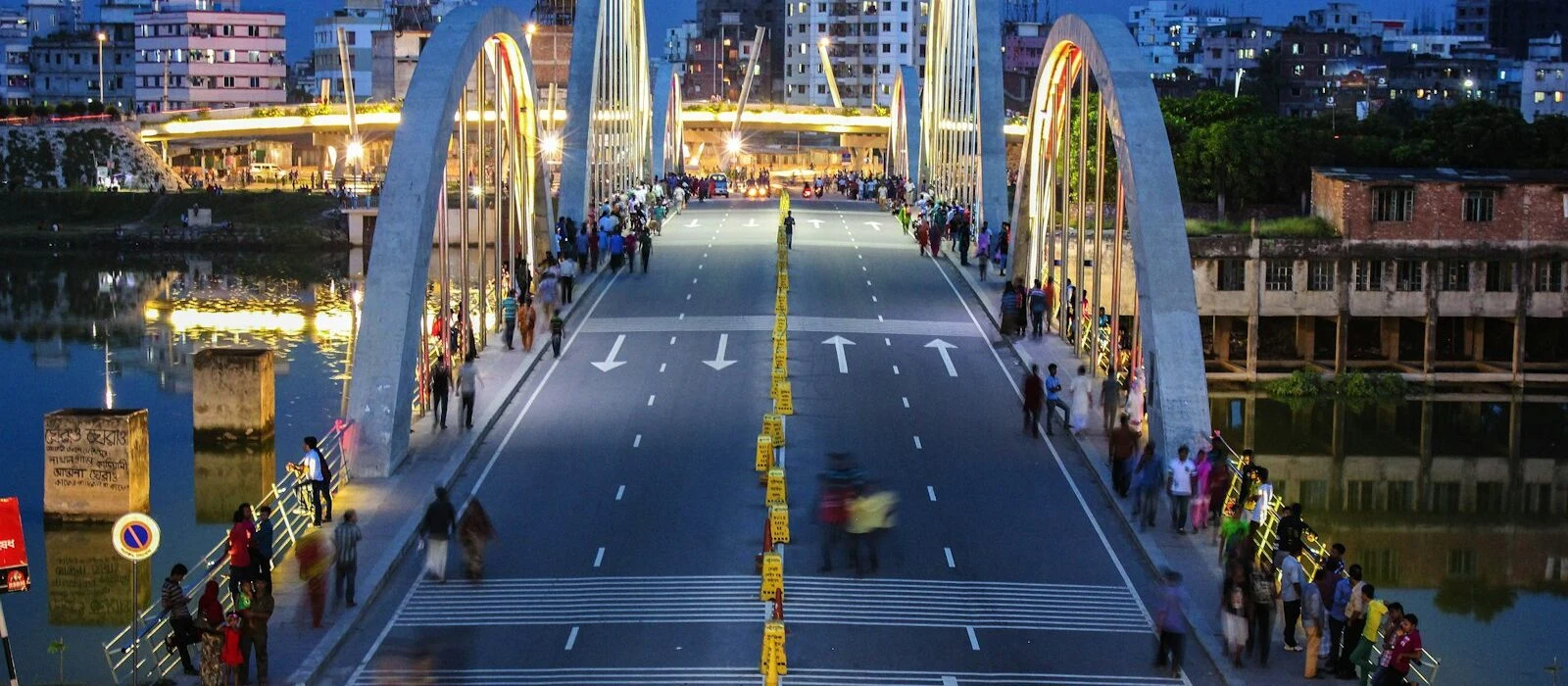
📷 Photos of Bangladesh
Explore Bangladesh Travel Guides
Explore our detailed guides to plan every part of your Bangladesh trip.
🗺️
Bangladesh: Itineraries
Plan 3, 5, 7 or 10 days in Bangladesh with realistic travel times between Dhaka, Cox’s Bazar, the Sundarbans and Sreemangal, plus...
View Guide › 🛂Bangladesh: Visa
Who needs a visa for Bangladesh, how the e-visa and visa on arrival work, which passport and arrival rules apply, and which...
View Guide › 📍Bangladesh: Best Places
The best places to visit in Bangladesh by type: Old Dhaka, the Sundarbans, Cox’s Bazar, UNESCO heritage sites and tea country, with...
View Guide › 🌤️Bangladesh: Best Time to Visit
When to visit Bangladesh by season and month, with weather in Dhaka, monsoon and cyclone timing, Ramadan and Eid effects, packing tips...
View Guide › ✈️Bangladesh: Flights
How to fly to Bangladesh: main international airports, airlines, getting from Dhaka airport to the city, and what to check before you...
View Guide › 🚆Bangladesh: Getting Around
How to get around Bangladesh by train, bus, domestic flight, car with a driver and ride-hailing, with realistic travel times between cities.
View Guide › 🛌Bangladesh: Hotels
Where to stay in Bangladesh by trip type: Dhaka’s Gulshan, Banani and Uttara, Cox’s Bazar beach areas, Khulna for the Sundarbans and...
View Guide ›🖼️ Bangladesh: Location, History, Culture & Food
✨ Complete Travel Guide
Safety notice, last checked November 2026
The US State Department rates Bangladesh Level 2, “Exercise increased caution”, and rates the Chittagong Hill Tracts (Khagrachari, Rangamati and Bandarban), the refugee camp areas near Cox’s Bazar and the areas along the Myanmar border Level 4, “Do not travel”. The UK government advises against all but essential travel to the Chittagong Hill Tracts. Read the US advisory and the UK travel advice before you plan, and check both again before you leave.
Where Is Bangladesh Located?
This Bangladesh travel guide starts with the basics. Bangladesh is a South Asian country on the Bay of Bengal, bordered by India on three sides and by Myanmar in the south-east. Its capital is Dhaka, and it covers roughly 148,000 square kilometres, mostly flat river delta.
Last checked: November 2026
Bangladesh sits in the eastern part of South Asia, in the delta region historically known as Bengal. India borders it on the west, north and east, and a short border with Myanmar runs along the far south-east. The southern edge is the coast of the Bay of Bengal, where the long beach at Cox’s Bazar faces the open sea.
Three big rivers shape the land: the Ganges, the Brahmaputra and the Meghna. Inside Bangladesh, the Ganges is called the Padma and the Brahmaputra is called the Jamuna. Their silt makes the soil fertile, but it also brings regular floods, which is why so many journeys here involve ferries, long bridges and slow roads.
Most of the country is low, flat delta. The Sundarbans, one of the world’s largest mangrove forests, covers the south-west coast and continues across the border into India. The hills lie in the south-east, while the north-east has tea country and seasonal wetlands called haors, which fill with water in the rainy season.
Dhaka, the capital, stands near the centre of the country on the Buriganga river. Chattogram, on the south-east coast, is the main seaport, and Sylhet is the main city of the tea-growing north-east. Bangladesh uses Bangladesh Standard Time, which is UTC+6, and it doesn’t currently observe daylight saving time. Most international flights arrive in Dhaka, as our flights to Bangladesh guide explains, and our guide to getting around Bangladesh covers how to reach the other regions.
Bangladesh Travel Guide: An Introduction to the Country
Bangladesh is a parliamentary republic of about 170 million people as of the 2022 census. Bengali is the official language, the currency is the taka, and Dhaka is the capital. The country is known for river deltas, tea gardens, mangroves, a very long beach and a strong literary and food culture.
That population figure is for the whole country. The city of Dhaka had about 10.2 million residents in the same census, according to the Bangladesh Bureau of Statistics. Bangladesh is a little larger than Greece but has more than 15 times as many people, so towns, roads and trains are busy almost everywhere.
Bangladesh and Bengal are not the same thing. Bengal is a wider region that also includes the Indian state of West Bengal. The two share the Bengali language and many traditions, but Bangladesh is an independent country with its own government, currency and national identity.
Three places in Bangladesh are on the UNESCO World Heritage list, according to the UNESCO World Heritage Centre: the Historic Mosque City of Bagerhat (1985), the Ruins of the Buddhist Vihara at Paharpur (1985) and the Sundarbans (1997). Beyond those, visitors come for Old Dhaka, the beach at Cox’s Bazar and the tea gardens near Sreemangal. Our guide to the best places to visit in Bangladesh sorts them by type, and the Bangladesh High Commission in London offers a short tourism overview.
Most visitors need a visa, and the rules depend on nationality. Read our Bangladesh visa guide for tourists before you book anything.
History of Bangladesh
Bangladesh’s story runs from early Bengal kingdoms through sultanates, Mughal rule and British rule to partition in 1947, when the region became East Pakistan. Independence was declared on 26 March 1971, and the Liberation War ended on 16 December 1971. That year is the foundation of the modern country.
Early Bengal and the Pala Era
People have lived in the Bengal delta for thousands of years, and both Buddhism and Hinduism flourished here. The Pala dynasty ruled much of Bengal from the 8th century, and its rulers are linked with the great monastery at Paharpur, now a UNESCO site. The ruins show how large and well organised these monastic centres were.
Sultanate and Mughal Bengal
From the 14th century, the Bengal Sultanate ruled much of the delta, and builders created mosques in brick and terracotta. Bagerhat’s mosque city dates from the 15th century and is linked with the commander Ulugh Khan Jahan. In 1610, Dhaka became the provincial capital of Mughal Bengal, and work on Lalbagh Fort began in the 17th century. Several of these historic places fit into short routes, and our Bangladesh itineraries show realistic timings for 3, 5, 7 and 10 days.
British Rule
After the Battle of Plassey in 1757, the British East India Company took control of Bengal, and British rule over the region lasted until 1947. Ahsan Manzil, a pink palace on the Buriganga river in Dhaka, was the residence of the Dhaka Nawabs in the 19th century. The jute and tea industries grew during this period, and tea is still grown around Sylhet and Sreemangal.
Partition, Language and Independence
In 1947, British India was divided, and the eastern part of Bengal became East Pakistan. On 21 February 1952, protesters demanding that Bengali be recognised as a state language were killed in Dhaka. The date is now International Mother Language Day, which UNESCO proclaimed in 1999. Political and economic tensions grew over the following years and led to the Liberation War of 1971.
Recent Years
In July and August 2024, mass protests led to the resignation of Prime Minister Sheikh Hasina on 5 August 2024, and an interim government took office. Bangladesh held national elections on 12 February 2026.
Culture in Bangladesh
Bangladeshi culture is built around the Bengali language, river life, family ties and shared festivals. Most people are Muslim, and there are also Hindu, Buddhist and Christian communities. Music, poetry, textiles and food are central to everyday life, and UNESCO lists five Bangladeshi traditions as intangible cultural heritage.
Language
Bengali, also called Bangla, is the official language and is spoken by most people. It has its own script, which you’ll see on signs, shop fronts and rickshaw art. English is used in many hotels, airlines and offices in the big cities, but a few Bengali words go a long way elsewhere, such as ‘dhonnobad’ for thank you.
Religion
A large majority of people in Bangladesh are Muslim, and Hindus form the largest minority, followed by smaller Buddhist and Christian communities. The call to prayer is part of the daily soundscape, and Friday is the weekly day of congregational prayer. Hindu temples, Buddhist monasteries and churches also stand in many towns.
Festivals
- Pohela Boishakh: the Bengali New Year, on 14 April, with street fairs and the Mangal Shobhajatra procession in Dhaka, which UNESCO listed in 2016.
- International Mother Language Day: 21 February, marked with flowers at the Shaheed Minar memorial in Dhaka.
- Independence Day and Victory Day: 26 March and 16 December.
- Eid al-Fitr and Eid al-Adha: the two biggest Muslim festivals, on dates that move each year with the lunar calendar.
- Durga Puja: the largest Hindu festival, held in autumn.
Festival dates affect crowds, prices and opening hours, and our best time to visit Bangladesh guide explains the effect month by month.
Etiquette
Dress modestly, especially at mosques and in rural areas, and remove your shoes before entering a mosque or a home. Use your right hand for eating and for handing over money or objects. Ask before photographing people, especially women and children.
Music and Arts
Baul songs, the mystical folk songs of wandering singers, were inscribed by UNESCO in 2008. Jamdani, a fine hand-woven muslin textile, followed in 2013, and Shital Pati, the cool woven mat of Sylhet, in 2017. In December 2023, UNESCO also listed Dhaka’s rickshaws and rickshaw painting, which turn everyday transport into colourful street art.
Poetry matters here as much as music. Rabindranath Tagore, who won the Nobel Prize in Literature in 1913, wrote the words of Bangladesh’s national anthem, and Kazi Nazrul Islam is honoured as the national poet. Everyday clothing includes the sari, the lungi and the salwar kameez, and men often wear a panjabi, a long cotton shirt, for prayers and festivals. Cricket and long conversations at tea stalls fill much of daily life.
Food in Bangladesh
Bangladeshi food centres on rice, freshwater fish, lentils and vegetables, flavoured with mustard oil, chilli and spices. Hilsa, called ilish, is the national fish, and kacchi biryani is a festive dish closely linked with Old Dhaka. Meals are usually shared, and street snacks and sweet yoghurt are part of daily life.
Staples
Rice is the base of almost every meal, usually served with dal (lentil soup), vegetables and fish or meat. Freshwater fish is everywhere, from rivers, ponds and flooded fields. Cooks rely on mustard oil, panch phoron (a five-spice mix), green chilli, turmeric and onion.
Signature Dishes
- Kacchi biryani: rice and marinated raw mutton cooked together in a sealed pot.
- Shorshe ilish: hilsa steamed or simmered in a sharp mustard sauce.
- Panta ilish: soaked rice served with fried hilsa, chillies and onion, often eaten on Pohela Boishakh.
- Bhorta: mashed vegetables, dried fish or fish with chilli, onion and mustard oil.
- Shutki: dried fish cooked in a strongly flavoured curry.
- Tehari: spiced rice cooked with beef or mutton, a popular Dhaka meal.
- Haleem: a slow-cooked stew of lentils, wheat and meat, common in Ramadan.
- Chingri malai curry: prawns in a coconut milk sauce.
- Khichuri: rice and lentils cooked together, often eaten on rainy days.
- Mezbani beef: a spicy beef curry from Chattogram, cooked for feasts.
Regions cook differently. Chattogram is known for spicy beef and dried fish, Sylhet uses shatkora, a bitter-sour citrus fruit, in curries, and the south-west favours prawns and coconut. If food is high on your list, our where to stay in Bangladesh guide compares areas with the widest choice of restaurants.
Street Food
Fuchka, crisp shells filled with spiced chickpeas or potato and tamarind water, is sold on most city corners. Chotpoti is a tangy chickpea and potato mix, jhalmuri is puffed rice with chilli and mustard oil, and singara is a triangular pastry filled with spiced potato or meat.
Drinks
Tea, called cha, is served milky and sweet at roadside stalls. Seven-layer tea, made in colour-banded layers, comes from Sreemangal. Borhani is a salty, spiced yoghurt drink served with biryani, and daab (green coconut water) and sugarcane juice are common in hot weather.
Desserts
Mishti doi, sweet set yoghurt, is closely linked with Bogura. Roshogolla and chomchom are syrup-soaked milk sweets, and pitha are rice-flour cakes made mostly in winter. Payesh, a creamy rice pudding, is common at celebrations.
Explore Hotels & Flights
Search accommodation and flights for your destination with Expedia. Compare available options and continue to Expedia to complete your booking.
Affiliate partner · Globe Navo may earn a commission from qualifying bookings at no extra cost to you.
❓ Bangladesh FAQ
Is Bangladesh safe to visit right now?
The US State Department rates Bangladesh Level 2, Exercise increased caution, and says not to travel to the Chittagong Hill Tracts. The UK government advises against all but essential travel to parts of the country. Avoid protests, read both advisories and check them before you go.
Do I need a visa for Bangladesh?
Most visitors do. Many nationalities can apply on the official e-visa portal, evisa.gov.bd, and some can request a visa on arrival at Dhaka airport, which officers issue at their discretion. Check your nationality with the official source and apply early.
When is the best time to visit Bangladesh?
The dry winter, from November to February, is the most comfortable season for most visitors. Summer is hot and humid, the monsoon runs from about June to October, and cyclones are most likely in spring and in October and November.
How do I get to Bangladesh?
Most visitors fly into Dhaka’s Hazrat Shahjalal International Airport. Chattogram and Sylhet also have international flights. Flights through the Gulf have been disrupted in October 2026, so choose flexible tickets and check your airline before you travel.
What language and currency are used in Bangladesh?
Bengali is the official language, and a few Bengali words help outside the main hotels. The currency is the Bangladeshi taka (BDT). Carry some cash for small towns, and check card acceptance before you travel.
Plan Your Trip to Bangladesh
Your Next Adventure in Bangladesh Awaits!
Explore Deals →🎁 Best deals for Bangladesh
Offers from trusted travel stores for your Bangladesh trip. Compare a few options before you book, and check each store's terms for the final price.
Browse by type: Hotel deals · Flight deals · Travel eSIM · Car rental
 KkdayFind current Kkday coupons and deals for tours, attraction tickets, transport and first app orders. See minimum spend, discount caps and exclusions before you book.
Get Coupon View Deal
 eSIMFOXeSIMFOX is a travel eSIM provider offering prepaid mobile data plans for single countries and wider regions, delivered digitally so you can connect as soon as you land.
Get Coupon View Deal
 QuibityQuibity is a travel eSIM provider that lets you buy a mobile data plan online and activate it on your phone, so you can get connected abroad without a physical SIM card.
Get Coupon View Deal
 ExpediaDiscover great deals on hotels, flights, vacation packages, car rentals, and activities with Expedia. Compare travel options and plan your next trip with convenient booking choices.
Get Coupon View Deal
 KlookKlook is a travel activities platform where you can book attraction tickets, tours, day trips, transport passes, airport transfers and local experiences in destinations worldwide.
Get Coupon View Deal
 Trip.comTrip.com is a global online travel platform for flights, hotels, train tickets, airport transfers, attraction tickets and travel packages, available on web and mobile app.
Get Coupon View Deal
 TourRadarTourRadar is an online marketplace for multi-day guided tours, small-group trips and tailor-made journeys offered by independent tour operators around the world.
Get Coupon View Deal