 India
DESTINATION
Australia
Learn where Australia is, how its history and cultures developed and what to eat, with links to the guides you need to plan a trip.
📅 Last updated:
Australia: Hotels · Flights · Visa Guide · Deals
🌍 Quick Facts

Australia at a glance
🏛️
Capital: Canberra
💱
Currency: Australian dollar (AUD)
💬
Language: English
👥
Population: About 27.9 million as of 31 March 2026
🕒
Time zone: UTC+8 to UTC+10 (three main zones)
📞
Calling code: +61
🌐
Internet domain: .au
✈️
Main airport: Sydney Kingsford Smith Airport (SYD)
★
Best time to visit: March to May and September to November (varies by region)
Food
- Meat pies
- Barramundi
- Flat white coffee
- Lamingtons
- Pavlova
Places
- Sydney Opera House
- Great Barrier Reef
- Uluru-Kata Tjuta National Park
- Great Ocean Road
- Blue Mountains
- Kakadu National Park
- Ningaloo Coast
Weather
Hot summers and mild winters in the south, wet and dry seasons in the tropical north
Culture
Aboriginal and Torres Strait Islander heritage, beach culture and cafe life
Cities
- Sydney
- Melbourne
- Brisbane
- Perth
- Cairns
📍 Australia Map
📷 Photos of Australia
Explore Australia Travel Guides
Explore our detailed guides to plan every part of your Australia trip.
🗺️
Australia: Itineraries
Use these realistic Australia itineraries for 3, 5, 7 and 10 days, with flight times between cities and tips for getting around.
View Guide › 🛂Australia: Visa
Find out which Australian visa tourists need, how the ETA, eVisitor and Visitor visa differ, and what to prepare before you apply.
View Guide › 📍Australia: Best Places
Explore the best places to visit in Australia by type, from heritage cities and reefs to beaches and food towns, with how...
View Guide › 🌤️Australia: Best Time to Visit
See the best time to visit Australia month by month, with weather by region, events, holiday effects and what to pack for...
View Guide › ✈️Australia: Flights
Plan flights to Australia with the main airports, airlines, airport-to-city links, time zones and a pre-flight checklist.
View Guide › 🚆Australia: Getting Around
Plan how to travel inside Australia, with domestic flights, trains, coaches, car rental, rideshare and city transport cards explained.
View Guide › 🛌Australia: Hotels
Find where to stay in Australia, with the best areas in Sydney, Melbourne, Brisbane, Cairns and Perth, plus stay types and booking...
View Guide ›🖼️ Australia: Location, History, Culture & Food
✨ Complete Travel Guide
Australia is a country in the Southern Hemisphere, set between the Indian and Pacific oceans and made up of the mainland, Tasmania and many smaller islands. This Australia travel guide begins with its place on the map, then covers its people, history, culture and food. Distance shapes everything here, so location matters before any plan.
Last checked: November 2026
Where Is Australia Located?
The mainland lies south of Indonesia, Timor-Leste and Papua New Guinea, separated from them by the Timor Sea, the Arafura Sea and the Torres Strait. New Zealand is more than 2,000 kilometres to the south-east across the Tasman Sea. The capital is Canberra, a planned inland city in the Australian Capital Territory, roughly between Sydney and Melbourne.
Australia covers about 7.7 million square kilometres, which makes it the sixth-largest country in the world by area. The Great Dividing Range runs along the east coast, the interior is mostly dry, and the Murray-Darling river system drains much of the south-east. The Great Barrier Reef stretches for about 2,300 kilometres off Queensland, and Mount Kosciuszko, at 2,228 metres, is the highest point on the mainland.
A map can make the cities look closer than they are. Sydney to Perth is about 3,300 kilometres in a straight line, so most visitors fly between regions. Our guide to flights to Australia covers the international airports, and the guide to getting around Australia explains domestic flights, trains and car travel.
The mainland has three standard time zones: Australian Western Standard Time (UTC+8), Australian Central Standard Time (UTC+9:30) and Australian Eastern Standard Time (UTC+10). New South Wales, Victoria, South Australia, Tasmania and the Australian Capital Territory move their clocks forward for daylight saving from early October to early April. Queensland, Western Australia and the Northern Territory don’t. Seasons are reversed compared with Europe and North America, so read the month-by-month guide to the best time to visit Australia before you choose dates.
Australia Travel Guide: What Should You Know About the Country?
Australia is officially the Commonwealth of Australia, a federal parliamentary democracy and constitutional monarchy. Its capital is Canberra, its currency is the Australian dollar and English is the main language in daily life. About 27.9 million people live there, according to the Australian Bureau of Statistics (ABS) estimate for 31 March 2026.
The country has six states, New South Wales, Victoria, Queensland, South Australia, Western Australia and Tasmania, and two mainland territories, the Northern Territory and the Australian Capital Territory. The 27.9 million figure is for the whole country and counts usual residents, not visitors. Most people live in coastal cities in the south-east and east.
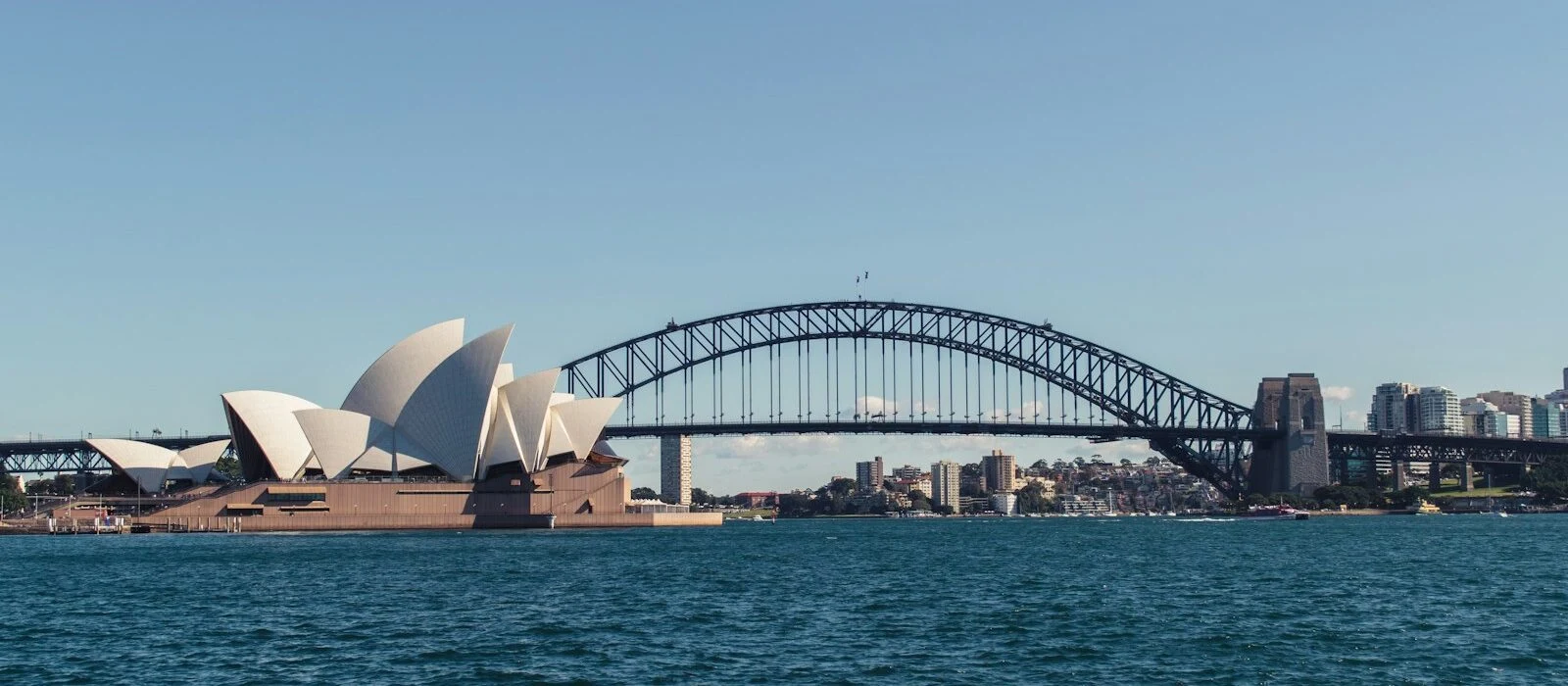
Australia is known for the Great Barrier Reef, Uluru, the Sydney Opera House, surf beaches and animals such as kangaroos, koalas and wombats. Many of its plants and animals are found nowhere else, which is one reason national parks matter so much here.
Many visitors assume Sydney or Melbourne is the capital. Canberra was created as a compromise between those two rivals, and Parliament has sat there since 1927. The Constitution doesn’t name an official language, and the 2021 Census recorded more than 300 languages spoken at home.
Planning starts with entry rules, so check the Australia visa guide for tourists early. The best places to visit in Australia are grouped by type of trip, and the Australia itineraries show how to link regions without losing days to transport. When you’re ready to pick a base, where to stay in Australia compares areas by city. For official trip ideas, see Tourism Australia. The population figure comes from the Australian Bureau of Statistics.
What Is the History of Australia?
Aboriginal and Torres Strait Islander peoples have lived in Australia for at least 60,000 years, long before European contact. Britain began a colony at Sydney Cove in 1788, the six colonies joined as one country on 1 January 1901, and Australia has since grown into a multicultural democracy.
First Nations history
Archaeological work at Madjedbebe in the Northern Territory points to human presence about 65,000 years ago, although researchers still debate exact dates. At the time of European arrival, there were hundreds of distinct nations and more than 250 languages across the continent.
European arrival and the colonies
Dutch navigator Willem Janszoon sighted the northern coast in 1606. James Cook charted the east coast in 1770 and claimed it for Britain. The First Fleet of 11 ships reached Botany Bay in January 1788 and settled at Sydney Cove on 26 January. Convict transportation continued until 1868, and the gold discoveries of 1851 in New South Wales and Victoria drew migrants from many countries.
Federation and the twentieth century
The Commonwealth of Australia began on 1 January 1901. The site for Canberra was chosen in 1908, and Parliament moved there in 1927. Australian troops landed at Gallipoli on 25 April 1915, an event remembered each year on Anzac Day. In the 1967 referendum, voters backed constitutional changes that allowed Aboriginal people to be counted in the census.
Modern Australia
The White Australia policy was dismantled in stages between 1949 and 1973, and migration from Asia, the Middle East and Africa grew afterwards. In 1992 the High Court’s Mabo decision recognised native title. On 13 February 2008, Prime Minister Kevin Rudd delivered a national apology to the Stolen Generations in Parliament.
What Is Australian Culture Like?
Australian culture combines some of the world’s oldest continuing cultures with British-derived institutions and waves of migration from Asia, Europe, the Middle East and the Pacific. Daily life is informal and outdoors, centred on beaches, sport, coffee and weekend barbecues. Respect for Aboriginal and Torres Strait Islander cultures is a growing part of how people are expected to behave.
Language
Australian English has its own accent and slang, such as arvo for afternoon and servo for service station. Many Aboriginal and Torres Strait Islander languages are still spoken, and several are being revived through schools and community programs.
Religion
In the 2021 Census, 43.9 percent of people identified as Christian and 38.9 percent reported no religion. Islam, Hinduism, Buddhism and Sikhism are also practised. For many First Nations people, spirituality is tied to Country, a word that covers land, water, sky and the relationships within them.
Festivals and public holidays
- Anzac Day (25 April): dawn services and marches honour military service.
- Australia Day (26 January): a public holiday that many Aboriginal and Torres Strait Islander people mark as Survival Day or Invasion Day, and the date remains debated.
- NAIDOC Week (July): celebrates First Nations history and achievements.
- Sydney Gay and Lesbian Mardi Gras (February or March): one of the largest parades in the country.
Etiquette
Greetings are relaxed, and first names are normal in most settings. Tipping isn’t expected because wages include service, although people sometimes round up for good service. Sun protection is part of daily routine because of strong ultraviolet levels. Some sites are sacred, so follow signs and ask before photographing people. The climb at Uluru was permanently closed on 26 October 2019.
Music and arts
The yidaki, often called the didgeridoo, comes from northern Australia and is traditionally played by men in some communities. Western Desert acrylic painting began at Papunya in 1971 and grew into one of the best-known contemporary art movements. The Sydney Opera House hosts opera, orchestral music and theatre, and popular music has produced acts such as AC/DC and Kylie Minogue. Cricket, Australian rules football and rugby league fill much of the sporting calendar.
What Is Australian Food Like?
Australian food mixes British-style baking and pies, fresh seafood, native ingredients and flavours brought by migrants. Typical staples include meat, seafood, bread, dairy and tropical fruit, while café coffee culture and multicultural dining define everyday eating in the cities.
Staples
Beef, lamb and seafood are common, and bread, rice and potatoes fill out most meals. Regional differences are clear. Tasmania is known for cold-water seafood, Queensland for mangoes and tropical fruit, and South Australia for wine regions such as the Barossa Valley. Native bush foods such as macadamia nuts, lemon myrtle, wattleseed and finger limes appear on more menus each year.
Signature dishes
- Meat pie: a baked pastry filled with minced beef and gravy, often eaten with tomato sauce.
- Chicken parmigiana: a crumbed chicken cutlet topped with tomato sauce and cheese, a pub favourite.
- Barramundi: a white fish from northern waters, usually grilled or pan-fried.
- Fish and chips: fried fish and thick chips, often eaten by the sea.
- Vegemite on toast: a salty yeast spread that is best used thinly.
- Kangaroo fillet: lean meat that is usually seared and served medium-rare.
- Moreton Bay bugs: small, sweet slipper lobsters from Queensland and New South Wales.
- Sydney rock oysters: small oysters farmed along the New South Wales coast.
- Damper: a simple bread traditionally baked in the coals of a campfire.
- Roast lamb: a Sunday meal with roast vegetables and gravy.
Street food
The sausage sizzle, a grilled sausage in bread with onions, is sold at community fundraisers across the country. The halal snack pack, chips topped with kebab meat and sauces, is a late-night staple in the big cities. Markets such as Queen Victoria Market in Melbourne sell pies, dumplings, doughnuts and hot food from many cuisines.
Drinks
The flat white, an espresso drink with silky milk, is served in nearly every cafe, and both Australia and New Zealand claim its origin. Wine comes from the Barossa Valley, Margaret River, the Yarra Valley and the Hunter Valley. Lemon, lime and bitters is a popular non-alcoholic pub drink.
Desserts
Lamingtons are sponge squares dipped in chocolate and rolled in coconut. Pavlova, a meringue base topped with cream and fruit, is claimed by both Australia and New Zealand. Anzac biscuits use oats, coconut and golden syrup, and they’re linked to the soldiers of the First World War. Fairy bread, white bread with butter and sprinkles, is a children’s party staple.
Explore Australia Tours
Discover unforgettable guided tours and adventures across Australia. Compare experiences and find your next adventure with TourRadar.
Find Hotels in Australia
Compare accommodation options across Australia with Trip.com. Search hotels for your next city break, coastal escape or longer journey.
Affiliate partner · Your booking helps support Globe Navo at no extra cost to you.
Explore Hotels & Flights
Search accommodation and flights for your destination with Expedia. Compare available options and continue to Expedia to complete your booking.
Affiliate partner · Globe Navo may earn a commission from qualifying bookings at no extra cost to you.
❓ Australia FAQ
Do I need a visa to visit Australia?
Almost every visitor does. Australia has no visa-free entry for tourists, so you need an ETA, an eVisitor or a Visitor visa before you fly. New Zealand citizens can get a visa on arrival. Check your passport on the Department of Home Affairs visa finder.
What is the best time to visit Australia?
It depends on the region. The south is pleasant from September to November and March to May, while summer from December to February is hot and busy. In the tropical north, May to October is the dry season, and November to April is the wet season.
Is Australia safe for tourists?
The US State Department rates Australia Level 1, exercise normal precautions. The UK FCDO notes a higher bushfire risk from October to February and says terrorists are likely to try to carry out attacks. Most everyday risks are natural, such as sun, surf and wildlife, so follow local signs and advice.
How many days do you need in Australia?
Plan at least 10 days for a first trip, because distances are huge and domestic flights take time. Seven days works for Sydney and Melbourne, or Sydney and the Great Barrier Reef near Cairns. Choosing two or three regions beats trying to see everything.
How do I get around Australia?
Most visitors fly between cities. Sydney to Melbourne or Brisbane is about 1.5 hours by plane, and Sydney to Cairns is about 3 hours. Within cities, trains, trams, buses and ferries cover most tourist areas. Driving suits regional trips, and Australians drive on the left.
Plan Your Trip to Australia
Your Next Adventure in Australia Awaits!
Explore Deals →🎁 Best deals for Australia
Offers from trusted travel stores for your Australia trip. Compare a few options before you book, and check each store's terms for the final price.
Browse by type: Hotel deals · Flight deals · Travel eSIM · Car rental
 KkdayFind current Kkday coupons and deals for tours, attraction tickets, transport and first app orders. See minimum spend, discount caps and exclusions before you book.
Get Coupon View Deal
 eSIMFOXeSIMFOX is a travel eSIM provider offering prepaid mobile data plans for single countries and wider regions, delivered digitally so you can connect as soon as you land.
Get Coupon View Deal
 QuibityQuibity is a travel eSIM provider that lets you buy a mobile data plan online and activate it on your phone, so you can get connected abroad without a physical SIM card.
Get Coupon View Deal
 ExpediaDiscover great deals on hotels, flights, vacation packages, car rentals, and activities with Expedia. Compare travel options and plan your next trip with convenient booking choices.
Get Coupon View Deal
 KlookKlook is a travel activities platform where you can book attraction tickets, tours, day trips, transport passes, airport transfers and local experiences in destinations worldwide.
Get Coupon View Deal
 Trip.comTrip.com is a global online travel platform for flights, hotels, train tickets, airport transfers, attraction tickets and travel packages, available on web and mobile app.
Get Coupon View Deal
 TourRadarTourRadar is an online marketplace for multi-day guided tours, small-group trips and tailor-made journeys offered by independent tour operators around the world.
Get Coupon View Deal