Choosing Where to Go in Malaysia
Malaysia is compact enough for a focused trip yet diverse enough that trying to see everything in one visit usually leads to rushed days and long transfers. The country splits naturally into the Malay Peninsula on the west and Malaysian Borneo (Sabah and Sarawak) on the east. Most first-time travellers spend their time on the peninsula, combining the capital with one heritage city, one island and perhaps a highland stop. Adding Borneo usually means a separate flight and at least five extra days.
Think about what you enjoy most: modern city energy, street food and colonial history, beaches, or wildlife and jungle. Then build a route around two or three of those themes. The destinations below are grouped by the kind of experience they offer, with practical notes on how long to stay and how they connect.
Kuala Lumpur: The Modern Gateway
Almost every international flight lands in Kuala Lumpur, and the city works well as both an arrival point and a destination in its own right. The skyline is dominated by the Petronas Twin Towers, still the tallest twin towers in the world at 451.9 metres. Visitors can walk the Skybridge that links the towers on levels 41 and 42 and, when tickets are available, continue to the observation deck on level 86.
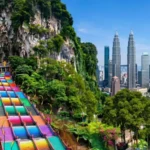
Beyond the towers, the city rewards neighbourhood walking. Chinatown (Petaling Street) is busy and commercial, Little India offers temples and spice shops, and Kampung Baru keeps a village-like feel in the middle of the capital. Batu Caves, about 30 minutes north by train or Grab, features a towering golden statue and 272 colourful steps leading into a Hindu cave temple complex. KLCC Park, the Islamic Arts Museum and the night food stalls along Jalan Alor give a good mix of green space, culture and local eating.
Two to three full days are enough for most people. Use the city as a base for a day trip to Melaka if time is short.
Penang: Food and Heritage
George Town, the historic heart of Penang, is a UNESCO World Heritage Site. Its streets are lined with colourful shophouses, clan houses, temples, mosques and some of the best street art in Southeast Asia. Armenian Street, the clan jetties and the area around Kapitan Keling Mosque form an easy walking circuit that reveals the island’s Chinese, Indian, Malay and European layers.
Food is the main reason many travellers stay longer than planned. Char kuey teow, Penang asam laksa, nasi kandar, Hokkien mee and cendol are everyday dishes here, and the quality is consistently high. Evenings are best spent at a hawker centre or along Gurney Drive. For cooler air and views, take the funicular up Penang Hill. Kek Lok Si Temple, one of the largest Buddhist complexes in the country, is another worthwhile half-day stop.
Three to four nights allow time for both the heritage core and some beach time at Batu Ferringhi if you want it. Penang pairs well with Kuala Lumpur by short flight or a combination of train and ferry.
Langkawi: Beaches and Duty-Free Island Life
Langkawi is an archipelago of 99 islands off the northwest coast and Malaysia’s best-known beach destination. Pantai Cenang and the quieter Pantai Tengah form the main tourist strip with hotels, restaurants and water sports. The island is duty-free, which makes alcohol and some shopping noticeably cheaper than on the mainland.
The Langkawi Cable Car climbs into the rainforest and ends at the Sky Bridge, a curved pedestrian bridge with wide views over the islands. Kilim Geoforest Park offers mangrove boat trips where eagles are regularly seen. Island-hopping tours, snorkelling and kayaking are easy to arrange. The interior has waterfalls and a more rural feel if you hire a car or scooter.
Three to five nights suit most visitors. Direct flights from Kuala Lumpur take about an hour, making Langkawi a straightforward beach extension after city time.
Melaka: Compact History
Melaka (Malacca) is a compact UNESCO World Heritage city that shows successive layers of Malay, Portuguese, Dutch and British rule. The old centre is walkable. St Paul’s Hill, the remains of the Portuguese fort A Famosa, the Stadthuys and the riverside area form the classic route. Jonker Street is lively, especially on weekend evenings when the night market fills the road with food stalls and souvenirs.
Food here includes chicken rice balls, satay celup and Nyonya (Peranakan) dishes that reflect the mixed Chinese-Malay heritage of the region. Melaka works well as a day trip from Kuala Lumpur (roughly two hours by bus or car) or as a quiet overnight stop.
One or two nights are enough for most travellers.
Sabah: Wildlife and Adventure in Borneo
Sabah, in Malaysian Borneo, is the place for nature and outdoor activity. Mount Kinabalu, at 4,095 metres, is Southeast Asia’s highest peak. The two-day climb requires permits and advance booking for the mountain huts; places fill months ahead in peak season. Even without the summit, Kinabalu Park is worth visiting for its cool climate and trails.
Near Sandakan, the Sepilok Orangutan Rehabilitation Centre and the Bornean Sun Bear Conservation Centre sit close together and can be combined in one day. River cruises on the Kinabatangan often produce sightings of elephants, proboscis monkeys, macaques and birds. Diving and snorkelling around Semporna and the islands of Tun Sakaran Marine Park rank among the best in Malaysia; Sipadan has strict daily visitor limits and must be booked early.
Five to seven days is a realistic minimum if you want both the mountain area and the east-coast wildlife or diving. Kota Kinabalu is the main entry point.
Sarawak: Caves, Orangutans and Longhouses
Sarawak feels quieter than Sabah and rewards slower travel. Kuching is a pleasant riverside city with good food, colonial buildings and easy access to nearby parks. Bako National Park, reached by a short boat ride, is one of the most reliable places in Malaysia to see proboscis monkeys in the wild. Semenggoh Wildlife Centre offers another chance to see orangutans in a semi-wild setting.
Further afield, Gunung Mulu National Park (a UNESCO site) contains some of the world’s largest cave systems and the dramatic limestone Pinnacles. Multi-day treks and cave tours need planning. Staying in a traditional longhouse with an indigenous community is a distinctive experience available through responsible operators.
Four to six days give a good introduction. Kuching is the usual base, with domestic flights from the peninsula.
Other Worthwhile Stops
The Cameron Highlands offer cooler temperatures, tea plantations and strawberry farms; they work well as a stop between Kuala Lumpur and Penang. The Perhentian Islands and Tioman, on the east coast, are excellent for snorkelling and diving between roughly March and October when the monsoon is quiet. Taman Negara National Park protects ancient rainforest and offers canopy walks and jungle treks for those who want nature without flying to Borneo.
How Long to Spend in Each Place
- Kuala Lumpur: 2–3 days
- Penang: 3–4 days
- Langkawi: 3–5 days
- Melaka: 1–2 days
- Sabah: 5–7 days
- Sarawak: 4–6 days
- Cameron Highlands: 1–2 days
Tips for Building Your Route
Do not try to combine the peninsula and both Sabah and Sarawak in a single short trip. A classic first visit might look like Kuala Lumpur + Melaka + Penang + Langkawi over 10–12 days, or Kuala Lumpur + Penang + a Borneo extension if wildlife is the priority. Check the monsoon calendar carefully: west-coast beaches and cities are generally better from December to March, while east-coast islands and much of Borneo are better from March to October.
Read our best time to visit Malaysia guide before locking dates, and see the Malaysia itineraries page for ready-made 7-, 10- and 14-day plans.
Related Guides
Back to the main Malaysia travel guide. Check visa and entry rules, where to stay, or flights and getting around.